
Liven vs. Headspace: Two Different Paths to a Calmer, Clearer Mind


Written by
Nadine M., Editorial Team Lead at Liven


Somewhere between scrolling through app store reviews and reading "best wellness apps" roundups for the third time, the real question gets lost: What do you need right now to feel better?
Liven and Headspace both show up on those lists, but they're built on different philosophies, serve different needs, and offer different day-to-day experiences. One isn't better than the other; they're designed for different stages of a person's self-care journey.
This article covers each app in full, then puts them side by side so you can make a confident decision.
Key Learnings
- Headspace is a structured meditation and mindfulness app that is ideal for beginners who want to build a daily meditation habit with guided audio content.
- Liven is a self-discovery platform built around understanding behavioral patterns, emotional regulation, and CBT-based habit change.
- Both apps offer free trials.
- Headspace has a larger content library and a more established track record. Liven has a tighter focus on personalization and behavior-based growth.
- If you want to learn to meditate, Headspace is the natural choice. If you want to understand yourself more deeply and build habits that stick, Liven is worth a close look.
Liven
Liven is a 360 well-being toolkit developed in collaboration with a board of licensed mental health professionals. It's built on a straightforward premise: that understanding your emotional patterns is a prerequisite for changing them. The app brings together mood tracking, journaling, AI-guided conversation, self-assessments, and a personalized learning program into a single daily practice.
Liven is not a meditation app, and it's not a therapy replacement. It functions as a self-discovery companion: a system of tools that helps you observe your behavior, recognize patterns as they happen, and practice something different in the moment.
The Science Behind Liven
Liven's core framework is the micro-cycle method, a three-step behavior-change loop grounded in behavioral neuroscience:
- Learn: encounter something live about your own behavior pattern
- Recognize: notice that pattern as it's happening in real time
- Practice: try a different micro-action in that exact moment
Liven's tools are informed by research from Harvard University, the University of Oxford, and the University of Cambridge, and the platform is built on the following evidence-backed methodologies:
- Cognitive Behavioral Therapy (CBT)
- Dialectical Behavior Therapy (DBT)
- Emotion Regulation Therapy
- Solution-Focused Brief Therapy
- Behavioral Activation Therapy
- Adapted Clinical Assessments (e.g., DASS-21, ACE)
- Structured Psychoeducation
- Psychological First Aid
- Neuroimaging and affective neuroscience studies
- Yoga Nidra and relaxation protocols
Liven operates with a strong commitment to mental health integrity and user safety. It is not intended to diagnose, treat, or replace professional therapy or clinical care.
If you're experiencing a mental health crisis, please reach out to a licensed professional or contact a crisis support line.
Liven's Key Features
What makes Liven's experience distinctive isn't any single feature — it's how the tools work together. Each check-in, each journal entry, and each assessment adds a data point. Over time, patterns emerge, the personalization sharpens, and the guidance starts to feel like it was built specifically for you.
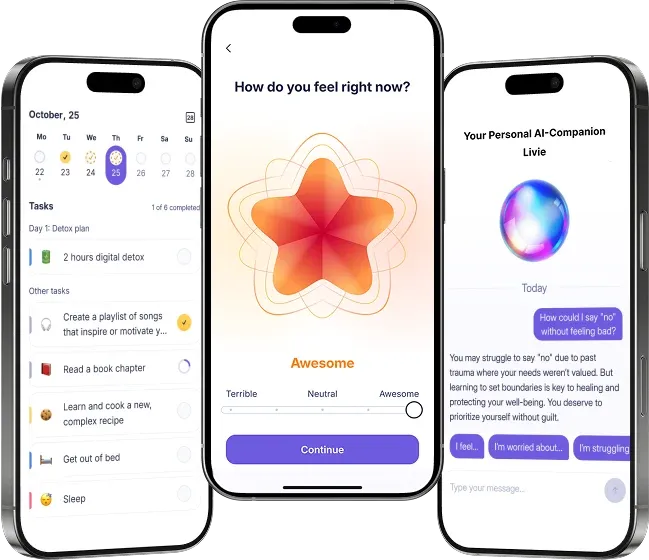
- Mood Tracker: Daily emotional check-ins where you name your feelings, add context, and log what's happening around you. The app generates interactive mood charts over time, surfacing triggers and emotional trends that are easy to miss at the moment. All data is private, stored securely, and never sold to third parties.
- Livie (AI Companion): Livie is Liven's AI-powered self-discovery companion available 24/7 for reflective conversation. It helps you process complex emotions, reframe unhelpful thoughts, brainstorm self-care ideas, and understand the patterns behind recurring behaviors. Sessions are saved as summaries, and Livie's tone can be adjusted between direct and supportive depending on what you need.
- Journey (Personalized Program): After the onboarding quiz, Liven builds a personalized learning path. Lessons unlock step-by-step, combining reading, exercises, and guided activities across topics like procrastination, stress, self-image, and emotional regulation.
- Tests and Assessments: Self-assessments covering anxiety, stress, emotional intelligence, and more. Results are stored as a history log so you can track shifts and spot recurring patterns over time. Assessments are adapted from clinical tools, including DASS-21 and ACE, and can be discussed directly with Livie.
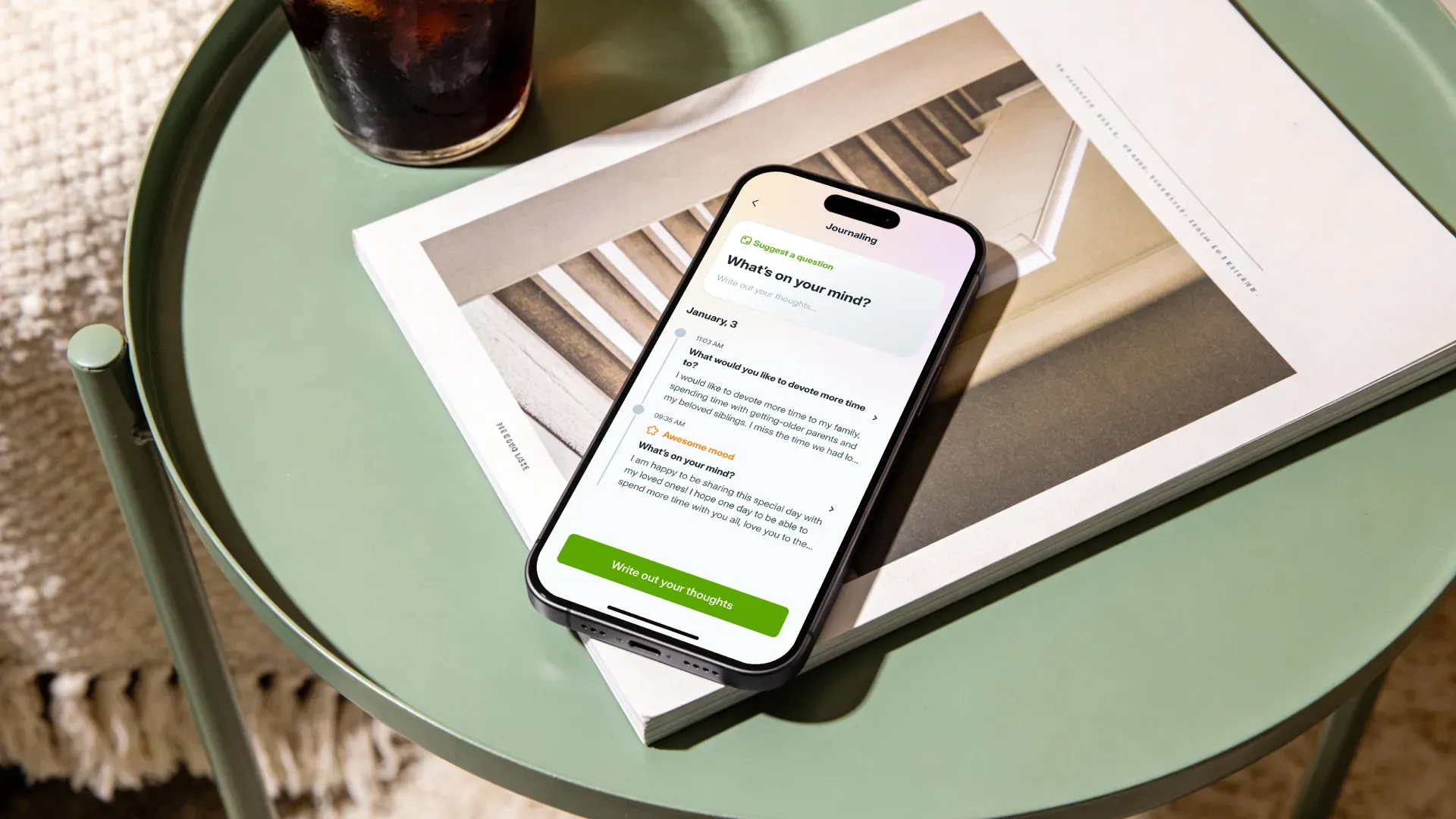
- Journal: Prompted or free-form journaling for moments when you're not sure where to start. The Journal is a tool for breaking out of emotional autopilot and gaining an outside-looking-in perspective on what's going on.
- Today's Routine: A 3-step daily structure that takes roughly 10 minutes: continue your personalized lesson, complete a daily task, and check in with a mental test or reflection. It's designed to make showing up for yourself feel achievable, even on the hardest days.
- Sounds: A library of nature sounds, binaural beats, lo-fi music, and focus tracksб useful for quieting a racing mind, blocking out environmental noise, or winding down before sleep.
- Explore: A personalized content hub with articles and expert videos, organized into themed self-discovery collections and surfaced dynamically based on your own app data.
Liven Pricing
Liven uses dynamic pricing, which means what you see may vary based on your region, device, and responses to the onboarding quiz.
| Plan | Price |
|---|---|
| Trial | 3 days with full access |
| Weekly | Starting at $7.99/week |
| Monthly | Starting at 49.99/month |
| Annual | Starting at $59.99/year |
Terms may vary depending on whether you subscribe through the web, the App Store, or Google Play. Please verify current pricing at theliven.com.
Liven Ratings and Recognition
- Best Mobile App Awards: Silver Award, September 2025
- App Store: 4.5/5 stars
- Google Play: 4.0/5 stars
- Trustpilot: 4.1/5 ("Great") from over 19,000 reviews
- Downloads: Over 2.5 million
- Research: Internal research division
- Media coverage: Featured in HELLO!, Woman's World, Muscle & Fitness, The Everygirl, and TechTimes
Liven Strengths
- Highly personalized from the first session — the onboarding quiz shapes your entire experience
- Behavioral pattern tracking that deepens over time
- Broad methodological foundation (CBT, DBT, emotion regulation, neuroscience)
- Smart companion (Livie) available 24/7 for reflective support
- Short daily commitment
- Oversight from licensed therapists and counselors
Things to Consider
- Dynamic pricing can make upfront cost comparison harder
- Smaller content library compared to Headspace's 1,000+ meditation catalog
- Newer platform with a shorter track record
Liven is a strong fit if you've already done some self-reflection and want to go deeper. If you feel like you understand your patterns intellectually but struggle to change them in the moment, the micro-cycle method is designed to fill that gap.
It's also well-suited for anyone who wants a daily practice that builds self-awareness over time.
Headspace
Headspace is one of the most established meditation and mindfulness apps available, founded in London in 2010 by Andy Puddicombe, a former Buddhist monk, and Rich Pierson. With over 100 million downloads and a library of more than 1,000 guided meditations, it has become a go-to entry point for people new to mindfulness.
The app's core philosophy is progressive skill-building: you learn the fundamentals of meditation and build a consistent practice over time, guided by structured courses and daily habits.
In recent years, Headspace has expanded significantly beyond meditation, adding movement content, sleep tools, and Headspace Care, a separate service offering access to licensed therapists and coaches.
The Science Behind Headspace
Headspace is grounded in the principles of Mindfulness-Based Stress Reduction (MBSR) and incorporates CBT techniques throughout its content. The app has an internal research division that contributes to peer-reviewed publications, and it cites partnerships with academic institutions to validate its approach.
The content is narrated primarily by Andy Puddicombe in a calm, conversational style, making it accessible to people who have never meditated before and approachable for those who have lapsed in their practice.
Like Liven, Headspace is not intended to diagnose or treat mental health conditions, and it is not a replacement for professional clinical care.
Headspace's Key Features
- Guided Meditations: The core of the Headspace experience. Over 1,000 meditations organized into multi-session courses spanning focus, anxiety, relationships, sleep, and more. You progress through beginner fundamentals before moving to intermediate and advanced content.
- Sleep Tools: Sleepcasts, sleep music, and wind-down meditations are among the app's most popular features. Users can fall asleep to narrative audio or calming soundscapes, and the app includes dedicated "Rest Day Meditations" for physical recovery.
- Mindful Movement: Yoga, dance, and mindful cardio content in a dedicated "Move" section. Includes partnerships with the Lincoln Center and Nike, plus sessions with outside contributors. A broad range of options for anyone looking to integrate movement with mindfulness.
- The Wake Up: A daily short video featuring thought-provoking questions, inspiration, and interview content hosted by Andy Puddicombe and guest speakers. A lightweight way to start the day with intention.
- Mindful Moments: Single reflective questions designed to prompt a pause in the middle of a busy day. Simple by design, and consistently noted by users as one of the more memorable daily features.
- Focus and AI Tools: AI-powered tools and focus music designed for productivity and stress management throughout the workday. Headspace's AI companion, Ebb, is accessible through Headspace Care.
- Headspace Care (separate subscription): A newer addition to the ecosystem offering access to licensed therapists, coaches, and psychiatric care. It operates separately from the core meditation subscription and can be accessed with or without a general Headspace plan.
Headspace Pricing
Headspace uses flat, publicly listed pricing with occasional promotional discounts.
| Plan | Price |
|---|---|
| Monthly | $12.99/month (7-day free trial) |
| Annual | $69.99/year (~$5.83/month; 14-day free trial) |
| Student (annual) | $9.99/year |
| Family (6 accounts, annual) | $99.99/year |
| Coaching | $99.99/month |
All pricing in USD. Local rates may vary. Verify current plans at headspace.com.
Headspace Ratings and Recognition
- Awards: Indigo Awards (2025), Anthem Awards (2024/2025)
- App Store: 4.8/5 stars
- Google Play: 4.0/5 stars
- Trustpilot: 1.5/5 (700+ reviews)
- Downloads: Over 100 million
- Research: Internal research division with contributions to peer-reviewed studies
HeadspaceStrengths
- Extensive, well-structured content library across meditation, sleep, and movement
- Flat, transparent pricing with multiple plan options, including student and family plans
- One of the most beginner-friendly entry points to meditation available
- Strong sleep content library
- Optional access to licensed therapists and coaches via Headspace Care
- Long-established research base and published studies
Things to Consider
- Trustpilot rating (1.5/5) reflects feedback around subscription management and billing support
- Free content is limited, and most features require a paid subscription
- Therapy access via Headspace Care comes as a separate, additional cost
Headspace is a natural fit for anyone new to meditation and mindfulness who wants a structured, well-designed starting point. It's well-suited for people who want guided audio content they can use during a commute, before bed, or at a desk. The optional therapy access through Headspace Care also makes it appealing for users who might want clinical support within the same platform.
Liven vs. Headspace: Side-by-Side Comparison
| Liven | Headspace | |
|---|---|---|
| Primary focus | Self-discovery, emotional wellness, CBT-based habit change | Meditation, mindfulness, stress relief |
| Best for | Self-improvers who want to understand and change behavioral patterns | Beginners building a daily meditation and mindfulness habit |
| Core methodology | CBT, DBT, Emotion Regulation Therapy, behavioral neuroscience | Mindfulness-Based Stress Reduction (MBSR), guided meditation |
| Personalization | High, onboarding quiz shapes the entire experience | Moderate — content is structured but not behavior-adaptive |
| AI companion | Livie is available 24/7 for reflective conversation | Ebb, available within Headspace Care |
| Mood tracking | Yes, with pattern analysis and interactive charts | Basic daily check-in |
| Assessments | Self-assessment tools (DASS-21, ACE, and more) | Not offered |
| Coaching | Yes | Yes |
| Content library | Courses, articles, soundscapes, expert videos | 1,000+ guided meditations, sleep content, movement classes |
| Daily time commitment | ~10 minutes | Flexible, sessions range from 3 to 30+ minutes |
| Pricing (monthly) | Starting from $19 | $12.99/month |
| Pricing (annual) | Starting from $59.99/year | $69.99/year |
| Free trial | Yes | Yes (7 days monthly / 14 days annual) |
| Student plan | Not listed | $9.99/year |
| Family plan | Not listed | $99.99/year (6 accounts) |
| Rating | 4.5/5 (App Store); 4.1/5 (Trustpilot); 4.0 (Google Play) | 4.8/5 (App Store); 1.5/5 (Trustpilot); 4.0/5 (Google Play) |
| Platform | iOS, Android | iOS, Android |
| Founded | 2022 | 2010 |
| Clinical oversight | Licensed therapists and counselors on the development board | Internal research team; clinical care via Headspace Care |
| Data privacy | Published privacy policy — review at theliven.com | Published privacy policy — review at headspace.com |
Pricing and features based on publicly available data as of March 2026. Always verify current plans on each app's official website.
So, Which App to Choose?
Headspace is one of the best meditation apps available, thoughtfully built, accessible, and backed by a decade of refinement. If meditation is what you're looking for, it's a natural place to start.
Liven is built for a different kind of work: understanding the emotional patterns that run below the surface and learning to work with them in real time. If what you want is self-awareness that translates into actual behavioral change, Liven's ecosystem of tools is worth trying.
The most honest answer: if you're standing at the beginning and want to develop a mindfulness habit, start with Headspace. If you've been doing inner work for a while and want a solution that helps you turn insights into action, Liven is a great choice.
Disclaimer: This article is for informational purposes only and reflects publicly available data as of April 2026. Pricing, features, and app ratings are subject to change. This content does not constitute medical advice. If you are experiencing a mental health crisis, please contact a licensed professional or a crisis support line such as the 988 Suicide and Crisis Lifeline (US).
References
- Clear, J. (2018). Atomic Habits: An Easy and Proven Way to Build Good Habits and Break Bad Ones. Avery.
- Duhigg, C. (2012). The Power of Habit: Why We Do What We Do in Life and Business. Random House.
- Fogg, B. J. (2019). Tiny Habits: The Small Changes That Change Everything. Houghton Mifflin Harcourt.
- Graybiel, A. M. (2008). Habits, rituals, and the evaluative brain. Annual Review of Neuroscience, 31, 359–387. https://doi.org/10.1146/annurev.neuro.29.051605.112851
- Lally, P., van Jaarsveld, C. H. M., Potts, H. W. W., & Wardle, J. (2010). How are habits formed: Modelling habit formation in the real world. European Journal of Social Psychology, 40(6), 998–1009. https://doi.org/10.1002/ejsp.674
- Mani, M., Kavanagh, D. J., Hides, L., & Stoyanov, S. R. (2015). Review and evaluation of mindfulness-based iPhone apps. JMIR mHealth and uHealth, 3(3), e82. https://doi.org/10.2196/mhealth.4328
FAQ: Liven vs. Headspace
Is Liven better than Headspace?
What is Liven's micro-cycle method?
Can I use both Liven and Headspace at the same time?
Is Liven a therapy app?