How to Choose the Best AI Mental Health Companion



We’ve all had those nights when our thoughts won’t let us sleep, and there’s no one around to talk to. Staring at the ceiling, you might find yourself thinking, “I wish someone could just listen.” Unfortunately, emotional support isn’t always available, whether it’s because therapy isn’t affordable or we don’t have a trusted person to turn to. That’s where AI companions come in, offering a solution for millions in need.
Studies show that one in three adults in the UK and one in eight adolescents in the U.S. use AI to improve their mental health. These companions help bridge the gap between our emotional needs and the resources available. In this article, we’ll explore different AI companions and guide you in choosing the one that fits your needs.
Key Learnings
- AI provides immediate, stigma-free emotional support when human care is unavailable, making mental health tools more accessible.
- Different apps serve different needs. Some prioritize deep emotional reflection (like Liven), while others focus on data tracking or quick check-ins — meaning the “best” option depends on what kind of help you want.
- Consistency strengthens results. Regular check-ins, applying insights, and combining AI tools with practices like journaling or mindfulness lead to deeper self-awareness and more sustainable mental health progress.
1. Liven: Combining AI Technology with Curiosity
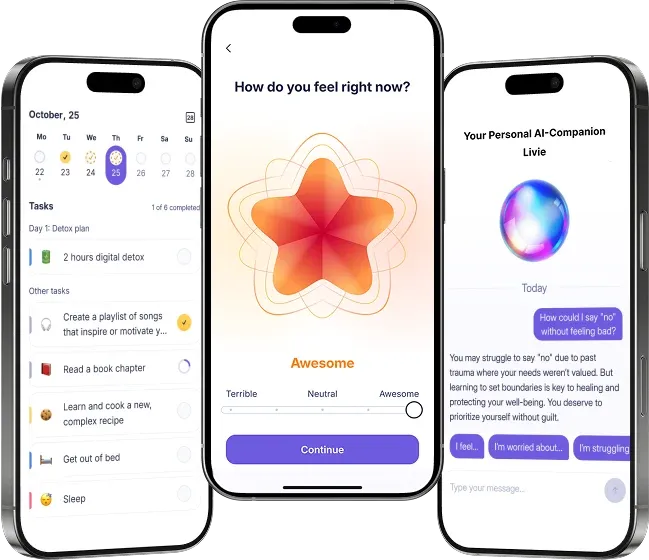
Not just an AI bot but also a self-discovery companion, Liven offers an ecosystem of tools that help users address their mental health outcomes and improve their self-awareness.
According to Liven’s CEO, Alex Seleznov, Liven adds contextual self-awareness into personal growth and combines this with empathy: “At Liven, we believe that self-awareness is the strongest foundation for meaningful progress in productivity, growth, and wellbeing. Liven is here to help people take the next step every day, even if it's a small one.”
Liven doesn’t focus solely on its AI companion; it combines various tools with deep research insights to help users build a unique personal journey.
Main Features
- AI companion. Livie is an AI model that is capable of recognizing human emotions and needs. She encourages users to talk openly and explore their feelings or guide them through practical grounding or soothing tools.
- Mood Tracker. You can log your emotions throughout the day and provide details about other factors surrounding them. Over time, it provides detailed insights into your personal patterns.
- Habit Builder. Liven integrates your personalized plan into Habit Builder to remind you about daily to-dos, exercises, and lessons to read.
- Bite-sized courses. The app covers crucial topics related to mental health, from improving concentration to fostering healthy relationships. For example, if you take the quiz to find out more about yourself, you get your personalized dopamine management plan plus a course on improving your dopamine levels.
Pricing: The subscription starts at $7.99 per week.
Strengths
- Liven combines an AI companion feature with other tools, encouraging a more integrated personal growth journey.
- Livie adapts to users’ emotional states, offering venting, grounding, or soothing based on their feelings.
- Each tool in the app is grounded in evidence-based mental health practices and is reviewed by a licensed therapist.
- With mood logs, habit reminders, and courses, users actively shape their growth path.
- Liven supports long-term change, not just short-term mood management, and can be paired up with therapy for maximum benefit.
Considerations
- Because Liven offers many tools (AI chat, courses, habit builder), new users might need time to adjust.
- Although Liven’s users can schedule calls with coaches and access a wide range of instruments, this app cannot replace the professional help of a therapist.
2. Wysa: Complementing Mental Health Support
By focusing on making mental health services more accessible and anonymous, Wysa has become an AI model that collaborates closely with human professionals.
Smriti Joshi, a therapist and chief of clinical operations at Wysa, states that the app continues 24/7 collaboration with public health services and observes users’ state if necessary:
“Tracking can be done in real-time, especially important because the AI software can help alert therapists to changes in emotional state—including the most severe, such as suicidal ideation.”
Due to its collaboration with several institutions, Wysa is often recommended as a complementary tool to professional therapy and has shown significant improvement in studies. Individuals can set goals and learn how to work on them. An AI companion from Wysa adjusts its approach and conversation based on the chat log.
Main Features
- Chat with an AI therapist. Totally anonymous and strengthened with clinical safeguards, Wysa’s AI companion helps users explore their thoughts, stop overthinking, and respond mindfully in the future.
- Self-help library. Wysa offers a library of 200+ self-care tools, backed by psychological research, including breathing exercises, meditation, CBT-based techniques, and more.
- Well-being coaches. You can arrange a call with a coach if you need a human touch. Customers can get 4 live sessions per month, and they can also message their coaches between sessions.
- SOS feature. Although Wysa encourages contacting professional services, it also offers an SOS feature with access to crisis resources and emergency contacts if a person has suicidal thoughts or feels in danger.
Pricing: Free basic version, premium starts from $9.99/month.
Platforms: Android and iOS.
Strengths
- Wysa utilizes various CBT-based tools, meditations, breathing exercises, and cognitive restructuring practices, all of which are suitable for addressing different mental health conditions.
- The AI chatbot is free to use and operates 24/7, providing a safe and non-judgmental space.
- Wysa collaborates with therapists and provides research backing for its operations.
- The app heavily prioritizes its security and delivers a high level of privacy.
Considerations
- Some users say the AI struggles with nuanced or particular emotional contexts, sometimes providing generic responses, which calls for improvement to its machine learning.
- Due to its structured nature, some users find that this AI model can become repetitive over time.
- A few users have mentioned that there are limited options for non-English languages or culturally specific idioms.
3. Youper: Personalizing Mental Health Care
Youper has entered the market as one of the most reliable mental health AI companion apps, available as an integration or complementary tool for individual care. Dr. Jose Hamilton, founder and CEO of Youper, claims that the task of today’s AI is to close the gap between therapy demand and supply: “The mental health care system is failing us – studies show that it can take ten years for someone to get adequate treatment.”
The solution, Hamilton states, is to ensure people can get help amid a significant shortage of available services and specialists.
Similar to Wysa, Youper collaborates with public organizations to deliver effective, multidimensional care. Research has revealed that the Youper app demonstrates efficiency in helping individuals with depression and anxiety.
Main Features
- AI chatbot. Youper’s AI companion responds with immediate, supportive assistance grounded in research and empathy.
- Mental health record. Users get access to an organized record of their mental health, including conversations and general psychological insights.
- Detailed statistics. Youper takes user conversations, improvements, and recent assessments and turns them into detailed data.
- Mood tracking. By checking in daily, customers get detailed information about their progress and can adjust their actions in the future.
Pricing: No free option, premium starts at $9.99/month.
Platforms: Android and iOS.
Strengths
- Highly engaging. Youper is one of the most engaging apps on this list, especially important for people who struggle to maintain their streak.
- Data-driven insights. Users have access to a mental health record, mood tracking, and detailed statistics, which help them see changes over time.
- Rooted in science. The app cooperates with mental health professionals and institutions to regularly update its efficiency and usability.
- Adaptable plan. Youper analyzes users’ behavior and mood and adjusts its support and improvement plan accordingly.
Considerations
- No free tier. A subscription is needed to access the whole app experience.
- Limited human input. Because Youper focuses on AI as its core feature, users seeking therapy or talking to real people might find it insufficient.
- Not intended to “treat.” Youper explicitly notes it’s not a diagnostic tool or a therapy instrument, which means it may not be suited for more complex psychological needs.
4. Earkick: Making Artificial Intelligence Practical
Aiming to enhance access to therapy, Earkick introduces AI to help people talk openly about what concerns them. Earkick co-founder Karin A. Stephan states that Earkick is totally private and accessible first: “There’s no login, no registration, no tracking. Just radically private support. You talk to it like a sidekick, and it helps you make sense of what’s going on.”
Although Earkick doesn’t provide therapy and mostly works as a self-guided tool, it establishes users’ baseline mood and behavior patterns and observes how they change over time. It treats each person as an individual with a unique voice and compares their mental check-ins with sleep data and more. In its randomized control trial, Earkick has found improvements in user mood and anxiety patterns.
Main Features
- A flexible AI companion. Earkick’s AI bot analyzes the user's mood and suggests tips and supportive encouragement to boost their mood and ground them.
- Mood logs. The app evaluates customers’ emotions and compares their health patterns to offer the best strategies.
- A library of tools. Users learn emotional management and coping techniques to become more self-sufficient and gain a deeper understanding of themselves.
- Adjustable strategy. Earkick provides tools and tone to match users’ behavior and needs.
Pricing: Free; premium varies by location.
Platforms: Only iOS.
Strengths
- Earkick uses biomarker data (such as physiological signals), machine learning, and conversational AI to personalize its assistance.
- The app’s features are designed to be lightweight and quick, making it easier for users to access them frequently in the future.
- Earkick has simple tools for managing stress, mood swings, and everyday challenges.
- Offers quick, practical check-ins for daily emotional updates.
Considerations
- The app focuses heavily on observation and brief interventions, which may feel minimal for people seeking deeper emotional conversations with human-like empathy.
- Some users report being confused by Earkick’s pricing and its lack of transparency.
- If a person is seeking a more personal and reflective support, Earkick might feel slightly too restrictive.
5. Elomia: Providing Empathetic Conversations
Elomia combines personalized tools and adaptive support to provide individuals with compassionate care rooted in research. Elomia’s founder, Taras Pohrebniak, shares that the goal of this AI companion is to combine context understanding and user needs with psychologically-based insights:
“The functioning of Elomia requires training that is based on thousands of conversations between psychologists and their clients. We have such data.”
Utilizing supportive self-management tools together with AI assistance, Elomia was found to be effective for managing depressive and anxiety states and mood improvement in a controlled study.
Main Features
- Science-based tools. The app relies on practical theories, including Cognitive Behavioral Therapy (CBT) and Dialectical Behavior Therapy (DBT), to help users change their thinking and behavior.
- Private AI companion. Elomia’s AI companion communicates with customers in a session-like format, providing specific support tailored to the conversation and progress.
- Personal improvement plan. The app adjusts grounding and mindfulness exercises based on user input.
- CBT-based tools. Users can choose to stop intrusive thoughts, work on their worry, or do deep breathing from the app’s library.
Pricing: The subscription starts at $2.99 per week.
Platforms: Android and iOS.
Strengths
- Elomia’s AI companion was explicitly designed to create a supportive, empathetic conversational experience that feels validating.
- Elomia incorporates CBT tools to challenge negative thoughts and manage users’ emotional resilience.
- You can receive helpful tips on different types of relationships and communication suggestions.
- Aside from long-term focus, Elomia also assists its customers in the moment when they are overwhelmed.
Considerations
- Some users stated that Elomia could introduce additional companions to enable more nuanced, personal relationships.
- A few reviews mentioned that the AI companion lacked nuance in conversations and didn’t respond effectively.
- According to a few comments, Elomia felt that the tools it suggested were restrictive.
All 5 AI Mental Health Companions Compared
| App | Main features | Pricing | Platforms | Strengths | Considerations | Best for |
| Liven | AI companion, mood tracker, habit builder, bite-sized science-based courses. | Free trial; from $7.99/week; $19.99/month | iOS & Android. | Holistic tools for self-discovery; emotion-adaptive AI; science-backed; long-term growth focus. | Learning curve for multi-tool experience; not a therapy replacement. | Users seeking an all-in-one mental health companion that fosters self-awareness and personal growth. |
| Wysa | AI chat, self-help library, well-being coaches, SOS support feature. | Free tier; premium from $9.99/month. | iOS & Android. | Evidence-based CBT tools; 24/7 anonymous support; clinical validation; high privacy. | Responses can feel generic or repetitive; limited cultural/language support. | People looking for structured CBT support with optional human coaching. |
| Youper | AI chatbot, mental health record, statistics dashboard, and mood tracking. | Paid only, from $9.99/month. | iOS & Android. | Engaging interface; detailed data assessment; adaptive AI plans; science-backed. | No free tier; limited human interaction; not for complex mental health needs. | Users who want data-driven mental health insights and structured tracking. |
| Earkick | AI chat, mood tracking, coping tools, behavioral trend analysis. | Free; premium varies by region. | iOS. | Real-time updates; intuitive and lightweight; flexible, practical tools. | Limited depth in conversations; pricing unclear; structured approach may feel minimal. | Users seeking quick, simple check-ins and real-time mood insights. |
| Elomia | AI companion, CBT-based tools, grounding exercises, personalized plan. | From $2.99 weekly. | iOS & Android. | Warm, empathetic AI; CBT/DBT tools; practical coping tips; suitable for stress relief. | Limited tone; some repetitiveness; narrow tool range. | People wanting compassionate, therapy-inspired AI conversation support. |
Final Thoughts: Maximizing Your AI Companion App Effects
Each Artificial Intelligence chatbot or therapist is a tool, and when we learn to work with them, our wellness benefits.
- Check in regularly. People who check in periodically and observe their emotions, responses, and real-life behavior are more likely to succeed than those who tend to forget about their goals.
- Engage actively. When we remain curious about the tools we use and actively engage with various exercises, courses, and reflective practices, we will learn more effective strategies to address daily challenges.
- Reflect and apply insights. Collaborating with AI chatbots that support your mental health brings in new findings about your patterns — learning to incorporate them will turn your theoretical knowledge into a practical skill.
- Set realistic goals. It’s easy to set high expectations and feel discouraged when instruments don’t work immediately. Small, consistent actions often create more meaningful future change than aiming for quick fixes.
- Combine your tools. While an AI mental health companion can significantly improve your mental health outcomes, you can get more out of it if you build up your progress with journaling, mindfulness, grounding, and therapy.
Having a companion to share our insights with can help us finally feel heard. If you feel as if you’re not sure what your final choice could be, it’s always a good idea to try different tools before finalizing your choice. Listening to yourself can be the first tiny exercise toward your healing.
References
- Aquino, S. (2024, November 4). How Wysa is using AI to make mental health services more accessible to everyone. Forbes. https://www.forbes.com/sites/stevenaquino/2024/11/04/how-wysa-is-using-ai-to-make-mental-health-services-more-accessible-to-everyone/
- Butty, J. (2025, September 18). #3 off the clock: Karin A. Stephan. https://julianeandlorena.substack.com/p/3-off-the-clock-karin-a-stephan
- Continued Earkick use correlates with improved mental health. Earkick. (2025, July 15). https://blog.earkick.com/continued-use-of-earkick-for-mental-health/
- Elomia. (2023). AI mental health chatbot designed by clinicians. https://elomia.com/effectiveness
- Kumar, K., Anusha, A. S., Bhavana, N., Bhavya, P., & Deekshitha, S. A. (2025). AI-powered mental health companion. International Journal of Advanced Research in Computer and Communication Engineering, 14(7). https://doi.org/10.17148/IJARCCE.2025.14729
- Major study from Stanford University and Youper finds artificial intelligence therapy effective at reducing anxiety and depression. BioSpace. (2021, July 15). https://www.biospace.com/major-study-from-stanford-university-and-youper-finds-artificial-intelligence-therapy-effective-at-reducing-anxiety-and-depression
- Matsuta, K. (2022, March 7). My startup journey: Taras Pohrebniak, Elomia: PUSB. Polish-Ukrainian Startup Bridge. https://www.startupbridge.eu/news-eng/my-startup-journey-elomia/
- McBain, R. K., Bozick, R., Diliberti, M., Zhang, L. A., Zhang, F., Burnett, A., Kofner, A., Rader, B., Breslau, J., Stein, B. D., Mehrotra, A., Pines, L. U., Cantor, J., & Yu, H. (2025). Use of generative AI for Mental Health Advice among us adolescents and young adults. JAMA Network Open, 8(11). https://doi.org/10.1001/jamanetworkopen.2025.42281
- Mehta, A., Niles, A. N., Vargas, J. H., Marafon, T., Couto, D. D., & Gross, J. J. (2021). Acceptability and effectiveness of artificial intelligence therapy for anxiety and depression (Youper): Longitudinal observational study. Journal of Medical Internet Research, 23(6). https://doi.org/10.2196/26771
- Orpwood, G. (2025, November 18). Over one in three using AI chatbots for Mental Health Support, as charity calls for urgent safeguards. Mental Health UK. https://mentalhealth-uk.org/blog/over-one-in-three-using-ai-chatbots-for-mental-health-support-as-charity-calls-for-urgent-safeguards/
FAQ: How to Choose the Best AI Mental Health Companion
Can an AI companion help with mental health conditions?
What’s the difference between AI therapy and traditional therapy?
Can AI tools offer immediate support in a mental health crisis?
Is it safe to discuss personal issues with AI companions?
How does AI technology improve mental well-being?
Can an AI therapist replace human therapists?