Ready to Grow? Try This Personal Growth Plan Template




Ever feel like you’re doing a lot, but somehow stuck in place? It’s easy to get caught up in a whirlwind of tasks without seeing much progress. That’s where a personal growth plan template comes in.
It transforms that feeling of chaos into a clear, manageable path forward. With a solid plan in hand, we know exactly where we’re headed, what steps to take today, and how we’ll keep moving tomorrow. Suddenly, progress feels tangible and, even in just a week, you feel more in control. That's the key word. Without control you always feel on the back foot, with it you feel you're powering forwards.
Key Learnings
- A personal growth plan saves time by providing a clear structure that incorporates self-reflection and awareness.
- By setting specific objectives, you create a simple way to track your growth and adjust as you go.
- Personal growth is a continuous process, which is why having a support system and actionable steps is key to staying on track.
How to Get Started
First, think about what really matters to you right now. Is it boosting productivity? Strengthening your leadership skills? Whatever it is, make it clear and measurable. Keep your focus narrow. It feels better to complete one or two activities fully than to have four or five half-done tasks. Ask yourself: What can I do today, even if it's just a small step, to move forward? And what can I do this week to make that progress stick? Keep track of each little win in a Journal or a Mood Tracker in the Liven app. A visual record of your achievements and progress is an important motivational tool.
Second, align your development plan with your manager and team. This makes it easier to showcase progress during performance reviews. If focusing on performance improvement, link development goals to organizational objectives to enhance core skills and job satisfaction.
Foundation for a Successful Personal Growth Plan
To move from idea to inspiration for action, start with these key sections of a personal development plan to help connect goals to real steps. This example begins with the highest level "stuff", your purpose, and can be used for both personal and professional development plan templates.
- Vision and long-term aspirations. Where you're going, what kind of person you want to become, and what professional achievements and personal growth are important. This way, you get a clear direction and an understanding of the action plan.
- Self-assessment. Identify your strengths and key skills, as well as areas that require development. Take a short self-discovery quiz to see those patterns more clearly and find where to focus next. We all have blind spots, so ask trusted colleagues what skills they see in you and value.
- Goal setting. Create a list of 1–3 goals. For each goal, formulate SMART goals that are specific, measurable, achievable, relevant, and time-bound. Research on goal setting indicates that setting specific, time-limited goals increases the likelihood of achieving them, particularly when you receive clear feedback and regularly track your progress.
- Action plan template. "A journey of a thousand miles begins with a single step". No goal is too small, so break down goals into small, manageable tasks and actionable steps. Be sure to specify the deadlines, the resources needed, potential risks, who can assist, methods for tracking progress, and key performance indicators.
- Review and measure progress. Track progress and summarize each week (remember, a visual record serves as a motivation tool), noting which actions yielded results and what needs to be changed. And try to review your goals once a month. This way, momentum will be maintained, and you will understand that your growth is part of an ongoing process and contributes to long-term growth.
🚀 Personal Growth Plan Template
Let's examine a concrete example of a personal growth plan for a Senior Tech Specialist aspiring to a Director role. This roadmap illustrates how to bridge the gap between being a top-tier individual contributor and becoming a strategic leader, specifically by shifting focus from 'doing the work' to 'managing the business'.
- Owner: Alex (Senior Marketing Specialist)
- Target Role: Marketing Director
- Timeline: 18 Months
- Review Cycle: Quarterly
💫 The "North Star" Vision
Vision Statement: To transition from a high-performing individual contributor to a strategic leader who drives business revenue through data-backed decisions and empathetic team management.
The "Why"
- Professional: To own the strategy rather than just executing tasks.
- Personal: To increase earning potential by 25% and build a mentorship capability.
🔍 SWOT Analysis / Self-Reflection
Before acting, we must assess the starting point. We need clarity before we self-critique!
| Strengths (Internal) | Weaknesses (Internal) |
• Exceptional tactical execution (I get things done). • Strong creative writing and content skills. • deeply trusted by current peers. | • Financial Literacy: Struggle to read P&L sheets. • Delegation: Tendency to micromanage. • Public Speaking: Nervous presenting to the C-Suite. |
| Opportunities (External) | Threats (External) |
• The company is launching a new vertical (needs a lead). • AI automation can handle my manual reporting tasks. • The annual industry conference is looking for speakers. | • Budget cuts in the department. • Rapid changes in marketing technology (need to keep up). |
🌱 Core Focus Areas
Based on the SWOT analysis, the growth plan focuses on three pillars:
- Strategic Thinking: Moving from "How do I write this post?" to "How does this drive Q3 revenue?"
- Financial Acumen: Understanding budgets, ROI, and P&L statements.
- Leadership Presence: Public speaking, delegation, and stakeholder management.
🎯 The Strategy: The 70-20-10 Model
Real growth occurs through action, not just study.
- 70% Experience (On the job): Leading new projects, managing interns, and cross-departmental work.
- 20% Exposure (Networking): Mentoring, shadowing the CFO, and industry networking.
- 10% Education (Formal learning): Courses, books, certifications.
⏳ Action Timeline /Roadmap
Phase 1: The Foundation (Months 1–6)
Goal: Address financial weaknesses and begin delegating tasks.
| Activity Type | Action Item | Metric of Success |
| Education | Complete "Finance for Non-Financial Managers" certification. | Pass final exam; explain ROI to CEO. |
| Experience | Request to manage the department's summer intern. | Intern delivers 2 successful projects. |
| Exposure | Coffee chats with the Sales Director once a month to understand revenue pain points. | 6 Insights documented and applied to marketing. |
| Habit | The "No-Touch" Tuesday: Dedicate Tuesdays to strategy; no manual execution tasks. | 4 hours of deep work logged weekly. |
Phase 2: The Expansion (Months 7–12)
Goal: Build visibility and demonstrate high-level strategy.
| Activity Type | Action Item | Metric of Success |
| Education | Join Toastmasters or hire a public speaking coach. | Deliver one presentation to the whole company. |
| Experience | Lead a cross-functional project (e.g., Product Launch) involving Sales and Tech. | Successful launch on time/budget. |
| Exposure | Attend a major industry conference and network with five directors from other firms. | Five meaningful LinkedIn connections made. |
| Habit | Weekly Retrospective: Friday, 4 PM review of "What did I delegate? What did I hoard?" | Reduction in operational hours by 20%. |
Phase 3: The Transition (Months 13–18)
Goal: Prove readiness for the Director title.
| Activity Type | Action Item | Metric of Success |
| Education | Read 3 biographies of successful leaders in my industry. | Apply 1 key leadership concept per month. |
| Experience | Propose the Annual Strategy Budget for the upcoming fiscal year. | Budget approved with minimal revision. |
| Exposure | Seek a formal mentor outside the company (Senior VP level). | Monthly mentorship calls established. |
| Habit | The Replacement Plan: Document all my current processes so I can be considered for promotion. | "Standard Operating Procedure" folder completed. |
💰 Required Resources & Budget
- Budget: $2,500 (Course fees, conference tickets, books).
- Time: 4 hours/week dedicated to professional development (Friday afternoons).
- Support: Monthly check-in with current manager to track progress against this plan.
📈 How I Will Measure Success
I will know I have succeeded when:
- Objective: I am the "go-to" person for strategic questions, not just tactical fixes.
- Objective: I have successfully managed a budget without overspending.
- Objective: I receive a formal offer for the Director role or a massive scope increase.
- Objective: I feel more confident with new high-level tasks

What Format to Choose?
The format for your personal development plan should reflect your individual preferences and the way you work best. Whether you prefer digital, physical, or hybrid options, the key is finding a method that helps you stay focused and track your progress.
- Notion is excellent for those who enjoy a structured, visual approach, with the ability to organize tasks into blocks, link related goals, and easily access your plan on both mobile and desktop. It offers flexibility, whether you’re using pre-made templates or creating your own.
- PDF format is ideal for those who prefer a tangible and straightforward approach. Printing out your plan and writing by hand can help reinforce your goals through physical action, offering an opportunity for reflection and a personal connection to your growth.
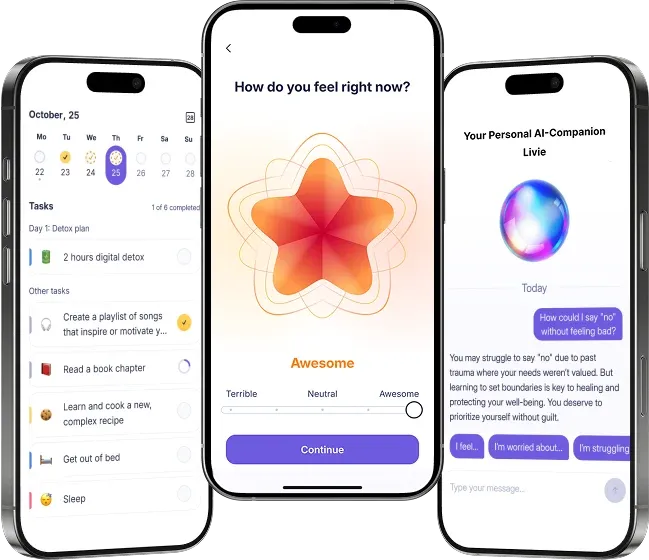
For those who enjoy combining digital tools with self-reflection, the journaling feature in the Liven app offers an easy way to track emotions, mark achievements, and connect actions to progress. Whatever format you choose, the key is to stay consistent and ensure your plan is actively integrated into your routine.
Conclusion: Start with One Goal
When creating your personal development plan, consider what truly matters to you in your career and what brings you genuine happiness. Align your personal aspirations with your company's business goals to ensure you're not only growing personally but also making meaningful contributions to your work. Be kind to yourself; aim for excellence, not perfection.
Choose a personal growth plan template that works for you, whether it's a simple list or a more structured framework; however, ensure it doesn't end up collecting dust. Use tools like to-do lists and reminders in the Liven app to keep your progress on track. And remember, don’t be too hard on yourself; growth is a journey, and every small step forward counts.
References
- American Psychological Association. (2023). Goal setting and mental health: Understanding how structure supports wellbeing. Retrieved from https://www.apa.org
- Locke, E. A., & Latham, G. P. (2020). A Theory of Goal Setting and Task Performance. Psychology Press.
(Foundational work is still standard in motivation and goal-setting theory.) - CIPD – Chartered Institute of Personnel and Development. (2023). Leadership development: An evidence review. Retrieved from https://www.cipd.org
- Banu, S. B., et al. (2023). Impact of leadership development on improving workplace communication and environment. ResearchGate. Retrieved from https://www.researchgate.net/publication/378481426
- Harvard Health Publishing. (2024). How setting achievable goals supports motivation and mental well-being.Harvard Medical School. Retrieved from https://www.health.harvard.edu
- World Health Organization. (2024, September 2). Mental health at work – Fact sheet. https://www.who.int/news-room/fact-sheets/detail/mental-health-at-work World Health Organization
- National Institutes of Health (NIH). (2024). The neuroscience of habit formation and behavior change. Retrieved from https://www.nih.gov
- Center for Creative Leadership. (2025, February 20). 4 Sure-Fire Ways to Boost Your Self-Awareness. https://www.ccl.org/articles/leading-effectively-articles/4-ways-boost-self-awareness/ (CCL)
- University of California, Berkeley – Greater Good Science Center. (2024). The science of self-reflection and personal growth. Retrieved from https://greatergood.berkeley.edu
- Harvard Business Review. (2018, January 4). What Self-Awareness Really Is (and How to Cultivate It). https://hbr.org/2018/01/what-self-awareness-really-is-and-how-to-cultivate-it (Harvard Business Review)
FAQ: Personal Growth Plan Template
What is a personal growth plan template, and why is it needed?
How does a personal growth plan template differ from a personal development plan template?
How to use SMART in a personal growth plan template?
Where can you get ideas for personal development goals?
How do you connect the plan with career goals and professional growth?
Do you need a personal development coach?
Are there free resources and templates available?
How does the plan affect mental health and job satisfaction?
What should you do if there are many goals?