Signs of Emotional Unavailability: How to Recognize the Pattern in Yourself or a Partner




Something feels off. The relationship exists: you go on dates, you talk, maybe you've even met each other's friends. But there is a ceiling you can never quite reach. Conversations stay surface-level. Vulnerability gets deflected. Emotional closeness feels like it's always just around the corner.
That gap has a name: emotional unavailability.
Understanding the signs of emotional unavailability matters whether you're seeing them in a partner, in a friend, or (and this is the part most articles skip) in yourself. Because the pattern rarely announces itself. It hides in plain sight, often dressed up as independence, self-sufficiency, or general guardedness.
Key Learnings:
- Emotional unavailability describes a genuine difficulty processing and expressing emotions, often with no conscious awareness it is happening.
- Roughly 1 in 4 adults has an avoidant attachment style, one of the primary drivers of emotional unavailability.
- Attachment patterns pass between generations at high rates, which partly explains why emotional unavailability can feel completely normal to those who grew up inside it.
- The pattern is not permanent: 70% of couples who undergo Emotionally Focused Therapy recover fully.
What Emotional Unavailability Actually Means
Emotional unavailability is a difficulty naming, tolerating, and sharing emotions in a way that makes real closeness hard. People with emotional unavailability can experience emotion deeply. They just struggle to let anyone else in on it.
The result is relationships that feel asymmetrical: one person reaching, the other retreating.
Emotional unavailability is not a diagnosable condition. It exists on a spectrum, from mild emotional guardedness to a near-complete shutdown of intimacy. And critically, it almost always has roots in very early experiences. Research shows that infants with emotionally unavailable caregivers develop higher baseline cortisol levels, meaning the stress response itself gets rewired when emotional safety is absent in childhood.
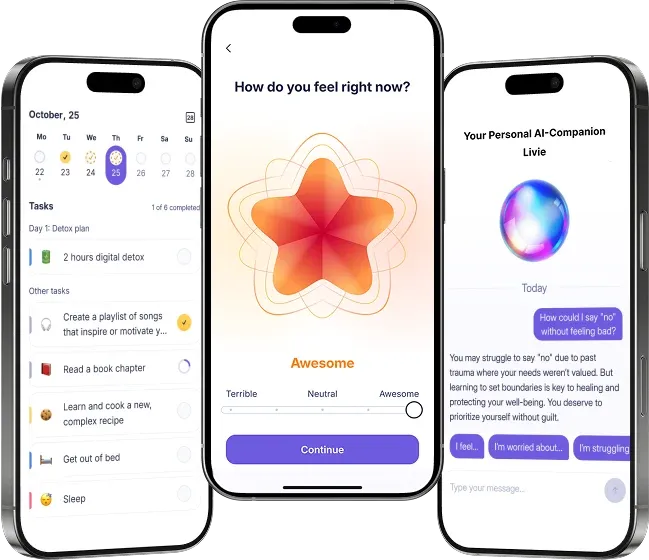
That gap between experiencing an emotion and being able to name it is exactly where the work begins. Something as simple as a daily mood check-in - the kind Liven's Mood Tracker is built around - trains that skill over time: not just I feel bad, but what kind of bad, when, and why. Small as it sounds, that practice is how emotional self-awareness actually develops.
How Common Is Emotional Unavailability, Really?
More common than most people realize. A 2023 nationally representative survey of 1,000 U.S. adults found that roughly 1 in 4 identify with an avoidant attachment style, the pattern most directly associated with emotional unavailability. When anxiously attached adults are included, well over a quarter of the population is navigating relationships with some form of insecure attachment.
Longitudinal research has documented a consistent decline in secure attachment rates among younger adults across recent decades. And dismissive attachment is rising correspondingly during the same period.
The pattern also passes down. Attachment styles transmit between generations, partly explaining why emotional unavailability can feel completely normal to those who grew up inside it.
The Signs Most People Recognize
Some signs of emotional unavailability are well-documented and relatively easy to spot.
Avoiding emotional conversations. When a deeper topic comes up (feelings, needs, the future), the person changes the subject, gives vague answers, or suddenly becomes very busy. Saying it feels unsafe, so they find ways not to.
Inconsistency in closeness. One week they are warm, present, and engaged. Next, they are distant and hard to reach. This hot-and-cold pattern is not calculated - it often reflects a genuine internal conflict between the desire for connection and the fear of it. People with avoidant attachment style try to minimize negative emotions but are often very physiologically distressed, meaning the calm exterior masks real internal turbulence.
Commitment avoidance. Labels, future plans, and conversations about the direction of the relationship get dodged. An emotionally unavailable person may participate in everything a relationship looks like while refusing to name it. The signs of commitment issues often overlap directly with emotional unavailability. Both tend to trace back to fear of vulnerability.
Low empathy in practice. A person can be kind and still struggle to feel what you are feeling. They may understand your situation logically but seem unmoved by it, or respond with problem-solving when all you needed was to be heard.
The Signs That Are Easier to Miss
The less obvious signs tend to cause more sustained damage, partly because they are easier to rationalize away.
They seem remarkably self-sufficient. Independence is a quality we tend to admire, so this one slips under the radar. But there is a version of self-sufficiency that functions as a defense: an inability to lean on others, ask for help, or let someone in during hard moments.
Avoidant individuals are less likely to seek out potentially rewarding relationships, including romantic ones. Closeness has been wired as a threat, so they preemptively keep their distance.
They focus more on surface than depth. Some emotionally unavailable people invest heavily in how they are perceived (appearance, status, achievements) rather than in how they are genuinely experienced. External markers feel like safer bets than the messiness of emotional intimacy.
They shut down during conflict rather than engage. Not with aggression, but with an unnerving calm. They become flat, detached, or exit the conversation entirely. To the other person, this reads as indifference. It is often something more complicated: an inability to stay regulated when emotions run high. A 2024 study of 557 university students found that almost half reported difficulties regulating their emotions, with avoidant attachment being a significant predictor, suggesting emotional shutdown during conflict is far more widespread than it appears.
They do not remember or ask about your emotional life. You share something significant and a week later, there is no follow-up. Emotional attentiveness requires tracking what matters to the other person, and that is genuinely hard for someone who struggles to track their own emotional world.
Everyone has situations that spark stronger emotional reactions than others. Understanding yours is a useful place to start. Try the emotional triggers test to see which patterns come up for you.
You Might Be Emotionally Unavailable Too
If you repeatedly find yourself drawn to emotionally unavailable partners, some part of you may be unavailable too.
People with anxious attachment styles often pursue emotionally distant partners not despite the distance, but because of it. The chase becomes the relationship. Closeness is craved in theory but avoided in practice. When a consistently available, emotionally present person comes along, the pull simply is not there.
For someone with these patterns, attraction has been wired to include uncertainty. If that sounds familiar, taking the anxiety type and triggers test can help you see what's actually driving your patterns - not just in who you choose, but in how you respond when someone gets close.
If you find yourself doing most of the emotional labor (initiating, following up, holding the weight of the relationship), it is worth asking not only whether your partner is unavailable, but whether the dynamic itself feels familiar because it mirrors something older. Settling for the bare minimum in a relationship often has roots in exactly this kind of unconscious wiring.
This is where journaling can be unexpectedly useful - not to vent, but to observe. Writing out what you're feeling and when, which is what Liven's Journal is designed for, has a way of surfacing patterns you can't always see from the inside. Over time, those entries become a timeline: one that shows you not just what happened, but how you consistently respond to it.
Where This Comes From
Emotional unavailability almost always has a learned origin.
The most common roots:
- Early childhood experiences where emotional expression was discouraged, ignored, or unsafe; caregiving that was inconsistent or conditional
- Past relationships involving betrayal or emotional trauma
- Attachment styles (particularly avoidant and disorganized) that formed as adaptive responses to environments where closeness came with risk
One number worth sitting with: studies suggest that only about 40% of people carry the same attachment style from childhood into adulthood. Life events, relationships, and intentional work can and do shift them over time.
What To Do With This Information
Whether you are recognizing these patterns in a partner or in yourself, pay attention to whether the relationship has actual reciprocity: are both people able to be vulnerable, and does closeness feel safe or does it consistently get avoided?
If you are seeing these signs in a partner, emotional unavailability cannot be resolved by proximity, patience, or enough love. Change requires the person themselves to want it.
If you are seeing these signs in yourself, the data is genuinely encouraging. A comprehensive meta-analysis across 20 studies and 332 couples found that 70% of those who completed Emotionally Focused Therapy (EFT) were symptom-free by the end of treatment, with treatment gains sustained at two-year follow-up.
Emotional availability is a learnable skill, and self-awareness, frustratingly slow as it often feels, is where the work actually starts.
References
Chopik, W. J., Weidmann, R., & Oh, J. (2024). Attachment security and how to get it. Social and Personality Psychology Compass, 18(1), e12808. https://doi.org/10.1111/spc3.12808
Howland, M. A., & Glynn, L. M. (2024). The future of intergenerational transmission research: A prospective, three-generation approach. Development and Psychopathology. https://doi.org/10.1017/S0954579424000919
Messina, I., Calvo, V., & Grecucci, A. (2023). Attachment orientations and emotion regulation: New insights from the study of interpersonal emotion regulation strategies. Research in Psychotherapy, 26, Article 703. https://doi.org/10.4081/ripppo.2023.703
Morales-Sanhueza, J., & Martín-Mora-Parra, G. (2024). Anxiety and avoidance in attachment as predictors of emotional regulation difficulties in university students. Psychiatry International, 5(4), 949–961. https://doi.org/10.3390/psychiatryint5040065
Orth, T., & Bialik, C. (2023). What do Americans say about their attachment styles? YouGov. https://today.yougov.com/society/articles/45827-what-do-americans-say-about-their-attachment-style
Spengler, P. M., Lee, N. A., Wiebe, S. A., & Wittenborn, A. K. (2024). A comprehensive meta-analysis on the efficacy of emotionally focused couple therapy. Couple and Family Psychology: Research and Practice, 13(2), 81–99. https://doi.org/10.1037/cfp0000233
FAQ: Signs of Emotional Unavailability
What is emotional unavailability?
What causes emotional unavailability?
Can an emotionally unavailable person change?
How do I know if I am emotionally unavailable?
What is the difference between emotional unavailability and introversion?
Can emotional unavailability affect friendships, not just romantic relationships?