
Dismissive Avoidant Attachment Style: Causes, Patterns, and How to Heal



Written by
Nadine M., Editorial Team Lead at Liven

Reviewed by
Tara Passaretti, M.S., LMHC


Someone in your life goes quiet when things get serious. They can be warm and present, but the moment a conversation turns emotional, or a relationship asks for something real, they're closing the door. Or maybe that someone is you.
One in four adults in the US is said to exhibit a dismissive-avoidant attachment style. For them, closeness feels uncomfortable, and distance feels like relief. Most don't know why. Some don't even know it's happening.
Below, we cover what causes it, how it shows up in your relationships, and where to start if you want to change it.
Key Learnings
- When caregivers consistently dismiss emotional needs, children adapt their strategies and start managing alone.
- People with dismissive-avoidant attachment often look calm on the outside because they've learned to mute emotional expression and keep feelings at arm's length, even when something is stirring inside.
- They use deactivating strategies like nitpicking a partner's flaws to create distance the moment closeness feels threatening.
- Avoidant patterns soften when you catch the moment of pulling away, and gradually let safe relationships teach your body that closeness can stay.
How Dismissive Avoidant Attachment Develops
Dismissive avoidant attachment usually starts with emotional neglect, where a caregiver couldn't meet a child's emotional needs. They’re often physically present, but when the child reached for reassurance or connection, they dismissed it.
And when comfort-seeking doesn't work, children learn to handle distress on their own and rely on themselves. That adaptation is where the “independence” comes from. It's a solution a child built when the alternative, e.g., needing someone unreliable, felt worse.
Parenting is the primary driver, but not the only one. A 2021 review in the World Journal of Psychiatry found that genetic factors explain up to 39% of the variability in avoidant attachment in adults. For example, people with higher methylation on the oxytocin receptor gene tend to score higher on avoidant attachment.
Oxytocin is the brain chemistry behind bonding and feeling socially connected. It helps your nervous system read closeness as safe, especially in relationships where trust and consistency hold steady. How sensitive your system feels to it varies from person to person, partly because of biology and partly because of the relational experiences you've had. There's no single on-off gene for this; small genetic differences interact with your environment over time, shaping how rewarding or safe closeness feels.
Early experiences matter too. Things like loss, parental separation, emotional inconsistency at home, or even watching a strained relationship between caregivers can shape how the brain learns to read closeness. Over time, these patterns influence whether intimacy feels naturally comforting or more activating and uncertain.
How Dismissive Avoidants Experience Themselves
From the outside, dismissive avoidants often look like people who have it together. They're capable, independent, and socially at ease. They don't complain much and tend to perform well professionally.
This self-sufficiency stems from a belief that other people aren't particularly reliable. So while most dismissive avoidants want connection, closeness makes them uncomfortable. They stop before they get there.
Researchers call them deactivating strategies. These are unconscious patterns that pull you toward distance the moment closeness starts to feel threatening.
Deactivating Strategies You Might Use
Though these strategies feel like genuine thoughts and preferences, they're knee-jerk responses that create distance every time someone gets close. Here are some deactivating strategies a dismissive avoidant might use, sometimes without realizing:
- Focusing on a partner's flaws: Small habits, minor irritations, physical quirks start feeling like dealbreakers the moment things get emotionally close. The attachment system is looking for an exit.
- Intellectualizing feelings: When a conversation turns emotional, the instinct is to analyze or problem-solve rather than feel.
- Getting very busy: Work, hobbies, and plans quietly expand to fill any space where intimacy might otherwise show up.
- Suppressing emotions before they surface: Sadness, fear, and need get dampened before they're fully felt. Dismissive avoidants often don't have conscious access to what they're experiencing.
- Withdrawing without explanation (ghosting): They go quiet, become unreachable, creating distance when closeness increases. Often, there’s no clear answer for why.
- Dismissing a partner's emotional needs: As emotional displays feel overwhelming, they instinctively redirect the conversation or wait for it to pass.
Brain imaging studies show that dismissive avoidants have reduced activation in the brain's reward circuitry when exposed to positive social situations. Closeness registers as less rewarding at a neurological level. Research also indicates reduced gray matter in the hippocampus, a region involved in memory, stress regulation, and emotion processing. That’s why they tend to think their way through emotional situations rather than feel them.
How Dismissive Avoidant Tendencies Show Up in Relationships
While people with dismissive-avoidant attachment can maintain relationships, it limits how deep that connection can go and what happens when it tries to go deeper.
Here’s how this can appear, depending on the type of relationship:
💗 Romantic Partners
Romantic relationships tend to start well. The early stages are easy, as there are no real emotional demands. The pattern doesn't activate until the relationship starts asking for more. That's when the distance appears, often before the dismissive avoidant has registered what's happening.
A study by University College, Dublin, found that both dismissive avoidants and their partners had lower relationship satisfaction than securely attached people. Being present in a relationship and being available in one are not the same thing.
Avoidant and anxious attachment styles are often attracted to each other. Researchers call this the complementarity hypothesis. The dismissive avoidant's independence reads as confidence. The anxious partner's warmth feels easy to receive, without requiring much in return.
But when the relationship gets serious, the same thing that created the attraction starts creating the problem. The anxious partner needs more closeness. The dismissive avoidant needs more space. The withdrawal triggers more pursuit. The pursuit triggers more withdrawal, and they’re stuck in a toxic loop.
🧑🧑🧒🧒 Friends and Family
Dismissive avoidants can be warm, funny, and present in everyday conversations. But the moment a friendship or relationship needs them to be vulnerable or get emotional, they get distant. Here’s also where they use deactivating strategies, such as redirecting the conversation, intellectualizing it, or simply going quiet.
A seven-day diary study tracked real interactions across attachment styles and found that dismissive avoidants had the least intimate and least emotionally positive interactions of any group, including other insecure styles.
They also consistently felt that others were less responsive to them. The attachment style also colored what they noticed in others.
💼 Work
Dismissive avoidants often perform well at work. Independence and self-reliance are professionally rewarded, and they have both in abundance. They take on more than they should, rarely ask for help, and don't admit when they're struggling.
But this pattern has a cost. A cross-cultural study found that avoidant attachment correlates positively with burnout across multiple professions and cultures. Carrying everything alone and never signaling distress is sustainable until it isn't. Criticism makes it worse as it is perceived as an attack on their competency and self-sufficiency.
How to Heal from Dismissive Avoidant Attachment
Dismissive-avoidant attachment is not a fixed trait. Let's explore some tips on how to process your emotions and develop a more secure attachment style:
1. Recognize Your Own Deactivating Strategies
Many people with dismissive avoidant attachment don't recognize their deactivating strategies for what they are. Nitpicking a partner's flaws, sudden emotional numbness, and analyzing feelings instead of having them can all feel like genuine reactions and preferences.
So, the clearest signal that one is running away from connections is relief. And the first step is paying attention to them.
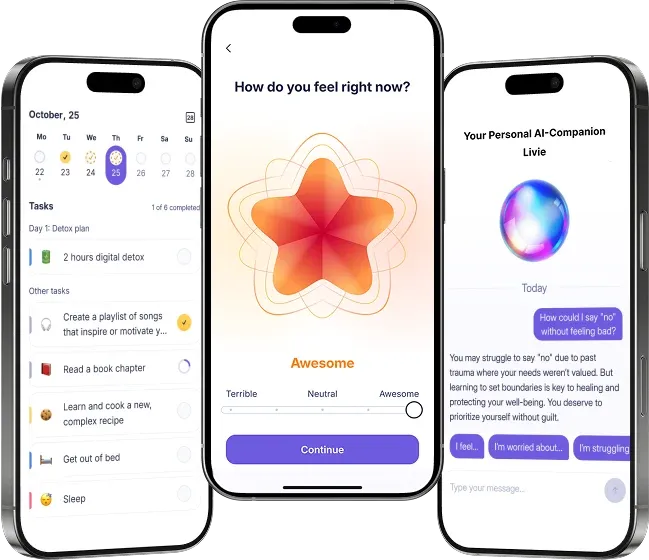
Journaling through your feelings is a good place to start. Writing things down by hand slows the rationalization process down enough to see what's happening. If you want to capture something in the moment (just after a conversation shifts or when you notice the urge to pull back), well-being apps like Liven come with a digital journal that lets you note it before the rationalization kicks in.
2. Build Tolerance for Emotional Closeness
A 2020 study in Family Process found that attachment representations update in response to new relational experiences. A consistently safe relationship, over time, changes what closeness feels like. Here’s how you can support this process:
- Start smaller than feels necessary: Think one honest sentence before a full conversation. Tell someone something true before you've had time to edit it. Shifting avoidant attachment patterns starts with noticing when you pull away, and gradually building tolerance for closeness and vulnerability inside relationships that feel safe.
- Name the withdrawal when it's happening: Saying "I'm shutting down right now" is not weakness. For someone whose entire system is built around self-sufficiency, it is one of the hardest things they can say.
- Stay in uncomfortable conversations a little longer: The urge to redirect or exit an emotional conversation is the deactivating strategy activating. Staying one minute longer than feels comfortable, consistently, builds a different kind of tolerance.
- Notice what safe feels like: Dismissive avoidants often don't register safety because they're not looking for it. Start paying attention to interactions that leave you feeling calm rather than just relieved.
- Let people help you with small things: Asking for a recommendation, an opinion, or a small favor are all practices for the larger version of letting people get really close to you.
3. Consider Trying Therapy
Some patterns don't budge, no matter how clearly you understand them. If you keep noticing the same loop even when you're trying to do something different, therapy is worth a look.
Approaches like Emotion-Focused Therapy (EFT) and Compassion-Focused Therapy (CFT) have solid evidence behind them for working with emotional processing and self-criticism. The relationship with the person sitting across from you carries as much weight as the approach itself, especially when emotional safety has been thin in earlier relationships. So finding someone you feel comfortable with often counts for more than the method.
Breaking the Pattern Starts With Noticing It
Dismissive-avoidant patterns usually form in homes where leaning on the people closest to you didn't go well, and learning to handle things yourself became the safer move. The pattern often stays even after you're surrounded by people who could be leaned on now.
A good place to start is catching the move as it's happening. When you feel yourself stepping back, write down what was going on and what you were feeling just before, even just one sentence. Over time, those notes start to show you the shape of the pattern.
If you want to go further, looking at how your early relationships taught your nervous system about closeness can be useful. A short self-reflection quiz on attachment can surface the themes still showing up for you now.
References
- Erkoreka, L., Zumarraga, M., Arrue, A., Zamalloa, M. I., Arnaiz, A., Olivas, O., ... & Basterreche, N. (2021). Genetics of adult attachment: An updated review of the literature. World Journal of Psychiatry, 11(9), 530–542. https://doi.org/10.5498/wjp.v11.i9.530
- Perlini, C., Bellani, M., Rossetti, M. G., Zovetti, N., Rossin, G., Bressi, C., & Brambilla, P. (2019). Disentangle the neural correlates of attachment style in healthy individuals. Epidemiology and Psychiatric Sciences, 28(4), 371–375. https://doi.org/10.1017/S2045796019000271
- Gleeson, G., & Fitzgerald, A. (2014). Exploring the association between adult attachment styles in romantic relationships, perceptions of parents from childhood and relationship satisfaction. Health, 6(13), 1643–1661. https://doi.org/10.4236/health.2014.613196
- Collins, N. L., Cooper, M. L., Albino, A., & Allard, L. (2002). Psychosocial vulnerability from adolescence to adulthood: A prospective study of attachment style differences in relationship functioning and partner choice. Journal of Personality, 70(6), 965–1008. https://doi.org/10.1111/1467-6494.05029
- Kafetsios, K., & Nezlek, J. B. (2002). Attachment styles in everyday social interaction. European Journal of Social Psychology, 32(5), 719–735. https://doi.org/10.1002/ejsp.130
- Pines, A. M. (2004). Adult attachment styles and their relationship to burnout: A preliminary, cross-cultural investigation. Work & Stress, 18(1), 66–80. https://doi.org/10.1080/02678370310001645025
- Suh, G. W., & Fabricius, W. V. (2020). Reciprocal relations between emerging adults' representations of relationships with mothers, fathers, and romantic partners. Family Process, 59(2), 807–821. https://doi.org/10.1111/famp.12458
FAQ: Dismissive Avoidant Attachment Style
What are the signs of a dismissive-avoidant attachment personality?
How do you love a dismissive avoidant partner?
Can dismissive avoidants have healthy relationships?
How do dismissive avoidants handle past trauma?
How do you practise emotional regulation as a dismissive avoidant?
Why do dismissive avoidants struggle with forming close relationships?
Is being fiercely independent the same as dismissive avoidant attachment?