What Is a Somatic Workout? Types, Benefits, and How to Start
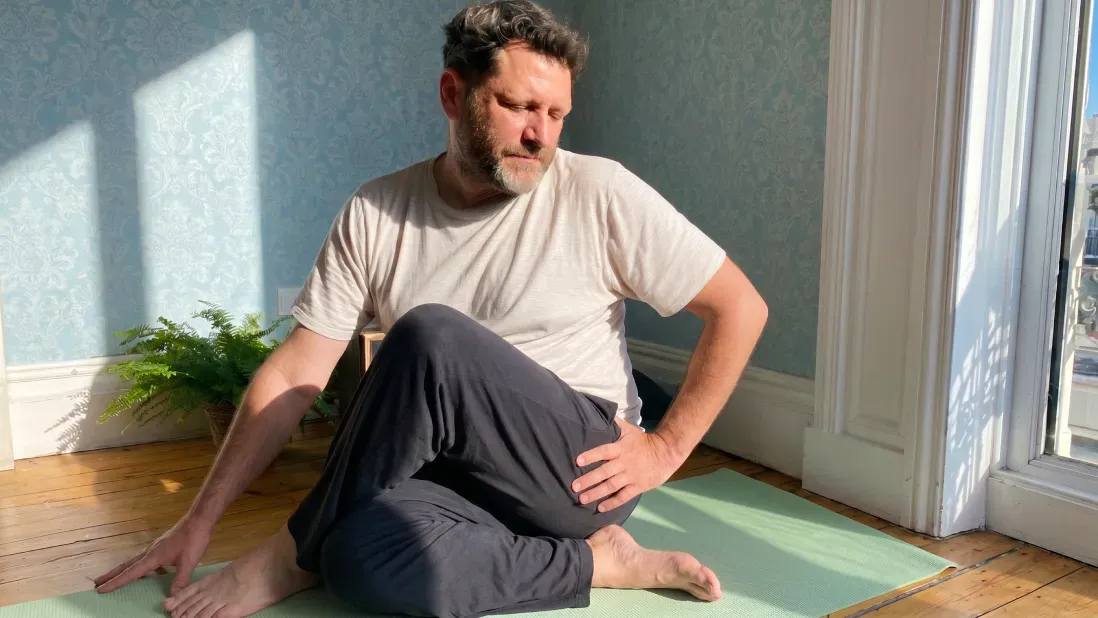



We learned to push harder, feel the burn, silence our body's complaints, and keep going. Somatic workouts start from the opposite premise: that the body is constantly communicating, and that tuning into those signals is one of the most effective ways to connect with it.
In this article, we'll cover the main types of somatic workout and walk you through one you can try as you read.
Key Learnings
- Most exercise teaches you to override your body. Somatic movement teaches you to listen to it.
- Chronic stress causes muscles to physically lose their ability to release - somatic exercises are designed to fix that.
- A longer exhale than inhale is one of the fastest nervous system resets you have.
- Some practices you can start tonight. Others need a practitioner. The difference matters.
What Makes a Workout Somatic
The word somatic comes from the Greek soma, meaning the living, sensing body. A somatic workout puts your internal sensory experience at the center of movement, rather than external performance metrics like reps, pace, or appearance.
This means moving slowly and deliberately, pausing to notice how a movement feels before continuing, and working with your nervous system rather than pushing against it.
Somatic movement supports the nervous system's ability to shift between activation and rest - not by suppressing one state, but by making the transition between them more fluid. Slowing down enough to sense what's happening in your body is a skill, and for many people it takes real effort to unlearn the habit of rushing through movement on autopilot.
The Mind-Body Science
Chronic stress, trauma, and repetitive postural habits cause what Thomas Hanna, who coined the term somatics, called sensory-motor amnesia. The brain loses its ability to voluntarily relax and control certain muscles. The result is persistent tension, pain, and restricted movement that no amount of stretching seems to fully resolve.
Somatic exercises work by re-educating the nervous system through a technique called pandiculation: slowly contracting a muscle, then even more slowly releasing it, while paying close attention to the sensation.
Unlike passive stretching, this process sends updated sensory feedback to the brain, helping it remember how to let go.



Try a Simple Somatic Exercise
You don't need a mat, a class, or a somatic certification. Just five minutes and enough quiet to notice your body. You can do this right now as you read.
- Sit or lie down comfortably. Close your eyes, or soften your gaze downward if that feels more comfortable.
- Take three slow breaths, exhaling longer than you inhale.
- Starting from your feet, scan slowly upward. Don't try to relax - just notice. Where do you feel tension? Heaviness? Numbness?
- Choose one tense area. Gently increase the tension there, hold for 3 seconds, then slowly release.
- Breathe again. Notice what changed.
That's somatic movement.
Your Options, Organized by How Much Guidance You Need
Not all somatic practices are the same thing. Some you can start tonight with a YouTube video. Others work best - or only really work - when someone trained is in the room with you. Here's the difference.
Somatic Breathwork
Breath is worth starting with because it underlies most other somatic practices. It's one of the few autonomic functions you can consciously control, which gives you a direct line into your nervous system.
Diaphragmatic breathing, meaning slow, deep breaths that expand the belly rather than the chest, activates the vagus nerve and shifts the body from sympathetic (fight-or-flight) into parasympathetic (rest-and-digest) mode.
To try it now:
- Sit comfortably and place one hand on your belly.
- Inhale slowly through your nose for 4 counts, letting your belly rise rather than your chest.
- Hold for 2 counts.
- Exhale through your mouth for 6 to 8 counts, longer than the inhale.
- Repeat for 3 to 5 cycles and notice what shifts.
The extended exhale is the active part. It signals to your nervous system that the threat has passed. If you work through the somatic reset exercise later in this article, you'll recognize this same breath pattern there, too - the two build on each other well.
Somatic Yoga
Somatic yoga looks like regular yoga on the surface, but the intention is different. In traditional yoga, the focus is often on achieving a shape: touching your toes, holding Warrior II with clean form. In somatic yoga, the question is: what do I feel as I move into this shape?
That internal shift activates interoception - your brain's system for reading what's happening inside your body. One study found that an interoception-focused yoga program produced significant improvements in well-being.
In practice, a session might include cat-cow, spinal rolls, or hip openers at a pace slow enough to feel each vertebra shift. Eyes closed. Breath leading the movement.
Somatic pilates
Pilates already has a reputation for precision and core strength. Somatic pilates layers body awareness on top of that.
This works well for people managing lower back pain or movement patterns shaped by old injury. By slowing down exercises like pelvic tilts, leg circles, or the hundred and focusing on internal sensation rather than output, somatic pilates helps the brain relearn efficient, pain-free movement patterns.
TRE (Tension and Trauma Releasing Exercises)
Developed by Dr. David Berceli, TRE is a series of exercises designed to deliberately fatigue the leg muscles. This triggers the body's natural trembling response - the same one mammals use to discharge stress after a threat. Modern humans tend to suppress that reflex. TRE gives the nervous system permission to complete it.
A basic sequence starts with wall sits, squats, or standing stretches to tire out the legs and inner thighs. Once the muscles are fatigued, you lie on your back with your knees bent and your feet flat. You let the legs shake on their own rather than stopping the movement. Stay with the trembling for several minutes, then slowly extend your legs and rest.
Most people can try the basics from a guided video. Anyone with a significant trauma history should approach it with support rather than alone. Releasing stored tension can sometimes bring up more than expected.
Better With a Practitioner
Some somatic work goes deeper than movement. The two approaches below address patterns that are hard to reach on your own, whether that's a long-held neuromuscular habit or trauma stored in the body.
The Feldenkrais Method
The Feldenkrais Method is one of the most researched somatic practices, and one of the strangest to experience. Moshé Feldenkrais was a physicist and judo master, and the method reflects both: precise, counterintuitive, and quieter than anything you'd expect from a body-based practice. The movements are tiny. A slight wrist rotation. A breath held a half-second longer. A micro-shift in the pelvis that you'd miss if you blinked.
That's also what makes it hard to do on your own. With breathwork or yoga, you can feel when something changes. Feldenkrais works at the level of neuromuscular habit, and those patterns are mostly invisible to the person carrying them. A practitioner's role there is to notice what you can't: the way your shoulder lifts when it doesn't need to, the tension you've been holding so long it stopped registering as tension.
Without that outside perspective, you tend to practice the same habits you came in with.
Somatic Experiencing
Developed by Dr. Peter Levine, Somatic Experiencing (SE) is a clinical approach designed for trauma, chronic stress, and PTSD. Research supports its effectiveness for trauma-related symptoms, and it's practiced by trained therapists rather than movement instructors.
In a session, a therapist helps you track physical sensations as they arise: tightness in the chest, a catch in the breath, a sudden urge to move or freeze. The goal is to help the nervous system complete responses that got stuck. Sessions are typically 50 to 90 minutes, and most people work with an SE practitioner over several months rather than a few sessions.
SE is not a movement class, and it's not talk therapy in the traditional sense. It sits somewhere between the two. If you're dealing with something that hasn't shifted through exercise, meditation, or conversation alone, it's worth looking into.
How to Build a Somatic Practice Into Your Day
A few ideas for getting started:
- Morning: 5 minutes of diaphragmatic breathing before you look at your phone
- Midday: A somatic cat-cow or hip circles between calls
- Evening: A body scan before sleep instead of scrolling
The key is consistency over intensity. Somatic workouts tend to help people who feel wired but tired at the end of the day, carry stress in the body (neck, shoulders, gut, jaw), find traditional exercise leaves them more tense, or want a movement practice that also supports emotional health.
If you'd like to continue your wellness journey, take a 3-minute quiz to get your personalized well-being management plan.
Learn to Work with Your Body
If the idea of working with your body rather than pushing against it feels like something you've been looking for, somatic movement is a good place to start.
Begin with the sequence above, explore a somatic yoga or pilates class, or simply bring a quality of internal attention to whatever movement you already do.
References
- Bennett, B. C. (2020). The somatic work of Thomas Hanna, Tai chi, and kinesiology. Kinesiology Review, 9(3), 236–244. https://doi.org/10.1123/kr.2020-0042
- Pebole, M., Singleton, C., Hall, K., Petruzzello, S., Alston, R., & Gobin, R. (2022). Exercise preferences among women survivors of sexual violence by PTSD and physical activity level: Implications and recommendations for trauma-informed practice. Mental Health and Physical Activity, 23, 100470. https://doi.org/10.1016/j.mhpa.2022.100470
- Berland, R., Marques-Sule, E., Marín-Mateo, J., Moreno-Segura, N., López-Ridaura, A., & Sentandreu-Mañó, T. (2022). Effects of the Feldenkrais Method as a Physiotherapy Tool: A Systematic Review and Meta-Analysis of Randomized Controlled Trials. International Journal of Environmental Research and Public Health, 19(21), 13734. https://doi.org/10.3390/ijerph192113734
- David Berceli’s official website. https://david-berceli.com/
- Kuhfuß, M., Maldei, T., Hetmanek, A., & Baumann, N. (2021). Somatic experiencing – effectiveness and key factors of a body-oriented trauma therapy: A scoping literature review. European Journal of Psychotraumatology, 12(1), 1929023.https://doi.org/10.1080/20008198.2021.1929023
FAQ: Somatic Workout
What is a somatic workout?
Can somatic workouts help with weight loss?
Are somatic workouts only for people dealing with trauma or stress?
Can I combine somatic workouts with my regular fitness routine?
Is somatic movement the same as stretching?
How is somatic yoga different from regular yoga?
Can somatic workouts help with anxiety?