Somatic Awareness: What It Is and Why It Matters




Your shoulders tighten before you even realize you're stressed. Your stomach drops before your brain registers the bad news. Your chest feels heavy on a Sunday evening for no obvious reason. That's somatic awareness at work - your body's constant conversation with your nervous system.
Most of us were never taught to listen to it.
Somatic awareness is the ability to notice, interpret, and respond to the physical sensations your body produces in response to emotions, stress, and experience. It's a skill, not a personality trait, and science suggests it plays a bigger role in mental health than most people realize.
Key Takeaways
- Somatic awareness is the ability to tune into your body's physical signals and connect them to your emotional state.
- The body often signals stress and emotion before the conscious mind catches up.
- Low somatic awareness is linked to difficulty regulating emotions and higher levels of chronic stress.
- This is a learnable skill - consistent, small practices can strengthen it over time.
What Does Somatic Mean?
The word somatic comes from the Greek soma, meaning body. In psychology and neuroscience, it refers to anything related to the physical body, as opposed to the mind alone.
Somatic approaches to well-being recognize that the body and mind are not separate systems. They're in constant two-way communication. What you feel emotionally shows up physically, and what happens physically shapes how you feel emotionally.
This explainer unpacks how somatic work helps you reconnect to body sensations and create space to respond rather than react:
Emma McAdam, a Licensed Marriage and Family Therapist, runs Therapy in a Nutshell, where she translates therapy skills and research into accessible mental-health resources. Her work draws on Acceptance and Commitment Therapy, polyvagal theory, and Somatic Experiencing.
What Is Somatic Awareness, Exactly?
Somatic awareness is your capacity to notice what's happening inside your body: sensations like tension, warmth, tightness, pulsing, or numbness, and recognize what those sensations might be telling you.
Think of it as an internal compass. When you're anxious, your chest tightens. When you're angry, heat rises in your face or chest. When you're excited, your energy feels electric and light. These aren't random physical events. They're your nervous system, translating emotional experience into body language.
People with developed somatic awareness can catch these signals early, before emotions escalate. That gives them more room to choose how they respond, rather than just react.
Why Your Body Knows Before Your Brain Does
Your body often reacts to a stressor before your conscious mind has even caught up.
Here is why: your brain has a built-in alarm system, the amygdala, that detects threat and fires a physical response in milliseconds. Heart rate up. Breath shorter. Muscles tense. All of this happens before your rational, thinking brain has had a chance to weigh in.
That is where body awareness becomes so valuable. People who are more attuned to their body's signals tend to manage stress and emotions more effectively, because they can feel what is happening early enough to respond rather than just react.
Your gut feeling is a real signal. Learning to read it is a skill worth building.
Signs You May Have Low Somatic Awareness
Low somatic awareness doesn't mean something is wrong with you. For many people, it develops as a coping mechanism, especially after stress, trauma, or environments where emotional expression wasn't safe.
Here are some common signs that you might be disconnected from your body's signals:
- You often feel stressed or anxious, but you're not sure why or where in your body you feel it
- You notice tension, pain, or fatigue only when it becomes very intense
- You tend to live in your head and find it hard to slow down
- Emotional conversations or conflicts feel overwhelming or hard to process in the moment
- You struggle to identify how you're feeling beyond fine, tired, or bad
- You frequently override your body's signals (hunger, exhaustion, discomfort) to keep pushing forward
These are simply patterns that, once recognized, can be gently shifted.
Why Somatic Awareness Matters for Mental Health
Most mental health tools focus on thoughts. But you often feel emotions in your body before you can name them. Here's what changes when you start paying attention to those signals.
It Helps You Regulate Emotions
When you can feel what's happening in your body, you can intervene before emotions escalate. People who are more attuned to their internal signals tend to manage emotions more effectively and experience fewer symptoms of anxiety and depression. The body gives you the information first. Somatic awareness helps you use it.
It Reduces Stress
Chronic stress often stays invisible until it becomes a physical problem: headaches, digestive issues, poor sleep, or burnout. By the time you consciously register it, it has already been building for a while. Somatic awareness helps you catch it earlier, because you start noticing the physical signals before they have a chance to escalate.
It Supports Trauma Recovery
Traumatic experiences don't only live in memory. They show up in the body too: in tension, in a racing heart, in a nervous system that stays on high alert long after the threat has passed. Learning to notice and gently work with those physical sensations is a key part of how many trauma-informed approaches support healing, including Somatic Experiencing and EMDR.
It Deepens Self-Knowledge
When you know what your body feels like when you're aligned versus when you're out of sync, you develop a more honest relationship with yourself. You stop overriding your needs. You start making decisions that actually fit who you are.
How to Build Somatic Awareness: 6 Practical Practices
Somatic awareness is a skill, and like any skill, it improves with practice. You don't need a therapist's office or a yoga retreat to start.
1. Body Scan Meditation
Before you reach for your phone in the morning, take a few minutes for a body scan. Sit or lie comfortably, and slowly move your attention from the top of your head to the soles of your feet. Notice sensations without judging them. Tingling, warmth, tension, numbness, the rhythm of your breath, even whether your energy feels light or heavy: all of it counts as information.
It's a well-supported practice for reducing anxiety and distress, and even a brief few days of consistent practice can make a noticeable difference. Done first thing in the morning, it trains your brain to tune in rather than tune out before the day's noise starts.
2. Name What You Feel
Most of us are trained to describe emotions in abstract terms: something like I feel anxious, or I'm upset. Try going one layer deeper: I feel anxious, and my jaw is clenched, my breathing is shallow, and there's a tight knot just below my sternum.
This practice, sometimes called somatic labeling, helps the nervous system process emotions more effectively. Research confirms that naming emotions consistently reduces distress, regardless of when the labeling occurs relative to the emotional stimulus.
3. Track Your Mood With Body Notes
Mood tracking becomes significantly more powerful when you include physical observations. Instead of just logging stressed at the end of the day, note where you felt it. Over time, you'll start to see patterns you never noticed before.
4. Move Your Body Mindfully
Exercise is one of the best tools for somatic reconnection, but only when done with attention. Yoga, tai chi, walking in nature, or even stretching with awareness all create opportunities to notice how your body moves, where it holds tension, and how movement shifts your mood. Those practices are particularly effective here because they combine movement with attention, giving the body and mind something to do at the same time.
5. Slow Down After Emotional Moments
After a difficult conversation, a frustrating meeting, or a moment of anxiety, pause for two minutes instead of immediately jumping to the next thing. Ask yourself:
- What am I feeling right now?
- Where is that showing up in my body?
- What does it need?
This somatic pause is one of the simplest and most effective ways to build emotional intelligence from the ground up.
One thing worth keeping in mind: not every sensation carries a hidden emotional meaning. Bodies fluctuate constantly from stress, sleep, hormones, caffeine, illness, and even the room you're in. Somatic awareness isn't about obsessively analyzing every signal. You don't have to figure out what every twinge means. With time, you start to recognize your body's patterns.
Final Thoughts
Your body and mind aren't two separate things that occasionally talk to each other. They're one system, always in conversation.
Building somatic awareness is a daily practice. Start with one practice, the one that felt easiest to imagine doing today, and let it settle into a habit before adding the next. You'll know it's working when you catch a feeling earlier than you used to, or when a tight shoulder reminds you that something needs your attention.
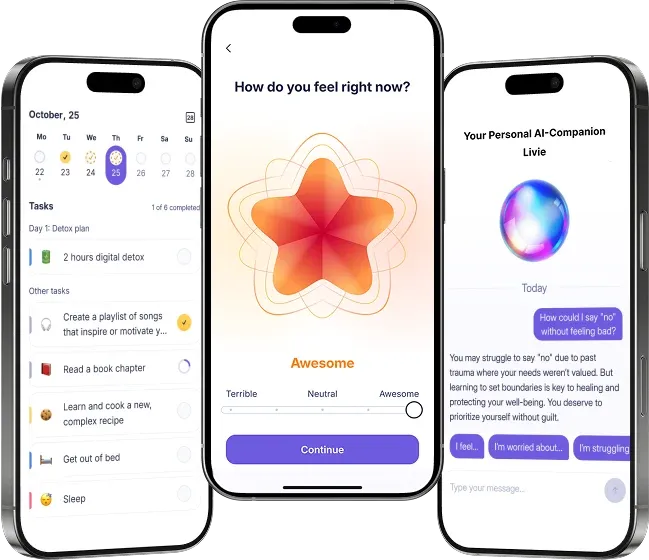
And if you want a daily companion for the work, the Liven app lets you track your mood with body notes and check in with yourself in under a minute. Find it on Google Play or the App Store.
Sources
- Allegretta, R. A., Rovelli, K., & Balconi, M. (2024). The role of emotion regulation and awareness in psychosocial stress: An EEG-psychometric correlational study. Healthcare, 12(15), 1491. https://doi.org/10.3390/healthcare12151491
- de Lima-Araujo, G. L., de Sousa Júnior, G. M., Mendes, T., Demarzo, M., Farb, N., de Araujo, D. B., & de Sousa, M. B. C. (2022). The impact of a brief mindfulness training on interoception: A randomized controlled trial. PLOS ONE, 17(9), e0273864. https://doi.org/10.1371/journal.pone.0273864
- Gan, R., Zhang, Q., Zhao, X., Zhu, Y., & Gao, X. (2022). The effects of body scan meditation: A systematic review and meta-analysis. Applied Psychology: Health and Well-Being, 14(3), 1062–1080. https://doi.org/10.1111/aphw.12366
- Kim, Y., Lim, S., & Lee, S. (2024). The relationship between interoceptive awareness, emotion regulation and clinical symptoms severity of depression, anxiety and somatization. Psychiatry Investigation, 21(3), 252–261. https://doi.org/10.30773/pi.2023.0221
- Levy-Gigi, E., & Shamay-Tsoory, S. (2022). Affect labeling: The role of timing and intensity. PLOS ONE, 17(12), e0279303. https://doi.org/10.1371/journal.pone.0279303
- Nicholson, W. C., Sapp, M., Karas, E. M., Duva, I. M., & Grabbe, L. (2025). The body can balance the score: Using a somatic self-care intervention to support well-being and promote healing. Healthcare, 13(11), 1258. https://doi.org/10.3390/healthcare13111258
- Remskar, M., Western, M. J., Osborne, E. L., Maynard, O. M., & Ainsworth, B. (2024). Effects of combining physical activity with mindfulness on mental health and wellbeing: Systematic review of complex interventions. Mental Health and Physical Activity, 26, 100575. https://doi.org/10.1016/j.mhpa.2023.100575
- Song, Y., Park, I., & Cho, H. (2024). Effects of online mindful somatic psychoeducation program on mental health during COVID-19. Psychiatry Investigation, 21(1), 63–73. https://doi.org/10.30773/pi.2023.0304
- Xu, X., Abdullah, B. B., Samsudin, S. B., & Tan, Y. (2025). Integrating mindfulness and physical activity: A meta-analysis of mindful movement interventions for symptoms of anxiety and depression among university students. PeerJ, 13, e19640. https://doi.org/10.7717/peerj.19640
FAQ: Somatic Awareness
What is the difference between somatic awareness and mindfulness?
Is somatic awareness the same as interoception?
Can anyone develop somatic awareness?
How long does it take to build somatic awareness?
What does somatic awareness feel like?
Is low somatic awareness a sign of a mental health condition?
Can somatic awareness help with anxiety?
What are somatic exercises?
Is somatic awareness the same as body image?
Do I need a therapist to develop somatic awareness?