5 Self-Discovery Coach Types to Help You Find Clarity and Purpose in 2026



You've read the books and listened to the podcasts. But somehow, all that self-help content hasn't translated into actual clarity about what you want from life.
The truth? There's a difference between consuming advice and having someone actually walk alongside you while you’re trying to figure yourself out. That’s when working with an actual self-coach can help.
Check out the 5 self-discovery coach categories, whether you’re looking for coaching sessions with a human, want 24/7 support from a digital self-discovery companion, or seek both.
Key Learnings
- Different self-discovery coach types serve different goals and lifestyles.
- Common types of self-discovery coaching include digital self-discovery coaching, traditional 1:1 sessions, group coaching and workshops, niche coaching, and hybrid coaching.
- Real progress comes from daily reflection and structured practices like mood tracking between sessions, not just occasional breakthroughs.
5 Self-Discovery Coach Models to Choose From
Let's explore the different types of coaches that can support your transformative journey toward an authentic life.
1. Digital Self-Discovery Coaching Platforms
You get 24/7 support on your self-discovery journey through smart companions, structured courses on burnout, anxiety, procrastination, and more, along with self-reflection tools.
How does it work?
Take, for example, Liven. As a self-discovery companion, it functions as a 360° well-being ecosystem that focuses on steady daily support:
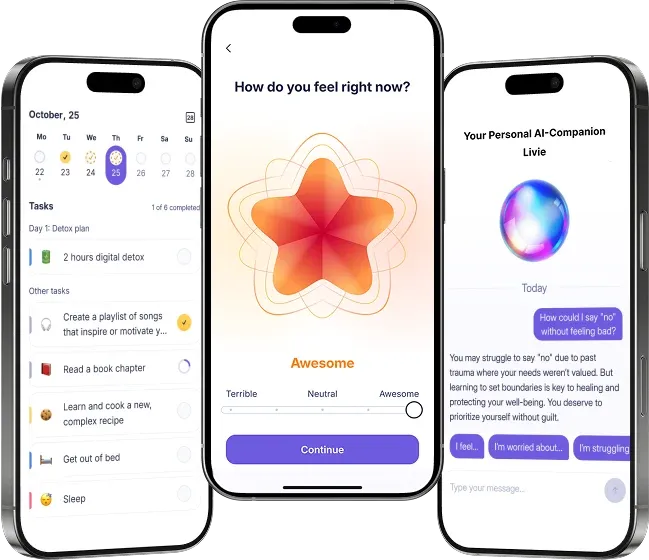
- Liven’s Mood Tracker helps you pause and label emotions. Over time, its Mood Breakdown feature reveals patterns in your behavior, helping you become more self-aware.
- After onboarding, you receive a structured path tailored to your needs, whether it’s a personalized plan for a calmer mind or another plan for dealing with anxiety, burnout, procrastination, or even stressful parenting.
- When thoughts spiral, the Journal offers a space for reflection.
- Livie, the Smart Companion, helps you process emotions and break overthinking loops.
- Liven’s Courses cover anxiety management, burnout recovery, procrastination, and childhood trauma.
- The To-dos help you integrate small, daily well-being habits.
- And if you’re curious about your mental state, Liven’s science-informed wellness tests provide measurable insights into anxiety and stress.
What to Expect
Most platforms cost $10-$30 monthly, less than a single traditional session. Plus, you engage whenever needed, whether it’s during moments of self-doubt at midnight or during your commute — no need to wait for the next session as with traditional coaches.
🤔 Did you know? In one study, human coaches and an AI chatbot both helped clients reach personal goals over 10 months. Surprisingly, the AI was as effective as humans at achieving goals.
2. Traditional 1:1 Self-Discovery Coaches
A traditional self-discovery coach works privately with a client in recurring coaching sessions, typically weekly or biweekly, for 45-60 minutes. Each session focuses on reflection, values clarification, guided emotional exploration, and goal alignment.
How does it work?
Through structured conversation, powerful questioning, and reflective exercises, coaches help clients uncover:
- Core values
- Hidden limiting beliefs
- Patterns of self-doubt
- Identity misalignment
- Emotional blind spots
Many coaching approaches draw on Positive Psychology, Cognitive Behavioral Theory, and Narrative Identity research.
If a coach claims to use therapeutic techniques (such as Trauma Processing, Somatic Trauma Release, or Cognitive Behavioral Therapy), make sure they hold appropriate credentials in psychology, counseling, or a related mental health field.
What to Expect
This individualized support accelerates self-awareness and develops self-trust. Still, it requires investment. Most coaches charge $100-$500 per session, with packages totaling $1,500-$6,000 or more.
🤔 Did you know? Studies on narrative counseling (many coaches are trained in this field) have shown that the story you tell about your life can help you better understand yourself, feel more confident, and make positive changes.
3. Group Coaching & Workshops
Group coaching offers a compelling alternative for personal growth, bringing together people on similar journeys to learn and support one another under expert guidance.
How does it work?
Programs typically run 6-12 weeks with regular video calls, structured learning, and community support under the coach’s guidance.
What to Expect
Hearing how others navigate challenges provides inspiration and practical advice. Affordability is another advantage, with programs typically costing $300-$2,000, which is far less than private coaching.
4. Niche Coaches (Career, Spiritual, Somatic)
Sometimes the most effective path is working with specialists who bring deep expertise to specific areas of self-discovery.
How does it work?
- Career coaches help you align your mission, strengths, and professional direction.
- Spiritual coaches work with existential questions like “What is my purpose in this world?” or “How do I live in alignment with my values?” and help clients connect to something larger.
- Somatic coaches address nervous system regulation and body-based awareness. Trauma research shows emotional memory stays in the body, so embodied practice helps regulate stress and rebuild confidence.
Again, confirm that any somatic or trauma-informed practitioners you decide to work with have appropriate certifications or clinical training.
What to Expect
Good for focused breakthroughs, as niche coaches are less about general self-discovery and more about solving one defined challenge well.
🤔 Did you know? In one study, Purpose-Based Career Coaching helped 80 young people discover their life purpose and match it to suitable careers. After 12 sessions, participants felt clearer about their choices and less stressed about making career decisions.
5. Hybrid Coaching Models (Coach + Digital Support)
This format supports progress between sessions; as such, models include regular check-ins with a coach plus digital resources for daily support.
How does it work?
Programs typically include monthly or biweekly video sessions supplemented by courses and check-in tools, which you access independently. Between live sessions, you track your mood, complete assignments, or message your coach.
What to Expect
Good option if you tend to lose momentum between sessions and need built-in accountability.
🤔 Did you know? Multiple studies show that AI can follow therapy steps to a good extent, but humans demonstrate greater care and understanding. Still, the same studies show that using both together leads to the best results.
Self-Discovery Coach Types
| Type | Best For | Pros | Cons | Pricing | Examples |
| Digital Self-Discovery Platforms | Self-paced growth; daily reflection | 24/7 access; structured plans; highly affordable | Less human interaction; self-driven | $10–$30 monthly | Liven, Wysa, Youper, Sanvello, Reflectly |
| Traditional 1:1 Self-Discovery Coaches | Deep clarity, life transitions, rebuilding self-trust | Fully personalized; high accountability | Expensive; limited to scheduled sessions | $150–$500+ per session | Tomas Svitorka, Steph (Phenomenally You), Trust & Bloom |
| Group Coaching & Workshops | Community-based growth | Peer support; shared learning; lower cost | Less individual focus; fixed program pace | $300–$2,000 per program | Co-Active Training Institute; The School of Life; Mothers to Daughters |
| Niche Coaches (Career, Spiritual, Somatic) | Specific goals (career, purpose, trauma, relationships) | Specialized expertise; focused outcomes | Narrow scope; credentials vary | $150–$400+ per session | Jenny Blake, OnUpBeyond; The Strozzi Institute |
| Hybrid Coaching | Ongoing accountability with flexibility | Live guidance + daily tools | Still premium pricing; tech quality varies | $150–$400 monthly | BetterUp, Modern Health app, Headspace, Talkspace |
Note: Always check the official company website for the most up-to-date pricing.
Self-Discovery Is a Practice
Whatever path you choose, the courage to seek clarity and purpose is already a profound step forward in this life-changing journey.
If you prefer daily micro-practices that compound over time, you can try the Liven app (Google Play or App Store) to build consistent reflection habits, explore thoughtful insights on the Liven blog, or take one of Liven’s free wellness tests to better understand your emotional patterns and plan your next steps forward.
References
- Aftikhar et al. (2025). Therapy as an NLP task: Psychologists' comparison of LLMs and human peers in CBT. arXiv. https://doi.org/10.48550/arXiv.2409.02244
- Khasanah, Z., & Habsy, B. A. (2025). Theory and application of narrative counseling: Literature study. Journal of Islamic Guidance & Counseling, 5(1). https://doi.org/10.53915/jbki.v5i1.570
- Lanfer et al. (2025). Online vs. face-to-face group coaching to promote teachers’ mental health. Frontiers in Digital Health, 7. https://doi.org/10.3389/fdgth.2025.1479524
- Otu, M. S. (2024). Effect of purpose-based career coaching on career decision-making. Current Psychology, 43, 25568–25594. https://doi.org/10.1007/s12144-024-06247-3
- Terblanche et al. (2022). Comparing AI and human coaching goal attainment efficacy. PLoS ONE, 17(6), e0270255. https://doi.org/10.1371/journal.pone.0270255
FAQ: Self-Discovery Coach
How can a self-discovery coach help me move forward in life?
What strategies help me build self-confidence and embrace my true self?
How does coaching help navigate challenges and unlock full potential?