How to Get Rid of Sunday Scaries and Enjoy The Weekend Again


What makes the Sunday scaries tricky is that they don't show up the same way for everyone. For some, it's physical and can manifest in a nervous stomach or tight jaws and shoulders. For others, it's more mental. You might end up overanalyzing the week ahead or blaming yourself for not doing enough.
Sometimes it even shows up in behavior with procrastination, withdrawal, and insomnia, all being symptoms, though not everyone experiences them the same way. And of course, it can hit you at any time — as early as Sunday afternoon or catch you off guard right as you're winding down for the night.
And it's far more common than most people let on. According to a 2025 study by researchers at Delft University of Technology, 80% of employees report frequently experiencing it. But there's a lot you can do about it, and here's where you can start.
Key Learnings
- The Sunday scaries are incredibly common, and they usually come from worrying about things that haven’t happened yet.
- Getting specific about what’s stressing you (instead of letting it stay vague) can instantly make anxiety feel more manageable.
- A simple Sunday routine, like planning for Monday, finishing chores early, and adding relaxing rituals, can completely change how the evening and the upcoming workweek feel.
5 Practical Tips to Beat Sunday Anxiety
The Sunday scaries are a form of anticipatory anxiety, which means worrying about things that haven't happened yet. The way through is to name what's stressing you, plan around it, and protect your time. Here's how:
1. Identify What’s Triggering Your Sunday Blues
Usually, there's something specific behind your Sunday scaries. It can be a difficult meeting, an overdue task, or even a conversation you've been putting off. When everything feels abstract and looming, the anxiety grows bigger than the actual work.
So, get specific about what's bothering you. This is called affect labeling, the practice of putting your feelings into words. Multiple studies prove that simply naming a negative feeling reduces distress.
✍🏼 Practical exercise: Write down everything on your plate for Monday, and rate each item by its level of worry. You’ll know what’s bringing you down.
2. Build a Low-Anxiety Sunday Routine
The Sunday scaries thrive in unstructured evenings. When you have no plan for Sunday night, your brain fills the gap with worry. So start by planning a relaxing Sunday routine. The goal is to rewire Sunday evenings so you actually look forward to them.
One thing you can do is to finish your chores by Saturday, where possible. That way, Sunday evening stays clear. Or you can use the Friday of the previous week (instead of your Sunday evening) to plan out the upcoming work week.
Small as these tasks sound, they shift your mindset from passive dread to active preparation, so you can manage your anxiety and focus on the positive aspects of your week.
3. Make Sunday Evenings Self-Care Time
When Sunday anxiety creeps in, one instinct is to push through it. You make a plan, stay busy, and think your way out of it. And it works for some people. But if it’s not for you, then we suggest self-care rituals.
A 2024 study found that self-care is more effective at improving mental health than coping strategies alone. You don’t need to plan anything elaborate. Here are some simple options:
- Move your body on Sunday afternoon: Light exercise, like a walk or a yoga session, is one of the most reliable mood regulators there is.
- Take a warm bath or shower before bed: Beyond the obvious relaxation benefit, the drop in body temperature afterwards signals to your brain that it's time to sleep.
- Spend five minutes with a gratitude journal. Write down three things from the weekend that went well, or if you've been keeping one, go back and read a few past entries.
- Put on some ambient noise: Rain, white noise, and lo-fi music can all quiet a restless mind and make it easier to wind down without reaching for your phone.
These activities don’t just make you feel better in the moment, but they also build your capacity to cope.
4. Set Boundaries That Lower Work Anxiety
Sometimes the Sunday scaries are more about a work culture that never really lets you switch off. If work notifications are landing on your phone all weekend, your nervous system never gets a real break. And by Sunday evening, you're already exhausted before the week has even started.
That’s why you need to set strict boundaries. You need the time to recover.
A few places to start are:
- Turning off work notifications after a set time: Pick a cutoff (like 6 pm on weekdays and all day on weekends) and stick to it.
- Defining a daily email-check window. Instead of staying available all day, check email at set times.
- Having an honest conversation with your manager. If your workload is the main driver of your Sunday anxiety, talk to your boss about priorities and realistic deadlines
These boundaries will also go a long way in reducing the baseline anxiety that seeps into your entire life beyond Sundays.
5. Have Quick Exercises for When You Feel Anxious
Sometimes the Sunday Scaries hit fast, and in that moment, a five-step plan isn't what you need. What helps is having a handful of simple, proven techniques you can reach for whenever anxiety spikes.
Save these and come back to them whenever you need to reset:
- Box breathing: Inhale for four counts, hold for four, exhale for four, hold for four. Repeat for two minutes. It's one of the fastest ways to manually calm your nervous system.
- Name one specific fear on paper: Don't let it stay vague. Write down the exact thing worrying you in one sentence. As we covered earlier, naming it reduces its power.
- 5-4-3-2-1 grounding technique: Name five things you can see, four you can touch, three you can hear, two you can smell, and one you can taste. It pulls your attention out of your head and back into the present moment.
- Body scan meditation: Find a quiet spot and spend three to five minutes slowly checking in with your body, from your feet to your shoulders. You'll often find tension you didn't know was there, and releasing it makes a noticeable difference.
Pick one, try it tonight, and see how you feel. Bonus points if you try more than one.
What to Do When a Sunday Evening Routine Doesn’t Work
If you've tried the routines, done the prep, and the Sunday Scaries are still showing up every single week without fail, that's worth paying attention to. Persistent, weekly anxiety can point to something deeper.
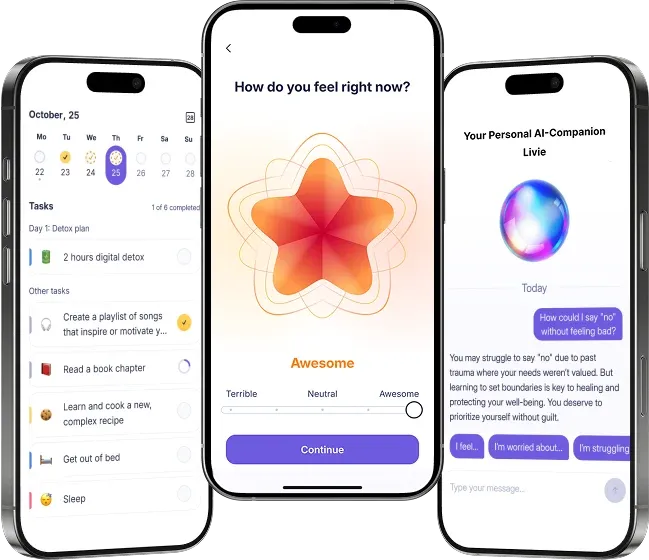
The first step is to stop dismissing it and start tracking it. How often does it happen? How intense is it? Does it follow a pattern? You can go analog and use a diary or try an app like Liven to track your mood and jot down your thoughts. This adds context over time, so you start to see patterns you'd otherwise miss.
Another idea is to take scientifically validated mental health assessments. They’ll give you a clear snapshot of where you are in terms of anxiety, stress, and overall well-being.
Take Back Your Sunday
Sunday scaries can affect your mood with friends, your ability to rest, and your outlook going into the new week. But small, consistent changes to how you spend the day can shift the whole tone of your week. Start with this simple checklist, your next Sunday night:
✅ Finish chores before Sunday evening
✅ Pack your bag and lay out your Monday outfit
✅ Set your alarm ten minutes earlier than usual
✅ Write down your top three tasks for Monday
✅ Play five minutes of calming audio before sleep
And for an extra boost, plan something small to look forward to on Monday night. This can be a favorite meal, a show you've been saving, or anything that makes Monday feel a little less like Monday.
References
- Peng, Z., Sethi, H., Xue, H., Hu, J., Kolks, L.A.G., & Desmet, P.M.A. (2025, July). When Sunday feels blue: A phenomenological study of the "Sunday Blues." Delft University of Technology.
- Levy-Gigi, E., & Shamay-Tsoory, S. (2022, December 29). Affect labeling: The role of timing and intensity. PLOS One, 17(12), e0279303.
- Riegel, B., Barbaranelli, C., Stawnychy, M.A., Matus, A., & Hirschman, K.B. (2024, August). Does self-care improve coping or does coping improve self-care? A structural equation modeling study. Applied Nursing Research, 78, 151810.
FAQ: Sunday Scaries
How do I get rid of Sunday scaries for good?
Why do I feel anxious every Sunday evening, even when work is fine?
Does a to-do list actually help with Sunday night anxiety?
How do I build a Sunday night routine that helps me sleep?
Can self-care on Sunday afternoon really reduce work anxiety?
What do I do when Sunday anxiety hits in the last hours of the weekend?
When should I worry that Sunday anxiety is actually depression?