



You finally decide to try meditation. You close your eyes and focus on your breath, but your heart races, and a memory surfaces. You open your eyes, hands shaking. Was meditation supposed to help? If you've ever tried meditation and felt worse coming out of it, this probably means that the practice wasn't built for what you've been through.
Trauma-sensitive mindfulness is a more careful version of standard mindfulness practice. It's shaped for people who've been through hard things or whose nervous systems can get overwhelmed when attention turns inward. The core practices stay the same, with extra attention to pacing, choice, and emotional safety.
Key Learnings
- Around 70% of people globally have experienced at least one traumatic event, yet most mindfulness programs were never designed with them in mind.
- Trauma lives in the body as sensation, muscle tension, and a nervous system that learned to stay on alert long after the danger passed.
- Trauma-sensitive mindfulness sits well alongside trauma treatment as a support, while trauma-focused therapies like TF-CBT, EMDR, and CPT carry the strongest evidence for directly easing trauma symptoms.
When The Body Reacts Differently
Most meditations assume that your body is a safe place to return to. For people carrying unresolved trauma, turning inward by slowing down, scanning the body, and sitting in silence can feel threatening rather than calming.
Traumatic memories live in the nervous system as sensations, sounds, smells, and reflexive fear. Dr. David Treleaven, founder of the Trauma-Sensitive Mindfulness Community and author of Trauma-Sensitive Mindfulness, explains that people struggling with trauma may find that distressing thoughts, memories, or body sensations become more noticeable. This can happen because mindfulness reduces distraction and avoidance, which can bring previously avoided material into awareness.
In standard meditation, you're told to follow whatever feels most present. For people with trauma history, that often means circling back to difficult memories or sensations without the tools to handle them safely.
Trauma-Focused, Trauma-Sensitive, and Trauma-Informed Mindfulness
Trauma-focused therapies like EMDR and Prolonged Exposure are structured treatments that work directly with traumatic memories to reduce their emotional weight over time.
- Trauma-sensitive mindfulness has a different aim: helping people stay grounded and present with their experience without getting overwhelmed, especially when internal sensations or emotions feel intense.
- Trauma-informed mindfulness is a broader framework in which the practice or teacher recognizes that trauma is common and shapes the space and instructions around safety, choice, and regulation.
A practical example: A trauma-informed yoga class might give you a choice in how you do each pose. In therapy, a trauma-sensitive approach might pace the work carefully, help you stay inside your window of tolerance, and lean on grounding strategies to keep you steady.
4 Principles That Make Mindfulness Trauma-Sensitive
There are a few key principles that distinguish trauma-sensitive mindfulness from standard practice:
1. Multiple anchors of attention
Trauma-sensitive practice doesn't default to breath work. Instead, it invites you to explore different anchors, such as the soles of your feet, sounds in the room, or a nearby object. The goal is to find what feels stable for you. This matters because the breath isn't neutral for everyone. Your breath and your autonomic nervous system are in constant two-way conversation. Depending on your rhythm, your context, and how you read the moment, breathing can tip you toward activation or toward calm. That means that focusing on breathing can activate the body rather than calm it.
2. The "Goldilocks principle" for practice intensity
Dr. Treleaven advocates a Goldilocks approach to mindfulness: more isn't always better, and adverse effects show up in a meaningful share of meditators, especially in unguided or high-intensity practice.
When you know you can slow down, pause, or stop if something feels overwhelming, mindfulness practice becomes safer and easier to come back to. Trauma-sensitive mindfulness is built on that idea: you stay in charge of how you meet discomfort.
3. The window of tolerance
The window of tolerance is the range where you can feel emotions without getting swept under or going numb. Inside this window, your nervous system is settled enough to think clearly, feel what you're feeling, and respond with some flexibility. Trauma-sensitive practices are built to help you stay in that range and notice when you're starting to drift out, so you can find your way back.
When you move outside your window, it can show up in two directions: too much (alertness, anxiety, racing thoughts, sometimes called hyperarousal), or too little (numbness, fogginess, disconnection, called hypoarousal). How these states feel and look varies a lot from person to person.
4. Choice is part of the practice
In standard mindfulness, structured instructions guide your attention so you can notice what's happening in the present more clearly. In trauma-sensitive mindfulness, a core piece is restoring your sense of choice and control. You're invited to adapt, pause, or modify the practice as needed, so you can stay within a level of activation you can manage. This matters especially for people who've been through situations where their sense of agency or control was taken from them.
5 Trauma-Sensitive Practices
Eyes-open awareness
Sit comfortably and let your gaze soften at the floor or a neutral surface in front of you. Notice what you see, hear, and feel without closing off the room. This keeps you anchored in the present without the vulnerability of darkness.
Orienting practice
Slowly look around the room. Name what you see. This activates the orienting response in your nervous system, telling your brain that this space is safe right now. This practice takes about 60 seconds.
Feet-on-the-floor grounding
Before any meditation, spend two minutes pressing your feet firmly into the floor. Notice the weight of your body. Bringing attention to physical sensations, like your feet on the floor or your back against the chair, can anchor you in the present moment and help your system settle when you feel activated. It's a common grounding practice that works well before turning your attention inward.
Compassionate self-check-ins
Instead of asking, "What am I feeling?" (which can feel threatening), try, "What's happening in my body right now?" Shifting from emotional to physical language is often less activating for people who have experienced trauma.
Exit strategy
Before starting any practice, remind yourself, “I can stop at any time. I can open my eyes. I can stand up.”
Clearing Up Myths About Trauma-Sensitive Mindfulness
Myth #1
🔴 "Trauma-sensitive mindfulness isn’t only for people with a PTSD diagnosis."
Difficult childhoods, grief, burnout, or relationship wounds can leave the nervous system sensitized. TSM is relevant for anyone who notices that standard mindfulness sometimes makes them feel worse rather than better.
Myth #2
🔴 "Trauma-sensitive doesn’t mean trauma-free."
TSM doesn't promise that uncomfortable feelings won't arise. It promises that you won't be left alone with them. The emphasis on choice, pacing, and self-compassion gives you tools to work with whatever surfaces.
Myth #3
🔴 "Trauma-sensitive mindfulness can replace trauma-focused therapy."
Trauma-sensitive mindfulness has a different role than trauma-focused therapies like EMDR or Prolonged Exposure. It's designed to support regulation, grounding, and safety during mindfulness practice, especially for people carrying trauma histories.
Present-centered and stabilization-focused approaches for PTSD have shown benefits, with sometimes lower dropout rates than more exposure-based treatments. Trauma-focused therapies are still the most strongly supported approach for directly reducing PTSD symptoms.
Choose a Gentler Path to Healing
Recovery isn't linear, and no single practice works for everyone. If you've struggled with conventional mindfulness, knowing that a trauma-sensitive alternative exists can shift the whole picture. You deserve a practice that meets you where you are.
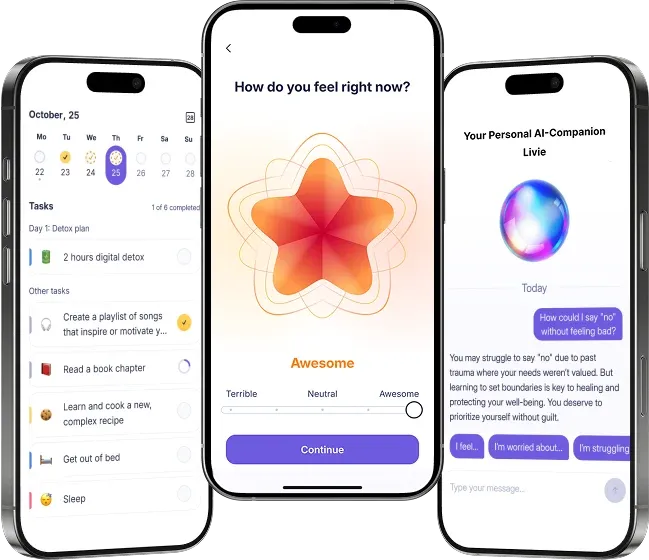
If you'd like a starting point shaped around what you're carrying right now, Liven's short quiz puts together your personalized well-being management plan with daily check-ins to support the work as it unfolds.
References
- Boyd, J. E., Lanius, R. A., & McKinnon, M. C. (2017). Mindfulness-based treatments for posttraumatic stress disorder: A review of the treatment literature and neurobiological evidence. Journal of Psychiatry and Neuroscience, 43(1), 7 to 25. https://doi.org/10.1503/jpn.170021
- Global Collaboration. (n.d.). Global prevalence of trauma. https://www.global-psychotrauma.net/global-prevalence-of-trauma
- Guo, L. (2023). The delayed, durable effect of expressive writing on depression, anxiety and stress: A meta-analytic review of studies with long-term follow-ups. British Journal of Clinical Psychology, 62(1), 272 to 297. https://doi.org/10.1111/bjc.12408
- Han, H., Miller, H. N., Nkimbeng, M., Budhathoki, C., Mikhael, T., Rivers, E., Gray, J., Trimble, K., Chow, S., & Wilson, P. (2021). Trauma informed interventions: A systematic review. PLoS ONE, 16(6), Article e0252747. https://doi.org/10.1371/journal.pone.0252747
- Treleaven, D. A. (2018). Trauma-sensitive mindfulness: Practices for safe and transformative healing. W. W. Norton & Company.
- Van Dam, N. T., Targett, J., Davies, J. N., Burger, A., & Galante, J. (2025). Incidence and predictors of meditation-related unusual experiences and adverse effects in a representative sample of meditators in the United States. Clinical Psychological Science. https://doi.org/10.1177/21677026241298269
FAQ: Trauma-Sensitive Mindfulness
Can I practice trauma-sensitive mindfulness without a therapist?
How is TSM different from regular meditation apps?
What if I don't know whether I have trauma?
Is TSM a form of therapy?
How long before it feels easier?
What's the best anchor to start with if breath feels uncomfortable?
Can TSM be practiced alongside other trauma treatments like EMDR or therapy?