5 Therapist-Approved Mood Tracker Apps to Know Yourself Better



Your mood affects everything: your decisions, relationships, energy, and how you show up every day. Yet most of us only start paying attention to it when something is off with our mental health.
A 2021 study found that most people turn to mood tracking apps during stressful or difficult periods. While the apps help, many fall short because they collect data without helping you make sense of it.
So we dug deeper. Here are our top mood-tracking apps that go beyond just logging how you feel. Some of these apps help you spot patterns and identify triggers, and others go a step further with additional features to help you improve your mood.
The Best Mobile Mood Tracking Apps at a Glance
| App | Best for | Best feature | Price |
| Liven | Anxiety, emotional overwhelm, overthinking | AI companion Livie + full well-being toolkit | From $7.99/week |
| eMoods | Bipolar disorder, depression, PTSD, anxiety | Shareable PDF reports for doctors | Free, up to $100/year |
| Moody Month | Women tracking hormonal mood patterns | Cycle-linked mood and symptom tracking | ~$9/month |
| PTSD Coach | Veterans and anyone managing PTSD | Symptom-triggered coping techniques | Free |
| How We Feel | Anyone wanting a simple, science-backed tool | Emotion vocabulary building | Free |
Here's a closer look so you know what each mood tracking app offers, including key features and how they help calm your mind:
1. Liven
Best for: Anxiety, emotional overwhelm, overthinkers, and anyone stuck in patterns they can't seem to break, or looking to reduce anxiety over time.
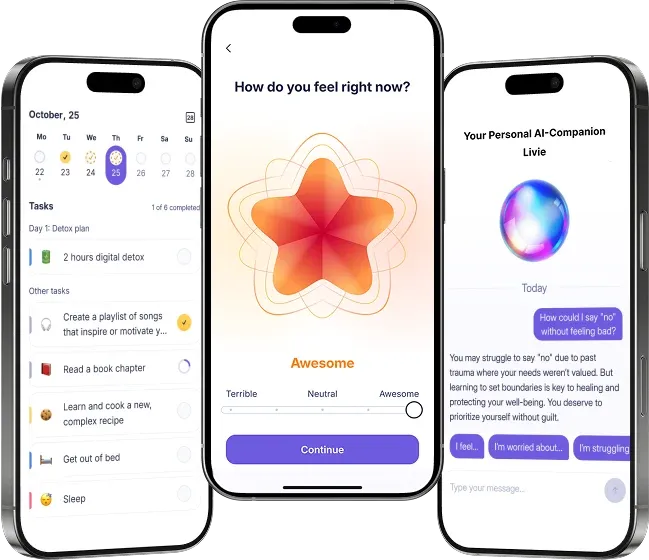
Most of us know something's off before we can explain why. Liven gives you a place to start figuring out your emotional patterns. Simply log how you're feeling, add a little context, and over time, the app starts connecting the dots you couldn't see on your own.
But it doesn't stop at mood tracking. The app is a full well-being toolkit built with licensed therapists, using the same frameworks used in actual clinical sessions — CBT, ACT, positive psychology, and more. Every feature connects back to your mood data, turning what you log into something you can learn from and act on.
Liven Features
- Mood tracker: Log how you feel with context so you can spot what actually triggers you over time
- Journal: Brain-dump your thoughts to break the overthinking loop and process emotions without judgment
- AI companion (Livie): Talk or text through feelings anytime for support, validation, and a fresh perspective on your mental health patterns
- Personalized journey: Get short therapy lessons tailored to your mental health and wellness goals
- Mental tests: Track anxiety, stress, and emotional health with science-backed assessments that show real progress
Liven Pros
- Built on therapy frameworks that clinicians actually use in sessions
- Connects mood data to actionable next steps, not just visualizations
- Helps you name feelings, patterns, and triggers you've avoided or ignored
- Gives you practical ways to challenge anxious thoughts and reframe self-talk.
Things to Consider with Liven
- Takes consistency over weeks to see results
- Can feel intense if you're looking for something lightweight
Liven Pricing
- Liven Weekly: $7.99
- Includes a free trial.
2. eMoods
Best for: People managing bipolar disorder.
Living with bipolar disorder means your mood doesn't just dip — it swings, and the distance between your highs and lows can be hard to explain to anyone, including your doctor. eMoods was built specifically for that gap. It gives you a structured way to log your daily highs and lows, sleep, irritability, and symptoms.
What sets it apart is the shareable PDF report you can send directly to your therapist or psychiatrist before appointments. Instead of trying to recall how you felt three weeks ago, your therapist gets a clear picture of your patterns, triggers, and medication responses.
eMoods Features
- Mood tracker: Log daily highs and lows, and add notes for context
- Medication tracker: Record medication changes and responses alongside other symptoms to help your doctor make adjustments
- Downloadable reports: Generate and share PDF reports with your healthcare provider before appointments
- Charts and visualizations: Use color-coded monthly calendars and graphs to track patterns and triggers over time
eMoods Pros
- Built specifically for bipolar disorder
- Shareable reports make doctor visits more productive
Things to Consider with eMoods
- Only logs mood once per day. It doesn't capture intraday fluctuations
- Full feature set requires a premium subscription.
eMoods Pricing
- Free plan
- Enhanced: $50/year or $5/month
- Pro: $100/year or $10/month
3. Moody Month
Best for: Women who want to understand how their hormones, menstrual cycle, and environment affect their mood.
Ever feel off and have no idea why, only to realize your period is three days away? Moody Month is built around that connection. It tracks your menstrual cycle phases alongside your mood, symptoms, and physical stats to show you how your hormones are actually driving how you feel day to day.
But it goes beyond cycle tracking. Moody Month factors in hormonal shifts across life stages — menstruation, pregnancy, postpartum, and perimenopause — and pairs that with expert guidance on nutrition, movement, and mindfulness tailored to where you are in your cycle. It even tracks moon phases, sex drive, and cramp logs if you want the full picture of your emotional well being.
Moody Month Features
- Cycle tracker: Log menstrual phases and physical stats to connect hormonal patterns to your mood
- Mood and symptom tracker: Track daily moods and symptoms across your cycle and life stages
- Hormone education: Articles and resources covering mood, hormones, and women's health across all life stages
- Memo and cramp log: Add daily notes, track cramps, and monitor sex drive for a complete picture
Moody Month Pros
- One of the few mood trackers built specifically around women's biology
- Connects mood patterns to hormonal phases rather than treating them in isolation
- Covers multiple life stages beyond just menstruation
Things to Consider with Moody Month
- Limited to women and those who menstruate
- No AI companion or therapy-based features
Moody Month Pricing
- Limited-feature free plan
- Paid plans start at approximately $9/month
4. PTSD Coach
Best for: Veterans, military service members, and anyone managing PTSD symptoms.
PTSD is a serious mental health condition — and most apps aren't built for it. PTSD Coach was developed by the U.S. Department of Veterans Affairs and the Department of Defense specifically to help people understand their trauma responses, track symptoms, and find ways to cope in the moment.
It's not a general wellness app. Every feature is designed around PTSD — from symptom tracking that suggests coping and relaxation techniques based on what you're experiencing, to a safety plan for crisis moments.
PTSD Coach Features
- Symptom tracker: Log distress levels and receive a coping technique based on what you're experiencing
- Relaxation tools: Guided breathing exercises, visualization, muscle relaxation, and sleep tips
- Self-help strategies: Positive self-talk, anger management, and other evidence-based coping tools
PTSD Coach Pros
- It's completely free, no in-app purchases, no subscriptions
- Covers symptom tracking, coping tools, and crisis support in one place
- Available in English and Spanish
Things to Consider with PTSD Coach
- Content is heavily geared toward military service members, and may feel less relatable for civilian users
- Doesn't track mood broadly as its focus is on PTSD symptoms
PTSD Coach Pricing
- Free to use.
5. How We Feel
Best for: Anyone who wants a simple, science-backed way to understand and regulate their emotions.
How We Feel is a nonprofit, cofounded by Ben Silbermann of Pinterest and backed by Dr. Marc Brackett's team at the Yale Center for Emotional Intelligence. The app starts with a simple mood tracker. But where it stands out is in how it builds your emotional vocabulary over time.
Pair that with science-backed regulation strategies and breathing exercises, and you have a tool that's genuinely rooted in how emotion science works — not just wellness trends. It's also completely free and stays that way through donations, which is rare for an app this well-built.
How We Feel Features
- Mood check-in: Log your emotions regularly to build self-awareness and track patterns over time
- Emotion vocabulary: Learn precise words to describe how you feel — beyond just "good" or "bad”
- Regulation techniques: Practice simple, science-backed strategies to manage emotions in the moment
How We Feel Pros
- Completely free
- Built by mental health experts, not a commercial wellness team
- Teaches you to understand what you feel, not just record it
Things to Consider with How We Feel
- Limited features for users managing clinical conditions
- Less comprehensive than full-scale well-being apps
How We Feel Pricing
- Free to use.
Start Tracking Your Mood Today
The hardest part is just starting. Pick one app, check in for a week, and see what comes up. You don't need to overhaul your routine. Just a minute a day of paying attention to how you feel adds up over time.
And if you want more than just a log — something that helps you improve your overall emotional wellness, then Liven is worth a look.
References
- Schueller, S. M., Neary, M., Lai, J., & Epstein, D. A. (2021). Understanding people's use of and perspectives on mood-tracking apps: Interview study. JMIR Mental Health, 8(8), e29368.
FAQ: Best Mood Trackers
What app features should I look for in a mood tracking app?
Do therapists recommend mood tracking apps?
Are mood tracking apps useful for specific mental health conditions?
What's the difference between a mood tracker and a journal app?
How long does it take to see results from mood tracking?
Can mood tracking apps replace professional mental health care?