How Your Posture Can Influence Your Mood




When anxiety or fatigue continues even after you’ve tried to manage it, it’s natural to look for possible reasons. Sleep and diet are often the first places people look, and they do matter. At the same time, a quieter, often-overlooked factor may also be contributing: your posture.
This might feel unexpected. Beyond physical discomfort like back pain, the way you hold your body can influence how you feel and behave over time. Many people try to correct their posture briefly, only to slip back into a slouched position without noticing.
Your body constantly sends signals to your brain, shaping your breathing, stress response, and mood.
In this article, we’ll explore how posture affects your mood, the science behind that connection, and some practical, manageable ways to start improving it.
Key Learnings
- Slouching can compress the diaphragm, the main muscle used for breathing, and may reduce lung capacity by up to 30%, which often leads to shallower breathing.
- Shallow breathing tends to switch on the stress response and can leave you feeling more anxious.
- The relationship between body and mind works both ways: emotions can influence posture, and posture can influence emotions.
- Sitting or standing more upright has been linked to higher self-esteem, greater alertness, and a more positive emotional state under stress
- Small posture adjustments made throughout the day can lead to noticeable shifts in mood over time.
Link Between Posture and Mood
In psychology, there’s a concept called embodied cognition, which holds that the body doesn’t merely reflect emotions; it can also shape them. Your brain is constantly reading signals from your body, including your posture, and using them to influence how you feel.
In one study, people sat either upright or slouched during a stressful task. Those sitting upright felt more capable and engaged, while those slouched felt more low, passive, and uneasy.
Those in a slouched position also used more negative language in their speech. This suggests that the brain may treat posture as a signal and respond emotionally accordingly.
The Posture-Breathing-Mood Chain
When you slouch, your chest folds inward, and your abdomen gets compressed, which can slightly narrow how far your diaphragm moves in some positions. Because the diaphragm needs space to move downward with each inhale, the body often shifts to shallow, chest-based breathing without you noticing.
Slouched posture has also been linked to reduced lung capacity, which can place more strain on the body and trigger a stress response, including an increase in cortisol. Higher cortisol levels are associated with anxiety, fatigue, and low mood.
In simple terms, slouching can lead to shallow breathing, which the body may interpret as stress, gradually raising cortisol and lowering mood. This matters because shallow breathing is also common in anxiety, creating a loop where posture and breathing reinforce that state. Over time, staying in this pattern may keep the body in a low-level stress response, even when there isn’t an immediate trigger.
What Slouching Can Do Over Time
The shift into a slouched posture usually happens slowly. Over hours spent at a desk or looking at a screen, the shoulders move forward, the chin juts out, and the natural curve of the lower back begins to flatten. It’s rarely a conscious choice, and it tends to build up gradually.
People often notice the physical effects of this, but the emotional and mental impact is easy to miss.
- Feeling low on energy without a clear reason.
- A subtle, lingering sense of unease.
- Finding it harder to think clearly or stay focused.
- A quiet negative mood that seems to come out of nowhere.
When your body settles into a slumped posture along with shallow breathing, it can be associated with feelings of sadness. In the same way, gently adjusting your posture and breathing may help shift your emotional state.
This can become a feedback loop. Feeling low can lead to more slouching, and slouching can deepen that low feeling. One way to begin interrupting this cycle is to start with small physical changes rather than trying to shift your thoughts first.
How Posture Can Influence What Your Mind Focuses On
The calming of the stress response is only one part of the picture. Sitting or standing more upright can also influence the kind of thoughts your mind tends to access.
One study found that a slouched posture made it easier for people to recall negative memories, while an upright posture helped them access more positive ones. This suggests that posture may not only affect mood but also make it harder or easier to bring to mind experiences that could shift how you feel.
This is an important insight, as many people try to improve a low mood by working only at the level of thoughts: through reframing, positive self-talk, or searching for reasons to feel better.
Those approaches can be helpful, but they can also feel slow, especially when your nervous system is already stressed or low. Starting with the body can sometimes be a more direct and supportive entry point. When you gently adjust your posture, your mind may begin to follow more easily.
Simple Posture Resets You Can Try During Your Day
These don’t require special equipment or a strict routine. They’re small adjustments you can gently fit into your existing day.
1. Set a 30-minute check-in
You might use a timer or a recurring reminder. When it goes off, simply notice your posture. Where are your shoulders? Is your chin drifting forward? What’s happening in your lower back? Awareness comes first, as it’s hard to change something you haven’t noticed yet.
2. Open up your chest
Gently draw your shoulders back and down, allow your chest to open, and take three slow breaths from your belly. This can help counter the forward, collapsed posture that often develops during long periods of screen time.
3. Try a chin tuck
Softly bring your chin back so your head is better aligned over your shoulders, rather than leaning forward. Forward head posture is one of the common reasons breathing can feel restricted.
4. Adjust your setup
- Keep your feet flat on the floor
- Position your screen at eye level so your head doesn’t naturally drift forward
- Adjust your chair so your hips are at or slightly higher than your knees
Your environment often shapes your posture without you realizing it. Making small adjustments here can reduce the need to constantly remind yourself.
5. Use your breath as a reset
Taking one slow, deep breath into your belly can signal your body to relax (this is linked to the parasympathetic nervous system, which helps the body settle). It can act as both a posture reset and a gentle way to reduce stress in the moment.
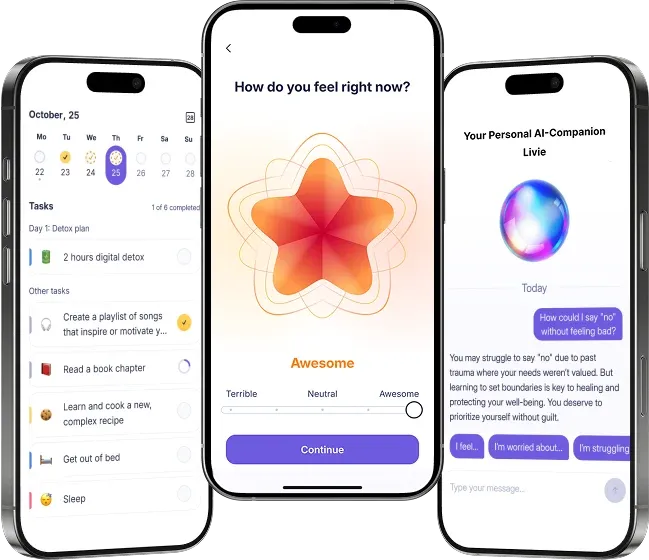
If you’re curious whether these small shifts are affecting your mood, you might try using Liven's Mood Tracker to see how you feel before and after. Over time, patterns can become easier to notice when you record them consistently.
Building Awareness of Your Body as Part of Understanding Your Emotions
Emotional awareness lives in your body as much as your mind. Sensations and posture can reflect emotional shifts alongside what you're thinking. Paying attention to these early signals and treating your physical state as useful information can support your posture and mental health. Your posture can reflect how you’re feeling, sometimes before you’ve found the words.
Over time, this awareness can shape your sense of posture and confidence. The way you hold your body can influence how steady or self-assured you feel. Pairing this with journaling can help you notice patterns more clearly, as both the body and mind are often telling the same story.
📝 Additional Resources
- Amy Cuddy's TED Talk "Your Body Language May Shape Who You Are": A research-backed look at how the posture you hold can shift your confidence, stress levels, and emotional state, directly relevant to everything covered in this article.
- Breath by James Nestor: This book explores how our breathing shapes our health, mood, and nervous system, making it a natural companion to the breathing sections of this piece.
- The Body Keeps the Score by Bessel van der Kolk: A deeper exploration of how physical states and emotional experiences are more closely connected than most people realize, grounding the body-mind link in broader scientific research.
References
- Awad, S., Debatin, T., & Ziegler, A. (2021). Embodiment: I sat, I felt, I performed – Posture effects on mood and cognitive performance. Acta Psychologica, 218, 103353. https://doi.org/10.1016/j.actpsy.2021.103353
- Cattaneo, D., Pellegri, A., De Marchis, C., Carozzi, F., Trecate, F., D'Anna, C., & Schmid, M. (2024). Breathing, postural stability, and psychological health: a study to explore triangular links. Frontiers in Bioengineering and Biotechnology, 12, 1347939. https://doi.org/10.3389/fbioe.2024.1347939
- Ganesh, B. R., & Tomy, C. (2022). Effect of upright and slouched postures on the diaphragm strength and chest expansion in obese young adults – an observational study. Indian Journal of Physical Therapy and Research, 4(2), 155–158. https://doi.org/10.4103/ijptr.ijptr_26_22
- Lin, P., Tien, Y., Kang, L., & Hsu, L. (2026). Stand tall, think bright: How embodied experience unlocks the power of posture in emotion regulation. Acta Psychologica, 263, 106351. https://doi.org/10.1016/j.actpsy.2026.106351
FAQ: How Posture Affects Mood
Is there a helpful time of day to focus on posture?
Can posture influence how others perceive you emotionally?
Can posture affect sleep quality?
Does exercise fix poor posture permanently?
Can posture affect children’s mood?
Does posture matter only when sitting?