Brainway Reviews: What to Know Before You Subscribe




You've been thinking about it for a few weeks. The Brainway ad shows up between meetings, before bed, in the middle of trying to do something else. It promises sharper focus, less procrastination, and a more disciplined version of you. Tonight, you finally tapped through to read the reviews.
Below, we look at how Brainway works, what it costs, how it holds up for people with ADHD, the patterns in its user reviews, and how it compares with Liven, a self-discovery companion.
Key Learnings
- Brainway combines brain-training exercises, courses, and habit prompts to support mental clarity, focus, and personal growth.
- The app suits people who like gamified, bite-sized learning, though the variety of content can feel overwhelming for some users.
- Brainway is free to download with limited free content. Premium unlocks the full library of courses, exercises, and tools.
- For more integrated mental and emotional support, Liven offers a structured well-being plan with mood tracking, journaling, and an AI companion alongside daily activities.
Brainway App Review
Here's what to expect after downloading and launching the Brainway app.
Onboarding & First Impressions
The app greets you with a warm, illustrated interface and walks you through a quiz about your goals, current mental state, and areas you want to work on. You'll select interests across categories like focus, anxiety, productivity, sleep, relationships, or self-discovery.
Brainway uses your answers to recommend a personalized starting course or learning track. From there, it prompts you to choose a subscription tier to unlock the full content library.
Brainway Pricing
The free version of Brainway gives you access to a small set of starter content. You'll need a premium subscription for:
- The complete library of courses, exercises, and brain-training games
- Personalized recommendations and tracking
- Advanced challenges and journeys
- Audio sessions and longer-form content
Brainway currently runs at $14.99 per month or $89.99 per year (about $7.50 per month when billed annually). Promotional pricing may appear during the onboarding flow, with steeper discounts on longer subscription terms.
A note worth knowing before you sign up: Brainway has drawn user complaints about billing transparency on Trustpilot and across App Store reviews. The most common issues are: subscriptions auto-renewing without clear notice, no cancel option in the Brainway app itself (users have to cancel through Apple ID or Google Play subscription settings, or contact [email protected]), and users being charged for lifetime plans that turned out to be recurring.
Note: Pricing details may change over time. For the most up-to-date information, check Brainway's official site, the App Store listing, or your device's subscription settings.
The Behavioral Science Behind Brainway
Brainway is built on a simple premise: small mental exercises done consistently can sharpen focus, steady your emotions, and build self-awareness over time. The approach draws on cognitive science and behavioral psychology.
The day-to-day experience leans on short lessons, gamified progress, and quick feedback that keeps users coming back. The goal is to make personal growth feel approachable enough to sustain across busy weeks.
Brainway App Features & Day-To-Day Experience
- Daily learning sessions: Short, themed lessons on topics like focus, anxiety, motivation, communication, and self-awareness. Each session takes 5 to 15 minutes.
- Brain-training games and exercises: Cognitive challenges designed to build attention, memory, and reasoning. The gamified format makes it feel less like work.
- Personalized tracks: Based on your quiz and goals, Brainway builds a recommended path through courses and exercises rather than dropping you into a generic library.
- Progress tracking: Visual feedback on streaks, completed sessions, and skill development over time.
- Mood and reflection prompts: Some versions include light mood check-ins and journaling-style reflections built into the daily flow.
Repeating actions in a consistent context strengthens habit automaticity, which is part of why daily-prompt apps work better than weekly ones for many people.
Brainway App for ADHD & Neurodivergence
Brainway's short, focused sessions can suit people with ADHD who find longer learning formats hard to stick with. Bite-sized content lowers the upfront cost of getting started, and gamified rewards can offer the kind of quick feedback that helps build momentum.
That said, some reviewers note that information overload and trouble keeping track of subscription dates or renewal reminders can be especially challenging for users with attention-regulation difficulties. The same gamified design that draws people in might also pull focus when the interface gets visually crowded.
As we cover in our article on approaches for better managing adult ADHD, the right tool is the one you'll actually keep using. Personal preference and ease of use matter as much as the feature list when it comes to building a habit that lasts.
Strengths
- Some users report increased focus, better emotional awareness, and stronger habits after a few weeks of consistent use.
- The app's friendly design feels approachable for beginners.
- Bite-sized lessons make it easy to start, even on busy days.
- The gamified format adds momentum and keeps engagement steady.
- The personalized starting track means you don't have to figure out where to begin on your own.
Things to Consider
- The free tier is limited, and most users will need a premium subscription to unlock the full content library.
- The breadth of content may take time to navigate, especially for users who prefer a tighter, more focused learning path.
- The specific research base isn't always presented alongside the content in the app or marketing materials.
- The app focuses on individual exercises and brain-training games rather than long-term mood or pattern tracking, which suits some users better than others, depending on their goals.
Should You Download or Subscribe?
Anyone who wants short daily lessons, gamified progress, and a friendly entry point into self-development may find Brainway a useful starting place. The mix of brain-training exercises, learning content, and habit prompts can build momentum during a season when self-improvement feels appealing but hard to start.
On the other hand, Brainway may not fit if you want deeper mood and pattern tracking, an integrated mental health framework, or support that pairs with therapy.
If you want a holistic framework that connects daily routines with mental and emotional wellness, consider exploring Liven for:
- Personalized programs grounded in CBT, ACT, DBT, and positive psychology
- Mood Tracker and Mood Breakdown
- Journal with structured prompts
- 24/7 validation and emotional support via Livie, the AI companion
- Daily activities through Today's Routine
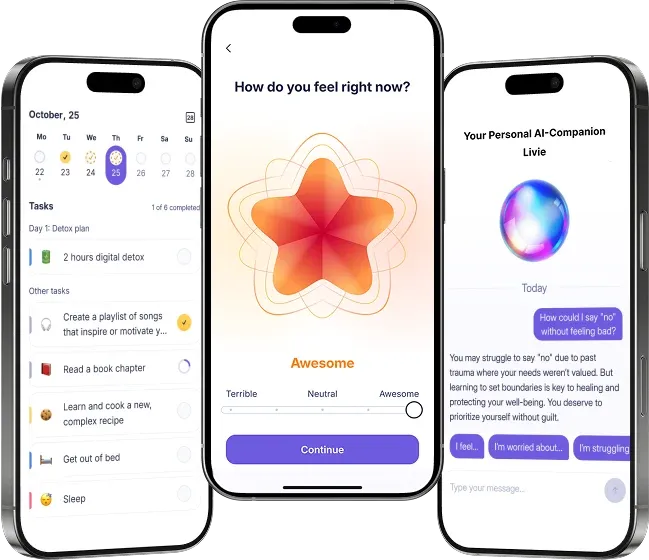
Brainway vs. Liven
Here's a side-by-side look at how Brainway and Liven compare on the things that matter most before you subscribe:
| Category | Brainway | Liven |
|---|---|---|
| Core idea | Daily brain-training exercises, gamified courses, and self-development tracks focused on procrastination, focus, and productivity | A personalized well-being plan combining therapy-informed programs, mood tracking, journaling, and a smart companion for daily emotional support |
| Best for | People who want a gamified, productivity-focused tool with bite-sized learning | People who want an integrated mental well-being plan with daily emotional support |
| Free vs. paid | Free download with limited starter content. Premium unlocks the full course library, personalized tracks, and advanced tools | Free resources available. Paid plans unlock assessments, programs, journaling, an AI companion, and tailored daily routines |
| Pricing | $14.99 per month or $89.99 per year (about $7.50/month annualized), with promotional pricing during onboarding | Subscription prices range from $7.99/week to $89.99/year, depending on your subscription type, region, and device |
| Cancellation | Cancel through Apple ID or Google Play subscription settings, or by emailing [email protected] | Cancel directly from in-app settings anytime, or through Apple ID or Google Play subscription settings |
| Scientific backing | Based on cognitive science and behavioral psychology principles, with content developed by the company's content team | Programs grounded in CBT, ACT, DBT, and positive psychology, developed with Liven's Board of Health Professionals |
| Core features | Daily lessons, brain-training games, personalized courses, mood and feelings logging, progress tracking, and gamified streaks | Journey (CBT/ACT/DBT programs), Mood Tracker, Journal, Today's Routine, Sounds library, Livie Smart Companion, Mental Tests |
| Getting started | Onboarding quiz, recommended starting course, then subscription prompt | An onboarding quiz that generates a personalized well-being management plan, with daily check-ins from day one |
The best tool fits the life you have. Liven's short quiz puts together your personalized well-being management plan shaped around what you're carrying right now, with daily check-ins to make the work easier to come back to on hard weeks.
Sources
- Apple App Store. (2026). Brainway: Boost productivity—Ratings & reviews. Retrieved May 26, 2026, from https://apps.apple.com/us/app/brainway-boost-productivity/id6450369743?see-all=reviews&platform=iphone
- Buabang, E. K., Donegan, K. R., Rafei, P., & Gillan, C. M. (2024). Leveraging cognitive neuroscience for making and breaking real-world habits. Trends in Cognitive Sciences. https://www.sciencedirect.com/science/article/pii/S1364661324002663
- Singh, B., Murphy, A., Maher, C., & Smith, A. E. (2024). Time to form a habit: A systematic review and meta-analysis of health behaviour habit formation and its determinants. Healthcare, 12(23), 2488. https://pmc.ncbi.nlm.nih.gov/articles/PMC11641623/
- Trustpilot. (2026). Brainway reviews. Retrieved May 26, 2026, from https://www.trustpilot.com/review/brainway.app
- Wasil, A. R., Venturo-Conerly, K. E., Shingleton, R. M., & Weisz, J. R. (2019). A review of popular smartphone apps for depression and anxiety: Assessing the inclusion of evidence-based content. Behaviour Research and Therapy, 123, Article 103498. https://doi.org/10.1016/j.brat.2019.103498
FAQ: Brainway Reviews
What is the Brainway app, and how does it help mental well-being?
Is the Brainway app free to use?
How much does the Brainway app cost?
What kind of exercises or programs does the Brainway app offer?
What makes Brainway different from other mental health apps?
Is the Brainway app a good fit for anxiety or stress management?
What do the premium features include?
How quickly can I see results with the Brainway app?
Is the Brainway app worth it?