The No Contact Rule: What It Is, How It Works, and What No One Tells You




You just went through a breakup. Your phone is right there. You know their number by heart. And every part of you wants to send a message that starts with "Hey, I was just thinking..."
This is the moment the no contact rule is designed for.
Not as a game. Not as a manipulation tactic. As a real, psychologically grounded way to give yourself the space your nervous system desperately needs to start healing.
Here is what it is, why it works, and what to expect when you try it.
Key Takeaways
- No contact is one of the most common ways people give themselves the space they need to heal after a breakup.
- It is not a strategy to make someone miss you. Its primary purpose is to help you heal.
- There is no magic number of days. The right duration is the one your nervous system needs.
- Men and women tend to experience and process breakups differently, which affects how the no contact rule lands for each.
- The clearest sign it is working is not that your ex comes back. It is that you stop needing them to.
What Is the No Contact Rule?
The no contact rule is a self-imposed period of zero communication with an ex-partner after a breakup. No texts, no calls, no checking their Instagram at 1 AM, no reaching out through a mutual friend to "just see how they're doing."
It sounds simple. Anyone who has tried it knows it is not.
The rule has a body reason behind it. A breakup runs through your nervous system, your hormones, and the brain circuits wired for attachment.
When a close relationship ends, the brain responds similarly to withdrawal from an addictive substance, with cortisol rising, dopamine dropping, and the reward system firing every time something reminds you of that person.
Maintaining contact, even casual contact, keeps that cycle running. Every text, every reply, every glimpse of their life online reactivates the very neural pathways you are trying to let quiet down. No contact is not cruelty. It is an interruption. And interruption is what allows the nervous system to finally begin resetting.
What Is the No Contact Rule in a Relationship Context?
In the context of a breakup, specifically, the no contact rule means creating a clean break from all communication channels for a defined period. It typically means:
- No texting or calling
- No watching their stories or liking their posts
- No emailing or DMing
- No showing up somewhere you know they will be
- No asking mutual friends for updates
It is worth being honest here: this is genuinely hard, especially if the relationship was long, if you share a social circle, or if you still have feelings that have not caught up with the decision to break up.
That difficulty is not a sign that something is wrong with you. Research shows that rumination, the repetitive mental replaying of a relationship, is one of the strongest predictors of delayed emotional recovery after a breakup. No contact is, in part, a way to reduce the daily inputs that feed that loop.
The Psychology Behind It: Why Distance Helps
Think about the last time you tried to stop thinking about something by trying very hard not to think about it. It does not work.
What does work is changing the conditions that keep triggering the thought in the first place.
When you stay in contact with an ex, every message is a data point your brain processes:
- What did they mean?
- Are they okay?
- Do they miss me?
- Are they moving on?
That's a heavy load to carry, in both head and heart, and it blocks the quieter work of grieving, adjusting, and eventually accepting that the relationship has ended.
A 2024 study on post-breakup distress confirmed that the frequency and nature of contact with an ex-partner directly influence how quickly and fully people adjust after a relationship ends. Less ongoing contact was consistently associated with better outcomes.
No contact creates the conditions where your nervous system can do what it is trying to do: process the loss and find a new equilibrium. You are not cutting someone off. You are giving yourself permission to grieve properly.
Not everyone can go fully no contact, especially when you share a social circle, a workplace, or a city with your ex. Dr. Maika Steinborn, a psychologist specializing in breakup recovery and attachment, breaks down what to do when a clean break is not possible:
How Long Is the No Contact Rule?
The most commonly cited number is 30 days, but there is no research behind it. What the research does tell us is that contact within the first weeks of a breakup slows the natural decline in feelings of love and sadness.
Beyond that, how long you need depends on factors no fixed number can account for:
- How long did the relationship last? A six-year relationship and a four-month relationship are not the same loss.
- How did the relationship end? A mutual, clean ending is different from betrayal or abandonment.
- Your attachment style. People with anxious attachment tend to feel breakup distress more intensely and may need more time.
- How much contact are you tempted to have? The pull itself is useful data.
The goal is not to hit a deadline. The goal is to reach a place where you are not outsourcing your emotional regulation to someone who is no longer your partner.
No Contact Rule in Female Psychology
Some research finds differences in how people express and report breakup distress, but those differences tend to track with culture and social expectation more than with sex on its own.
The clearest example: women report higher levels of rumination after a relationship ends,with more replaying of conversations, more analyzing of what went wrong, and more emotional processing in the short term. A lot of that comes from how girls are taught from a young age to process emotions out loud.
From the outside, it can look like more distress. From the inside, it's also more active processing, and that work tends to lead to a more complete emotional recovery over time.
For women, the no contact rule can be particularly challenging because of this ruminative tendency. Checking their ex's social media, reading old messages, or reaching out for closure can feel like processing, but it often keeps the rumination loop running rather than closing it.
No contact interrupts the loop. It forces the processing inward, which is where the real work happens. It is uncomfortable. It is also what moves things forward.
No Contact Rule in Male Psychology
Men tend to process breakups differently: more externally suppressed, more delayed in their emotional response. Research suggests men are more likely to distract rather than reflect in the immediate aftermath, which can look like they are handling things well when they are actually just postponing the grief.
This means that for men, the no contact rule can feel easier at first and harder later. The emotional reality of the loss often catches up somewhere in the second or third week, sometimes longer.
Men who maintain contact with an ex often do so as a way of keeping the door open without consciously intending to. The logic is something like: if we are still talking, the loss is not fully real yet. No contact closes that door, which can be confronting, but it is also what finally allows the emotional processing to begin.
The delayed nature of men's breakup grief is not weakness, and it is not indifference. It is a different timeline for the same process.
5 Signs the No Contact Rule Is Working
These are not about whether your ex is coming back. They are about whether you are starting to heal.
1. You stop reaching for your phone every few minutes. In the early days of no contact, the urge to check for a message or look at their profile can feel almost physical. When that pull starts to ease, something is shifting in the nervous system.
2. You start sleeping better. Elevated cortisol and an overactivated nervous system make deep sleep harder. As the acute stress of the breakup begins to settle, so does your sleep. This is one of the first physiological signs of recovery.
3. You feel something other than them. Curiosity about your own life. Enjoyment in something small. The ability to laugh without it feeling wrong. When your emotional range starts to expand beyond grief and longing, the no contact rule is doing its job.
4. The thought of reaching out stops feeling urgent. There is a difference between wanting to talk to someone and needing to in order to feel okay. When the thought shifts from urgent need to optional choice, that is real progress.
5. You start thinking about yourself more than the relationship. What do I want now? Who am I outside of this? What does my life look like going forward? When those questions start to feel interesting rather than terrifying, you are healing.
What No Contact Is Not
A few things are worth naming directly.
- It is not a strategy to make your ex miss you. You might have read that no contact triggers anxiety in an ex and makes them more likely to reach out. Maybe. But using no contact as a manipulation tool to provoke a reaction puts your healing in someone else's hands. That is the opposite of what it is supposed to do.
- It is not permanent by definition. No contact does not mean never speaking again. It means creating enough distance for both people to process the breakup independently. What happens after that is a separate conversation.
- It is not punishment. You are not punishing your ex by not reaching out. You are protecting your own nervous system. That is self-respect, not cruelty.
- It will not automatically fix your feelings. No contact creates the conditions for healing. You still have to do the work: processing grief, rebuilding routines, finding your way back to yourself.
When No Contact Is Especially Important
There are situations where no contact is not just useful but genuinely important:
- When the relationship was emotionally or psychologically harmful
- When the relationship ended without closure (through ghosting or a sudden disappearance)
- When your ex is struggling to accept the breakup, and contact is reinforcing their distress
- When you find yourself feeling worse after every interaction, even if the contact felt like comfort in the moment
What to Do During No Contact
No contact is not just about not contacting your ex. It is about what you do with the space that opens up.
- Let yourself grieve. Not performing is okay. Feeling the loss, in whatever form it takes, because grief that is not felt tends to find other ways out.
- Rebuild your nervous system. Breakups are physiologically stressful. Sleep, movement, time outside, and routines all signal safety to a nervous system that has been in a low-level threat state.
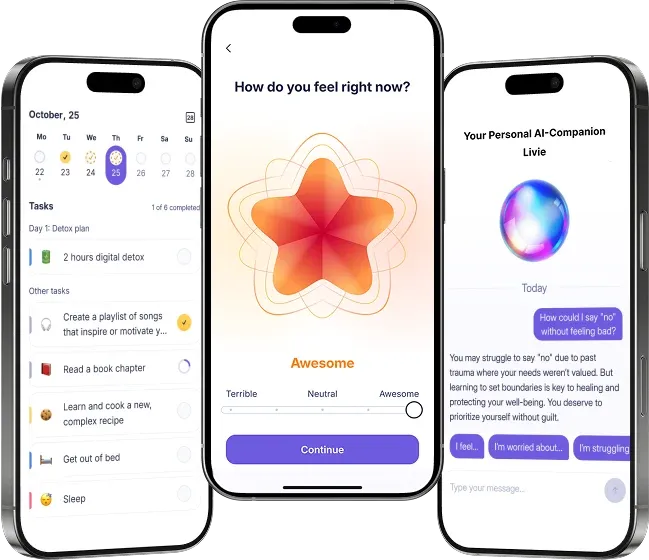
- Track your emotional patterns. The no contact period is a good time to notice what you feel, when you feel it, and what triggers the hardest moments. That self-knowledge becomes useful long after the breakup is over. Liven's Mood Tracker is a simple way to start building that picture.
- Reconnect with your own life. The things that were yours before the relationship. The friendships that got less attention. The projects you set aside. This is not a distraction. It is remembering who you are when you are not defined by a relationship.
- Write it out. Not to send, just to process. The act of putting your thoughts somewhere external rather than cycling them endlessly in your head reduces the mental load significantly. Liven's Journal includes prompts for this kind of processing.
You Deserve the Space to Heal
The no contact rule works not because it sends a message to your ex. It works because it sends a message to you: that your healing matters, that your attention is valuable, and that the next chapter of your life doesn't begin with a text you'll regret.
The urge to reach out will pass. So will the worst of the pain. What you build in the silence is entirely yours.
References
- Dailey, R. M., Zhong, L., Varga, S., Zhang, Z., Kearns, K. (2024). Explicating a comprehensive model of post-dissolution distress. Journal of Social and Personal Relationships, 41(2), 369–395. https://doi.org/10.1177/02654075231207588
- Eisma, M. C., Tõnus, D., & de Jong, P. J. (2022). Desired attachment and breakup distress relate to automatic approach of the ex-partner. Journal of Behavior Therapy and Experimental Psychiatry, 75, 101713. https://doi.org/10.1016/j.jbtep.2021.101713
- Mancone, S., Celia, G., Bellizzi, F., Zanon, A., & Diotaiuti, P. (2025). Emotional and cognitive responses to romantic breakups in adolescents and young adults: The role of rumination and coping mechanisms in life impact. Frontiers in Psychiatry, 16, 1525913. https://doi.org/10.3389/fpsyt.2025.1525913
- Stelzer, E.-M., Zhou, N., Maercker, A., O'Connor, M.-F., & Killikelly, C. (2019). Gender differences in grief narrative construction: A myth or reality? European Journal of Psychotraumatology, 10(1), Article 1688130. https://doi.org/10.1080/20008198.2019.1688130
FAQ: The No Contact Rule
What is the no contact rule?
How long should no contact last?
Does the no contact rule work?
What is the no contact rule in relationships?
What does no contact do to an ex?
What are the 5 signs the no contact rule is working?
Can you break the no contact rule?
Is no contact cruel?