How to Get Over a Breakup and Prepare for Healthier Relationships




If you're reading this, you've probably had a tough few days, or weeks, or longer. Breakups don't run on a tidy timeline. You can feel okay one hour and not the next. What follows is a small set of things that tend to help, at whatever pace you can take them.
There's no single answer to how to get over a breakup. What follows is a small set of practices that tend to help, used at whatever pace makes sense for the week you're in.
Key Learnings
- Recovery is non-linear, but gradual processing supports lasting resilience.
- People who reflect on their feelings after a breakup show higher levels of self-understanding and personal growth.
- Adults who socialize regularly experience faster recovery from loss.
How to Get Over a Breakup: Proven Ways that Help You Heal
These ideas are grounded in psychology and designed to help you process what happened at your own pace. Yes, we know you wonder how to get over a breakup fast, but please, give yourself time to grieve and rest as much as you need to.
1. Limit Contact to Create Space for Yourself
Staying in contact with an ex often prolongs distress. Continued contact keeps your nervous system in a state of anticipation: you wait for a message, brace for a reaction, and second-guess every word you say. It's exhausting, and it makes moving on genuinely harder.
Going no-contact gives your brain the conditions it needs to stop the loop.
Sure, in some cases like co-parenting, a complete no-contact isn't realistic. But even then, keep your communication direct, factual, and straight to the point, especially if you're co-parenting with a narcissistic ex-partner.
⚠️ Reminder: If there was any kind of abuse in the relationship, going no-contact is a non-negotiable step toward safety and recovery.
Even if you've decided to stay friends eventually, both of you need time to process what happened before that friendship becomes genuine and healthy.
2. Allow Yourself to Feel Every Single Emotion
Crying one day, raging the next, almost fine the day after, and then back to square one. The emotional ride after a breakup is genuinely unpredictable, and if it feels like something is wrong with you, it isn't. Your mind and body are just working hard to process something really painful.
So, what you can do is give yourself permission to go through it all and take each day as it comes.
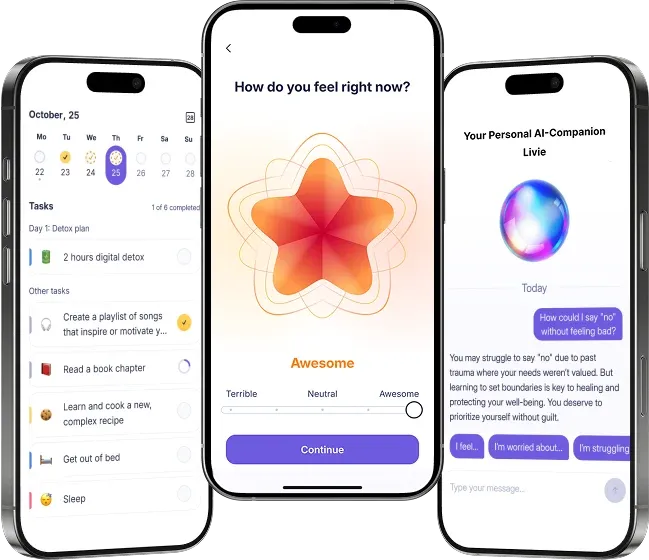
- Do daily emotional check-ins
Three times a day, pause and ask yourself: "What am I feeling right now?" Try to notice what you're feeling, and if you can, where it lands in your body. Let it be there without judgment. This trains your nervous system to experience emotions as signals, not threats.
- Put your thoughts on paper
Writing helps because it moves thoughts from your head into a structured narrative.
You can try prompts like “What hurts the most right now?”, “What did this relationship teach me?” or “What do I need today to feel a little better?” By the way, if you’re not a fan of the pen-and-paper method, you can even use Liven’s Journal to log these reflections, track shifts in your emotions over time, and uncover insights you might otherwise miss.
- Give your body a way to release stress
Healthy ways to release that stress include:
- walking or light exercise
- breathwork or meditation
- listening to calming sounds
- stretching or yoga
3. Reconnect With Your Inner Self
When in a relationship, you become a part of “we” in your habits, your choices, your whole daily rhythm. Then, suddenly, the breakup happens, and you have to change everything that makes your daily life yours.
Reconnecting with your inner self is hard. But it's also a rare opportunity to notice how your sense of self shifts when the relationship isn't there to shape it, and which parts of you hold steady.
Psychology professor Dr. Gary Lewandowski reframes the moment after a breakup as one of the rare times you get to find out who you are without the relationship:
Try some things from the list.
- Write a "Before" list. Make a list of hobbies, rituals, places, and habits that belonged to you before the relationship. The music you listened to alone. The hike you always wanted to do. The creative project you put on the back burner.
- Claim new spaces and rituals. Find places that are yours alone: a new coffee shop where you have your favorite drink in the morning, a bookstore with comics, or a park trail you take on Sundays. These will become anchors for your new routine.
- Avoid shared places for now. The restaurant where you had your first date or the neighborhood where your partner lived won’t be off-limits forever. It’s just that for now, they’ll trigger memories, and those memories will hurt.
4. See the Relationship for What It Was
You might want to remember only the good times, or, conversely, you might focus entirely on all the times your ex failed you. Both of these are natural, but neither is the full picture.
Try the re-authoring exercise from narrative therapy to create a base for your personalized plan for healthier relationships.
Take a piece of paper and divide it into three columns:
| What the relationship gave me | What the relationship cost me | What I learned about myself |
|---|---|---|
| Love, safety, growth, adventure, companionship... | Energy, self-esteem, time, identity, unmet needs... | My needs, patterns, and values I see more clearly now than I did before... |
Then, write down your needs and non-negotiables for the future:
- What does your next relationship look like?
- What are your deal-breakers?
- What qualities in a partner actually matter to you? Not the ones you thought you wanted, but the ones you now know you need?
5. Spend Time With People Who Lift You Up
Social connection matters in recovery after a loss, and over time, it helps your nervous system handle stress more steadily. It also reminds you that life continues beyond heartbreak.
A few ways to ease back into the world:
- Text one person today. Just one. A "hey, thinking of you" counts.
- Volunteer somewhere that matters to you: animal shelters, community gardens, youth programs.
- Get a pet, or offer to walk a neighbor's dog. The combination of physical activity, routine, and unconditional affection is genuinely therapeutic.
- Join something with a schedule: a dance class, a running club, a pottery studio, a community choir. The structure removes the decision fatigue of "should I go?"
- Say yes to one thing you'd normally decline. A dinner, a walk, a last-minute plan. Experiences that interrupt the loop of isolation are almost always worth it, even when the couch feels safer.
Final Thoughts
Learning how to get over a breakup isn't a linear path, and there's no universal timeline.
And if you're still in the thick of it, wondering how long to get over a breakup and whether the pain will ever actually ease - it will. You'll add new experiences, new people, new versions of yourself, until the grief takes up proportionally less space.
The best thing you can do right now is keep showing up for yourself.
And you don’t have to go through it alone. Meet us on the Liven app (Google Play or App Store), keep learning on the Liven blog, or discover what your current mental health state is saying with Liven's free wellness tests.
References
- Cai, S. (2025). Factors influencing post-breakup recovery. SHS Web of Conferences, 222, Article 02023. https://doi.org/10.1051/shsconf/202522202023
- Godman, H. (2023). Even a little socializing is linked to longevity. Harvard Health Publishing. https://www.health.harvard.edu/mind-and-mood/even-a-little-socializing-is-linked-to-longevity
- Yue, X., & Cui, X. (2025). Psychological factors related to positive post-breakup adjustment: SAGE Open. https://doi.org/10.1177/21582440251339662
FAQ: How to Get Over a Breakup?
How long does it take to get over a breakup?
Is it normal to still love someone after a breakup?
Should I stay friends with my ex?