Healing After a Breakup: Where Do You Even Start? 7 Tips to Follow




You didn't see it coming. Or maybe you were the one who initiated it. Regardless, going through a breakup is painful. It leaves you stuck in memories, replaying the final conversation and scrolling through their Instagram.
Still, there comes a moment when you have to remind yourself of who you are when you’re not in a relationship and take deliberate steps towards the new chapter.
These 7 tips won't rush that process (after all, healing after a breakup doesn’t happen in a day), but they'll help you deal with post-breakup feelings at your own pace and in a healthy way.
Key Learnings
- Healing after a breakup takes time, and you don’t need to rush yourself into feeling okay.
- No contact, even temporarily, can give your heart and mind the space they need to stop reopening the wound.
- Simple routines, hobbies, and social connections can help you feel steady again when everything feels unfamiliar.
- A breakup can become a chance to understand your patterns, rebuild self-trust, and move forward with more self-awareness.
7 Tips For Healing After a Breakup
If you’re wondering how to start the healing process after a breakup, it usually doesn’t begin with a big decision. These are a few ways to support yourself through that process.
1. Go No-Contact At Least For a While
Even if you've both decided to stay friends eventually, you can't build a healthy friendship on a foundation that's still raw.
- Mute or unfollow them on social media
- Delete or archive the conversation thread, so you're not reading old messages at 1 AM
- Let mutual friends know that you need some space if they keep bringing up your ex in every conversation
- Create a 24-hour rule: if you feel the urge to reach out, wait 24 hours. Usually, the urge passes.
In case you have to stay in contact (for instance, you share kids, a lease, or a business), keep conversations brief, practical, and straightforward.
2. Let Yourself Feel Everything
Regardless of how many healing after a breakup quotes you've read, nothing quite prepares you for the reality of it.
When a relationship ends, the brain processes it similarly to other forms of loss. The part of your brain responsible for emotional regulation gets heavily activated, while the prefrontal cortex (the part that helps you think clearly and rationally) can temporarily go a little offline.
That's why you might make decisions that don't feel like you. You can cry in the grocery store over a song. Or even feel completely fine one hour and devastated the next.
Check out these simple practices you can do when you find yourself in the storm.
Name the Feeling
When emotions surge, try to label what you're feeling: anger, sadness, fear, or relief. Naming an emotion reduces its intensity. Even just saying "I feel sad" out loud (or typing it) helps your nervous system settle.
Do a Body Check-In
Emotions live in the body. Notice where you're holding tension (chest, jaw, shoulders, etc.) and try to relax that part of your body.
Give Yourself a 20-Minute Window
Set a timer and fully let yourself feel it. Cry, journal, let yourself fully feel it. When the timer goes off, do something small and grounding: make tea, go outside, or wash your face with cold water to help your nervous system settle and shift states.
3. Create a New Routine
Multiple studies show that rebuilding routines and social connections play a key role in emotional recovery and personal growth.
- Have consistent sleep and wake times to stabilize your mood and energy.
- Eat at least two nourishing meals a day - breakups destroy appetites or trigger stress eating.
- Move your body daily. And for that matter, get out of those four walls. A walk in a park, a slow yoga session, or a swim will do the job.
4. Come Back to Your Hobbies
Hobbies add flavor to your life by reminding you of who you were before the relationship. They also distract you from the breakup in a healthy way.
- Revisit something you loved before the relationship. Did you paint, play guitar, bake, or garden?
- Try something new if old interests don't pull you yet. New hobbies build fresh perspectives and open up new possibilities for who you can be.
- Don't pressure yourself to enjoy it immediately. Sometimes, the early stages of re-engaging with anything after a breakup feel flat. What matters is that you still show up.
5. Stay Social Even For a Little Bit
Staying connected with others sends a signal to your brain that you’re safe and belong somewhere.
- Reach out to one friend or family member a day. A 15-minute phone call will suffice.
- Reconnect with people you may have drifted from during the relationship.
- Consider a social hobby: a group fitness class, a book club, a community choir.
- Volunteer. Helping others can gently reconnect you with life outside the breakup.
When you spend too much time alone, it can affect more than your mood - it can touch your stress levels, sleep, body, and even the way you think. Dr. Tracey Marks breaks this down really clearly in this video:
6. Redecorate Your Space
This is especially true if you used to live together. But even if you didn’t, changing your environment is a great way to make it reflect the new chapter in your life.
Simple things that don’t require a renovation budget are:
- Add one new thing that is only yours: a plant, a print, a lamp.
- Clear out anything of theirs that's still lingering. Box it up, return it, or donate it.
- Buy a new candle or a diffuser.
- Rearrange the furniture.
7. Talk to a Therapist
A therapist can help you identify patterns, for instance, how your attachment style may have shaped this relationship, and give you tools to build something healthier next time. Think of it as developing your personalized plan for healthier relationships with someone who actually knows what they're doing.
Liven also offers structured Courses on topics that often surface during breakup recovery: anxiety management, overthinking, and navigating childhood trauma. They’re not a replacement for real therapy. But they are still a good option when you’re not quite ready to talk to someone yet, but don’t want to process everything alone.
Final Thoughts: Moving Forward, One Day at a Time
Healing after a breakup is really about coming back to yourself, little by little. It can show you how resilient you are, how much care you deserve, and how much stronger you are than you may feel right now.
You don’t have to turn this pain into a lesson overnight. Just give yourself time. As much as you need.
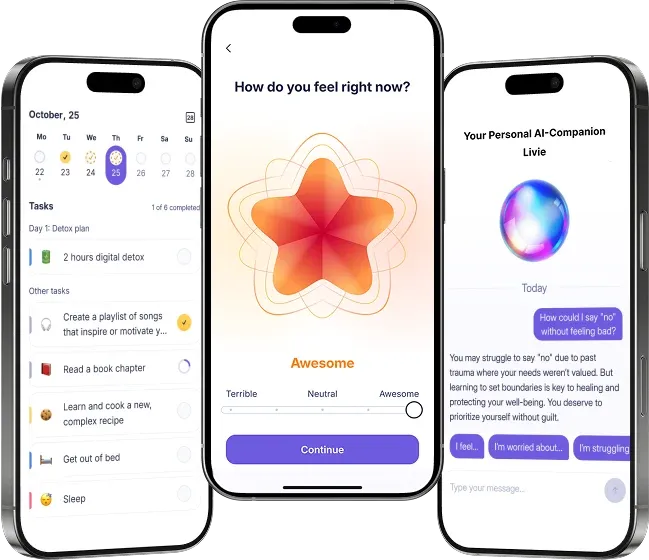
If you want a little structure and support, Liven is worth exploring. Build a routine, track how you're feeling over time, and access content that's actually relevant to where you are. Download the Liven app (Google Play or App Store), get more insights on the Liven blog, or try our wellness tests to understand your current mental health state.
References
- Farber et al. (2024). The role of psychotherapy in coping with romantic breakups. Psychotherapy, 61(4), 324–333. https://doi.org/10.1037/pst0000531
- Godman, H. (2024). Having a hobby is tied to happiness and well-being. Harvard Health Publishing. https://www.health.harvard.edu/mind-and-mood/having-a-hobby-tied-to-happiness-and-well-being
- Marks, T. (2025). What loneliness really does to your brain [Video]. YouTube. https://www.youtube.com/watch?v=MqWESgZxCPI
- Singh, A., & Ali, A. (2023). Mastering the art of letting go. Indian Journal of Psychiatric Social Work, 14(2). https://doi.org/10.29120/ijpsw.2023.v14.i2.220
FAQ: Healing After a Breakup
How long does healing take after a breakup?
How to know you are healing after a breakup?
How to start healing after a breakup?