Symptoms, Causes, and Recovery From Mom Burnout
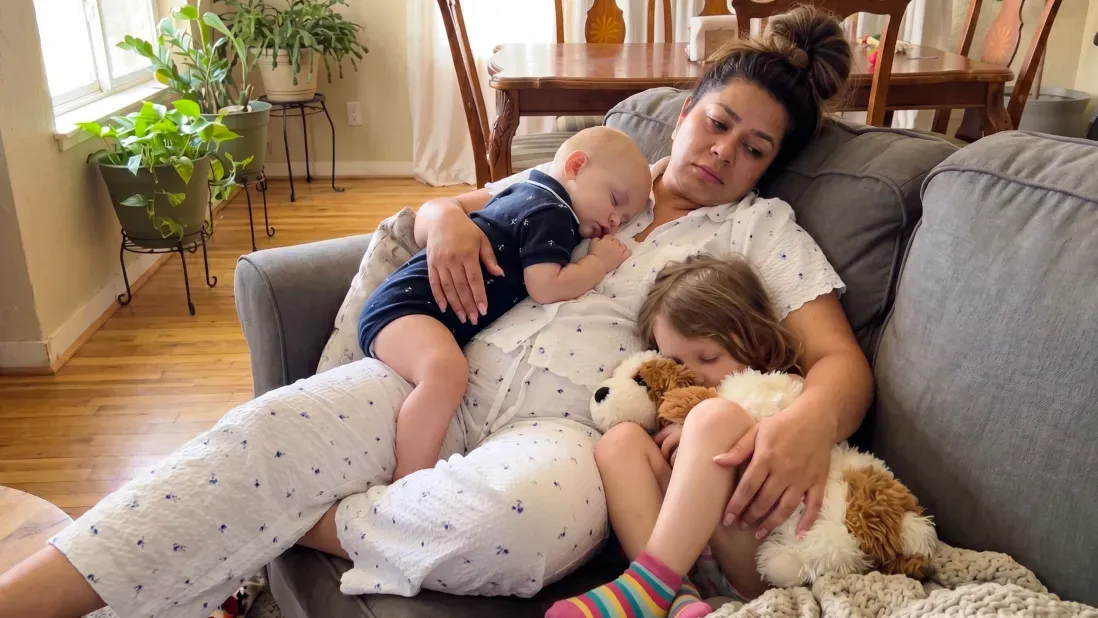


Mom burnout builds slowly, week by week, until one day you're physically present with your kids and completely gone at the same time.
What makes it hard to name is that it rarely starts with exhaustion. Research on mothers who've experienced burnout points to something that comes much earlier: fear. Fear of not being enough. Fear of getting it wrong. Fear of who you're becoming when the patience runs out.
Exhaustion is the end of a long road, and it's a road many mothers are on. Recent studies suggest roughly one in two women shows measurable burnout symptoms at some point. Most of them started out as the ones trying hardest.
This piece explores how burnout manifests in your body and behavior, and how you can recover from it.
Key Learnings
- Signs show up in the body first (fatigue, headaches, physical heaviness), then emotionally as numbness, detachment, and dread
- The main causes are the invisible mental load, impossible cultural standards, parenting without community support, and losing yourself in the role.
- Recovery starts with nervous system regulation, rebuilding support, and treating your own needs as the foundation.
Mom Burnout Is Not Being Tired
In pop culture, you’d see burnout being used as a synonym for tiredness, but that framing undersells it. Burnout isn't like everyday tiredness. A good night's sleep or a weekend off won't shake it, and left unchecked, it tends to linger. A study breaks burnout into four clinical dimensions:
- Emotional exhaustion
- Loss of pleasure in parenting
- Emotional distancing from your children
- Contrast, the felt gap between the mother you were and the mother you've become.
For burned-out mothers, this can mean:
- Not having the energy to be warm, patient, or enjoy a moment with their kids.
- Being physically present but mentally absent. You go through the motions of bedtime, meals, and school runs while feeling nothing behind it.
- Not being able to plan beyond the current hour without anxiety spiking.
In all these cases, there is a bone-deep exhaustion, but also more. You start feeling like a stranger to yourself.
Stay-at-Home Mothers vs. Working Mothers
Mom burnout doesn't discriminate by employment status. Research shows moms tackle 71% of the household mental load regardless of whether they also work outside the home. This includes the invisible labor of scheduling, anticipating, and managing everyone's needs.
Where mom burnout differs is in how the pressure arrives:
- Stay-at-home mothers describe the exhaustion of work that has no external validation and no clear boundary between being a person and being a caregiver.
- Working mothers describe coming home from a full day to find another full day waiting, and having to manage it all.
Identifying Mom Burnout: Symptoms and Signs
Burnout tends to show up in the body first, and in your emotional life second. Here's what to look for in both.
| Physical signs of mom burnout | Emotional signs of mom burnout |
|
|
Common Reasons For Mom Burnout
Burnout doesn't happen randomly. Research keeps pointing to a handful of conditions that cause it, and most are structural, not personal.
- The mental load: It's the remembering, the anticipating, the planning three steps ahead for everyone in the household. That kind of cognitive labor runs in the background constantly and rarely gets acknowledged as work.
- Impossible standards: The cultural image of a good mother is someone who does everything well and makes it look easy. That image functions as a standard that most mothers silently measure themselves against, all day, every day.
- Parenting without support: Previous generations raised children within extended family and community networks. Most mothers today are doing it without that infrastructure. When there's no one to share the load, everything falls on one person.
- Losing yourself in the role: There's something specific at play here. Mothers who over-identify with the caregiver role, leaving no room for any other part of themselves, show a significantly higher risk of burnout.
If you're postpartum, some of what you're feeling may have a physiological layer. During pregnancy and breastfeeding, the body prioritizes the baby's nutritional needs. This means iron, B vitamins, omega-3s, and other essential nutrients can run low in the process. Combined with sleep deprivation and the emotional demands of a newborn, the depletion can compound quickly.
This isn't the same as burnout, but it can look similar and make burnout recovery harder. If you're in the postpartum period and struggling, it's worth talking to your doctor about your nutrient levels alongside any emotional support you're seeking.




5 Tips to Recover From Mom Burnout
Recovery from burnout isn't a self-care checklist. Research on parental burnout describes it as a gradual erosion that unfolds over months or years, beginning with exhaustion that slowly pulls the rest along with it.
So recovering from it will also take time and look different for everyone. Here are five approaches that can help you with mom burnout, while ensuring you stay a good parent.
1. Regulate Your Nervous System
When burnout gets intense, your body can stay stuck on high alert, even when nothing's actually wrong in the moment. Thinking your way out of it doesn't work at that point. The physiological state has to shift first. Small, consistent resets do more than occasional big ones.
10 minutes with noise-canceling headphones, for example, can give your nervous system a genuine break from sensory input. That reduction in stimulation allows cortisol levels to drop. You can also try sitting alone for 5 minutes without your phone.
It sounds small, but it activates the parasympathetic nervous system, which is the branch responsible for calming the body down after stress.
Burnout hits differently when you have ADHD and are working harder to manage the mental load.
Some things you can do:
- Writing everything down: If it lives only in your head, it's competing for attention with everything else.
- Body doubling: Having another person in the room while you tackle avoided tasks significantly lowers the activation energy. They don't need to help, just be present.
- Functionality over aesthetics: A clean enough home is a valid goal. Chasing perfection creates a loop that's hard to exit.
2. Shift to Conscious Parenting
Burnout and reactive parenting feed each other. When your nervous system is depleted, small things trigger outsized responses, and the guilt that follows depletes you further. Conscious parenting interrupts that cycle by redirecting attention from your child's behavior to your own internal state.
It helps to understand what's going on with your child, but it's just as worth turning some of that attention inward and checking in with how you're doing, too.
Instead of trying to control the situation, you get curious about your own triggers, like what they're connected to, where they come from. Repair matters here, too. Apologizing to your kids when you lose your temper takes the pressure off being perfect and improves your relationship with them.
And if you're curious about how you're responding to your children, here’s a reactive parenting quiz. It can help you check whether you're often getting triggered and whether your reactions are creating emotional distance with your child.
3. Rebuild Your Village
For most of human history, mothers raised children in the presence of other adults, such as grandparents, neighbors, and extended family. Most of us are doing it without that now, and research spanning 42 countries backs this up: isolation is one of the strongest predictors of burnout.
Start by having a specific conversation with your partner. Tell them what you need rather than waiting for them to notice, because studies show most partners genuinely believe they're contributing more than they are. And if family is nearby, try to ask for their support.
4. Practice Mindfulness in Small Doses
Mindfulness gets oversold as something that requires a meditation cushion and 30 quiet minutes. For most burned-out mothers, that's not realistic. But small, consistent moments of presence can do more than occasional long sessions.
In practice, this can look like:
- One slow breath before you open your kids' bedroom door in the morning.
- Eating lunch without your phone.
- Noticing what you're feeling before you respond to something that irritates you.
Tracking your mood patterns over time can also help, even if it feels tedious at first. When you can see how your mood shifts across days and weeks, patterns become visible that are hard to notice in the daily routine.
5. Dedicate Time For Yourself
Burnout narrows your world down to everyone else's needs. Taking time for yourself becomes a reward for getting everything done, and as things rarely get done, you’re stuck with no intentional me-time.
That has to change. Start with small things like taking a walk without your kids, reading something that has nothing to do with parenting, or sitting quietly for 20 minutes. The point is a consistent reminder that you exist outside your role.
Note: If formal support feels like the right next step, therapy or a mother's support group can be good places to start. Both give you a space to be honest about what you're going through without worrying about anyone else's reaction. Postpartum Support International also has a directory of groups specifically for mothers if you want to start there.
Recovering From Mom Burnout As a Single Mother
Single mothers report significantly higher levels of psychological stress than partnered mothers, and rate their own health as poor nearly twice as often. That's what happens when a two-person job is managed by one person, indefinitely, without a break.
Here are some tips that can help:
- Find your off-duty signal: When there's no partner to take over, you never get the psychological cue that you're off. Create one deliberately. This can be after the kids are in bed, a cup of tea, a specific playlist, anything that tells your nervous system the shift is over.
- Protect your decision-making energy: Single mothers make every call alone. That wears down your mental resources faster than the physical tasks do. Wherever you can, remove decisions: the same meals on rotation, the same bedtime routine, the same rules every time.
- Let your kids carry more than you think they can: Age-appropriate responsibility builds a child’s confidence and genuinely reduces your load. A seven-year-old can pack their own school bag. A ten-year-old can make their own lunch. You don't have to do everything for them to feel like a good mother.
Guilt is one of the most documented features of parental burnout, and single mothers tend to carry more of it. So ask yourself, "Where did the standard you're measuring yourself against come from?" Because it probably wasn't built with you in mind.
Take Care of You, Too
When your own cup is full, you have so much more to give. It sounds simple, but it's the part most mothers in burnout are learning to embrace: your needs aren't optional extras. They're the foundation everything else rests on. And the mothers who come back from burnout do it by gently rebuilding their resources, not by squeezing out more willpower.
So pick one thing from this piece and try it this week. Notice what shifts, then add another. And whenever you can, let people support you. You don't have to carry it all on your own.
References
- Hubert, S., & Aujoulat, I. (2018). Parental burnout: When exhausted mothers open up. Frontiers in Psychology, 9, 1021.
- Lebert-Charron, A., Dorard, G., Wendland, J., & Boujut, E. (2021). Who are and are not the burnout moms? A cluster analysis study of French-speaking mothers. Journal of Affective Disorders Reports, 4, 100091.
- Lin, Q., et al. (2024). A systematic review of parental burnout and related factors among parents. BMC Public Health, 24, 376. https://doi.org/10.1186/s12889-024-17829-y
- Roskam, I., et al. (2021). Parental burnout around the globe: A 42-country study. Affective Science, 2(1), 58–79.
- Sartor, T., Lange, S., & Tröster, H. (2023). Cumulative stress of single mothers: An exploration of potential risk factors. The Family Journal, 31(1), 88-94.
- Schittek, A., Roskam, I., & Mikolajczak, M. (2024). Parental burnout stages and their link to parental violence: A longitudinal study. Journal of Applied Developmental Psychology, 95, 101718. https://doi.org/10.1016/j.appdev.2024.101717
- Sutherland, J.-A., et al. (2024). Medical communication, internalized "good mother" norms, and feminist self-identification as predictors of maternal burnout. Frontiers in Communication, 9, 1265124. https://doi.org/10.3389/fcomm.2024.1265124
FAQ: Mom Burnout
What are the signs of mom burnout?
How is mommy burnout different from regular stress?
How do working moms experience mom burnout differently?
Can ADHD mom burnout look different?
How do I start overcoming mom burnout?
When should I see a health professional about mom burnout?