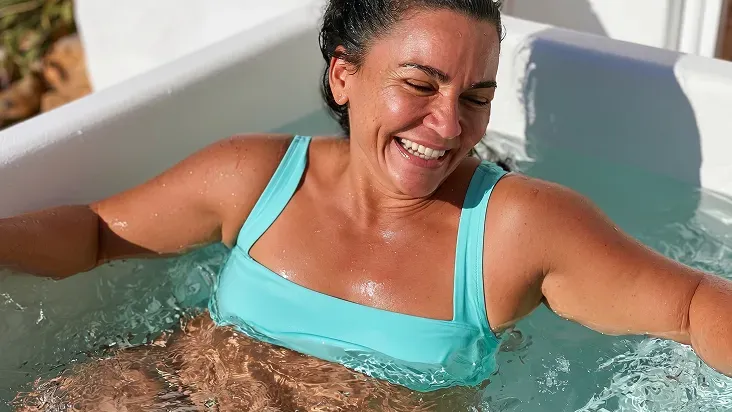



You’ve probably noticed that the cold plunge trend isn't going anywhere. What's less obvious is why it works and whether the science lives up to the hype.
Cold water immersion, stepping into water between 10-15°C or 50-59°F for a few minutes, has been practiced for centuries, from ancient Greek physicians prescribing cold baths to modern-day athletes using ice tubs for recovery. It has a measurable impact on your nervous system, your cells, your mood, and your recovery, and some of those effects kick in within 60 seconds.
In this article, we’ll explore the cold plunge benefits and how to do it safely. Consider this your first deep dive before you take the cold one.
Key Learnings
- A single cold plunge can raise dopamine levels, and the result lasts for several hours.
- Regular cold water immersion improves cellular autophagy, the process your body uses to clear out damaged cells and build resilience from the inside out.
- Pairing a cold plunge with heat (sauna or hot tub) amplifies the cardiovascular benefits and accelerates recovery in ways neither practice achieves alone.
What Happens in Your Body the Moment You Enter Cold Water
The moment cold water hits your skin, your sympathetic nervous system fires. Heart rate spikes, blood vessels constrict, and your brain releases a flood of hormones: norepinephrine and adrenaline, followed by dopamine. This is the whole point of the cold plunge experience.
The Hormone Rush
Norepinephrine surges by up to 530% during cold water immersion, with peak response occurring within the first 30 seconds and remaining elevated for several hours. It's the chemical that sharpens focus and lifts mood.
Dopamine, the molecule behind motivation and pleasure, is boosted by up to 250% and stays elevated for hours. That combination is why people describe the post-plunge feeling as calm but switched on.
Unlike scrolling or snacking, it produces a dopamine response that doesn't ask for a bigger hit tomorrow. If you've been working on building healthier dopamine habits, cold water is one of the few physical practices that support that.
Down at the Cellular Level
Zoom out to the cellular level, and things get even more interesting. After regular daily cold water immersion, cells show improvements in autophagy, the process your body uses to clear out damaged proteins and cellular debris. Cold also triggers cold-shock proteins that make cells more resilient to stress. Think of it as your body's stress-hardening protocol running in the background.
Brown adipose tissue (BAT), the type of metabolically active fat that generates heat instead of storing it, becomes more active with regular cold exposure. It's not a weight loss hack, but it is evidence that the body is adapting and working harder to regulate itself.
You've read what's happening in your body during a plunge, but seeing the mechanism laid out helps it click. This 4-minute video breaks down the actual science behind cold plunges and why the shift happens so fast:
The Mental Health Benefits of Cold Plunge
A lot of what people feel after a cold plunge - lighter, clearer, less rattled by the day - comes directly from what's happening neurologically. The norepinephrine spike (released during cold exposure) reduces pain perception and has anti-inflammatory effects on the brain. The dopamine elevation supports motivation and mood in the hours after.
One study used fMRI scans to track what happens to brain networks after cold water immersion. Participants reported feeling better: less negative emotion, more positive mood. Their brain scans showed increased connectivity between the networks involved in emotional regulation.




Cold Plunge and Sauna Benefits
Used alone, both sauna and cold plunge are valuable. Combined as contrast therapy, the effects stack.
Sauna heat (70-90°C / 158-194°F for 10-20 minutes) exposure dilates blood vessels and drives blood toward the skin and muscles. Cold immersion afterward causes rapid vasoconstriction. The repeated expansion and contraction act like a vascular pump, improving circulation, reducing muscle soreness, and accelerating the clearance of metabolic waste from tissues.
When You Combine Both
Cold plunge and hot tub combo benefits follow the same contrast principle. While a hot tub typically runs cooler than a Finnish sauna (around 38-40°C / 100-104°F), it still produces meaningful vasodilation and muscle relaxation. Moving between a hot tub and a cold plunge, 3-4 rounds of 10-15 minutes hot, 2-3 minutes cold, deliver many of the same circulatory and recovery benefits.
If you're building a recovery and well-being routine, pairing contrast therapy with movement practices like somatic workouts can support the nervous system regulation benefits of both.
Who Should Avoid Cold Plunging
Avoid cold plunges if you have:
- Heart conditions, including coronary artery disease, arrhythmias, uncontrolled high blood pressure, or a history of heart attack or stroke. The American Heart Association advises against activities that place sudden cardiovascular stress on people with a cardiac history. People on beta-blockers may also have a reduced ability to adapt to the cold shock.
- Respiratory conditions. Cold water can trigger bronchospasm in people with asthma or COPD.
- Raynaud's disease. Cold is a direct trigger for severe vascular reactions in affected individuals.
- Peripheral neuropathy or reduced sensation. Impaired ability to feel cold increases the risk of tissue damage before you're aware of it.
- Pregnancy. The cardiovascular stress and risk of hypothermia make cold plunging inadvisable.
- Active infection or fever. The immune system is already under strain, and cold shock adds an additional physiological burden.
Even for healthy people, there are real risks if this practice is approached carelessly. Never combine breath-holding or hyperventilation techniques with cold water immersion. This is responsible for multiple drowning deaths and requires no underlying condition to be fatal.
How to Start Safely
You can use this simple guide to prepare for the cold plunge:
- Begin with cold showers. End your regular shower with 30-60 seconds of cold water. Do this for 1-2 weeks.
- Control the temperature progression and don't start with ice water. Aim for 15°C (59°F) initially, which is cold enough to trigger a physiological response without being extreme.
- Keep sessions short. 1-3 minutes is enough for beginners.
- Never plunge alone for the first several sessions, as the involuntary physical response can catch you off guard.
- Breathe deliberately. Slow, controlled exhales help regulate the cold shock response and keep your nervous system from spiraling into panic.
- Rewarm naturally. Dress warmly and let your body generate its own heat afterward instead of jumping straight into a hot shower.
- Pair a cold plunge with somatic stress release practices. It can help your nervous system land more smoothly afterward.
Your First Cold Plunge
There's a specific few seconds, right after you get out, that's hard to describe until you've felt it. The cold is gone, your skin is alive, your head is quiet, and everything that felt heavy an hour ago somehow weighs less. People who do this regularly will tell you that feeling is the reason they keep coming back.
The only way to know if they're right is to get in. Start small, track how you feel, and let your body guide your progress.
During your self-discovery journey, take Liven's quiz to establish a snapshot of where you're starting, so you can see your own patterns unfold over time.
References
- Cain, T., Brinsley, J., Bennett, H., Nelson, M., Maher, C., & Singh, B. (2025). Effects of cold-water immersion on health and wellbeing: A systematic review and meta-analysis. PLOS ONE, 20(1), e0317615. https://doi.org/10.1371/journal.pone.0317615
- Espeland, D., de Weerd, L., & Mercer, J. B. (2022). Health effects of voluntary exposure to cold water — a continuing subject of debate. International Journal of Circumpolar Health, 81(1), 2111789. https://doi.org/10.1080/22423982.2022.2111789
- Huo, C., Song, Z., Yin, J., Zhu, Y., Miao, X., Qian, H., Wang, J., Ye, L., & Zhou, L. (2022). Effect of acute cold exposure on energy metabolism and activity of brown adipose tissue in Humans: A Systematic Review and Meta-Analysis. Frontiers in Physiology, 13, 917084. https://doi.org/10.3389/fphys.2022.917084
- King, K. E., McCormick, J. J., & Kenny, G. P. (2024). The effect of 7-day cold water acclimation on autophagic and apoptotic responses in young males. Advanced Biology, 9(2), e2400111. https://doi.org/10.1002/adbi.202400111
- Laukkanen, J. A., Laukkanen, T., & Kunutsor, S. K. (2018). Cardiovascular and Other Health Benefits of sauna Bathing: A Review of the evidence. Mayo Clinic Proceedings, 93(8), 1111–1121. https://doi.org/10.1016/j.mayocp.2018.04.008
- Leach, O. K., Strong, K., Mack, G. W., & Gifford, J. R. (2024). The vascular response to acute sauna heating is similar in young and middle-aged adults. Journal of Applied Physiology, 136(3), 573–582. https://doi.org/10.1152/japplphysiol.00287.2023
- López-Ojeda, W., & Hurley, R. A. (2024). Cold-water immersion: Neurohormesis and possible implications for clinical neurosciences. The Journal of Neuropsychiatry and Clinical Neurosciences, 36(3), 177–185. https://doi.org/10.1176/appi.neuropsych.20240053
- Medical Saunas. (2026, July 14). Hot and Cold Therapy Benefits. https://medicalsaunas.com/blogs/official-blog/hot-and-cold-therapy-benefits
- Peter, S., Michaelis, A., Wagner, R., Marshall, R. P., Bovet, M., Weickmann, J., Weidenbach, M., Dähnert, I., & Paech, C. (2026). Cold shock response in healthy children: reassessment and first comparison between cold and warm water immersion. Frontiers in Sports and Active Living, 7, 1610144. https://doi.org/10.3389/fspor.2025.1610144
- Plutzky, J. (2022). You're not a polar bear: The plunge into cold water comes with risks. American Heart Association News. Retrieved from https://www.heart.org/en/news/2022/12/09/youre-not-a-polar-bear-the-plunge-into-cold-water-comes-with-risks
- Schepanski, S., Batta, F., Schröter, M., Seifert, G., & Koch, A. K. (2025). Protocol for a systematic review and meta-analysis on the effects of cold-water exposure on mental health. Frontiers in Psychiatry, 16, 1603700. https://doi.org/10.3389/fpsyt.2025.1603700
- Sharpe, B., & Spooner, R. (2025). Dopamine-scrolling: a modern public health challenge requiring urgent attention. Perspectives in Public Health, 145(4), 190–191. https://doi.org/10.1177/17579139251331914
- Šrámek, P., Šimečková, M., Janský, L. et al. Human physiological responses to immersion into water of different temperatures. Eur J Appl Physiol 81, 436–442 (2000). https://doi.org/10.1007/s004210050065
- Yankouskaya, A., Williamson, R., Stacey, C., Totman, J. J., & Massey, H. (2023). Short-term head-out whole-body cold-water immersion facilitates positive affect and increases interaction between large-scale brain networks. Biology, 12(2), 211. https://doi.org/10.3390/biology12020211
FAQ: Cold Plunge Benefits
What is a cold plunge and how does it work?
What are the benefits of cold plunge?
What are the cold plunge and sauna benefits when combined?
What are the cold plunge hot tub combo benefits?
How cold does the water need to be?
How long should a session last?
When's the best time to cold plunge?