Why Does Music Therapy Work? The Science of How Sound Heals You




There's a moment most people recognize: the afternoon slump hits, stress settles into the shoulders, and without much thought, someone reaches for a pair of headphones. A song starts. A few minutes pass. The weight lifts.
That instinctive reach for music is the brain self-regulating through sound. Music therapy formalizes this impulse into a targeted intervention, one that actively shifts brain chemistry rather than simply masking stress.
The effects are measurable. Music significantly lowers anxiety, and the biggest effects show up in the highest-stress moments: the minutes before surgery, the hours in a hospital bed, the kind of waiting where your pulse picks up on its own.
So why does music therapy work? Three mechanisms are at play: it shifts your brain chemistry, syncs your neural patterns to rhythm, and opens a path for emotions that resist words. The rest of this article walks through each one.
Key Learnings
- Within 10 to 30 minutes of pressing play, your cortisol starts to drop, and your heart rate and blood pressure come down with it.
- Your brain releases dopamine in two places: at a song's emotional peak and in the buildup to it, which is why an old favorite can hit as hard as a new song, sometimes harder.
- A steady beat around 60 to 80 BPM gives your brain a pattern to follow, which pulls your attention out of the worry loops and onto something steady and predictable.
- Music reaches your limbic system before the language part of your brain catches up, which is why a song can name a feeling you couldn't put into words.
How Music Impacts Your Emotional State
Think of your brain as a chemical symphony. When you feel stressed, cortisol plays too loudly. Music dials it down and turns up the neurochemicals that make you feel good.
The cortisol effect is substantial. A recent multilevel meta-analysis found that music therapy significantly reduces cortisol levels, with changes often measurable within 10 to 30 minutes.
The mechanism runs through the HPA axis, your body's main stress-response system. When music engages the brain's reward and emotional circuits, it sends competing signals that dampen the stress response downstream. Heart rate and blood pressure drop along with cortisol.
Dopamine moves in the opposite direction. When you listen to music you enjoy, your brain releases it, the same neurotransmitter you get from a good meal or laughing with a friend.
And the connection is causal. Pharmacological studies show that drugs that block dopamine make the same songs feel less rewarding. Drugs that boost it amplify the effect.
The Power of Rhythm and Predictability
An anxious brain feels chaotic, stuck in loops of what-ifs. Music gives the brain what it may crave in those moments: structure and predictability. This is called rhythmic entrainment.
The brain seeks patterns. When you listen to a steady beat, neural networks synchronize with the rhythm. That gives the brain a clear external pattern to track, which pulls attention away from internal worry loops.
A song with a strong beat feels grounding because your focus has somewhere specific to go: outward, instead of in.
Entrainment happens in the body, too. Slower tempos can pull your heart rate and breathing down to match them.
Music around 60 to 80 beats per minute, close to a resting heart rate, tends to produce the strongest calming effect. Your physiology has somewhere predictable to settle. That's why guided breathing exercises and meditation tracks often layer slow, steady music underneath.
The effect extends beyond mood. Rhythmic Auditory Stimulation (RAS) is a music therapy technique used with Parkinson's and stroke patients to improve movement and coordination.
The mechanism is the same one that calms an anxious brain. When neurons lock onto an external beat, the brain has a steady cue to organize itself around. Pacing a walking step or quieting a worry loop, the principle is the same.
Music as a Gateway to Your Emotions
Sometimes words fail to describe what we feel, but a song captures it exactly. There's a reason for that.
Music and language are processed by overlapping but distinct brain regions. Emotional responses to music engage the limbic system directly, often before verbal processing catches up. A song can land before you've made sense of why.
Music also reaches autobiographical memory more efficiently than most other stimuli. A song from a specific period of your life can pull up the feeling of that period whole, even when the explicit memory has gone hazy.
Music therapy leans on this in dementia care. Musical memory often persists when other forms of memory don't.
When language runs out, music opens a path for emotional expression, and you don't need any training to use it.
- Try sitting with a song that resonates. When a lyric or melody feels like an exact description of what you're feeling, that's information. Notice which line lands hardest and what it tells you about what's underneath. You don't have to do anything with it. Letting it register is enough.
- Or use your body instead of your skill. Sing in the shower, drum on the steering wheel, hum while you cook. The goal is to give emotion a physical channel. Skill doesn't matter, and neither does sounding good.
- If you have the impulse to write, try phrasing the feeling as a lyric, even badly. Putting feeling into structure does the work, whether or not the final lyrics are any good.
If you want to go further, psychiatrist Dr. Tracey Marks (host of one of the most-watched mental health channels on YouTube) walks through how music calms an anxious brain in this short video:
Music Therapy vs. Listening at Home
Worth drawing a line. Music therapy is a clinical practice with a credentialed therapist working toward specific goals over multiple sessions. Putting on a calming playlist after work is a different kind of activity.
Both can support well-being, and the practices in the previous section are real and effective, but they're closer to intentional music listening than to music therapy as a profession. For everyday stress, the distinction doesn't matter much. For clinical conditions, it does.
Your Personal Soundtrack for Well-Being
Music therapy works because it's a full-body, full-brain experience. It uses the brain's natural response to rhythm and melody to regulate mood and give shape to emotions that resist words.
The afternoon slump moment, the headphones, the song that lifts the weight: that instinct is the brain doing what it knows how to do, given the right input. You don't need to be a musician or join a formal program to use it. The next time stress settles into your shoulders, choose the song deliberately. Notice how your breathing shifts. Pay attention to what the melody brings up.
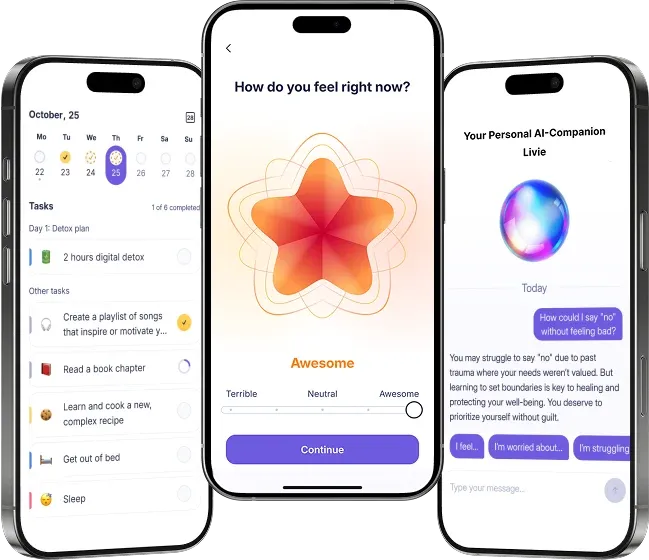
Music is one practice that can settle your nervous system. When you're ready to build a wider routine, Liven's personalized well-being plan takes a couple of minutes and gives you a starting point shaped around how you feel.
References
- Barbaresi, M., Nardo, D., & Fagioli, S. (2024). Physiological entrainment: A key mind-body mechanism for cognitive, motor and affective functioning, and well-being. Brain Sciences, 15(1), 3. https://doi.org/10.3390/brainsci15010003
- de Witte, M., Aalbers, S., Vink, A., Friederichs, S., Knapen, A., Pelgrim, T., Lampit, A., Baker, F. A., & van Hooren, S. (2025). Music therapy for the treatment of anxiety: A systematic review with multilevel meta-analyses. eClinicalMedicine, 84, 103293. https://doi.org/10.1016/j.eclinm.2025.103293
- Kaiser, A. P., & Berntsen, D. (2023). The cognitive characteristics of music-evoked autobiographical memories: Evidence from a systematic review of clinical investigations. WIREs Cognitive Science, 14(3), e1627. https://doi.org/10.1002/wcs.1627
- Koshimori, Y., & Thaut, M. H. (2023). Rhythmic auditory stimulation as a potential neuromodulator for Parkinson's disease. Parkinsonism & Related Disorders, 113, 105459. https://doi.org/10.1016/j.parkreldis.2023.105459
- Mas-Herrero, E., Ferreri, L., Cardona, G., Zatorre, R. J., Pla-Juncà, F., Antonijoan, R. M., Riba, J., Valle, M., & Rodriguez-Fornells, A. (2023). The role of opioid transmission in music-induced pleasure. Annals of the New York Academy of Sciences, 1520(1), 105–114. https://doi.org/10.1111/nyas.14946
- Pranjić, M., Braun Janzen, T., Vukšić, N., & Thaut, M. (2024). From sound to movement: Mapping the neural mechanisms of auditory-motor entrainment and synchronization. Brain Sciences, 14(11), 1063. https://doi.org/10.3390/brainsci14111063
- Trost, W., Trevor, C., Fernandez, N., Steiner, F., & Frühholz, S. (2024). Live music stimulates the affective brain and emotionally entrains listeners in real time. Proceedings of the National Academy of Sciences, 121(10), e2316306121. https://doi.org/10.1073/pnas.2316306121
FAQ: Why Does Music Therapy Work
What is music therapy?
Is music therapy backed by science?
What conditions can music therapy help with?
Do I need a music therapist, or can I practice on my own?
What kind of music is best for reducing anxiety or stress?
How long does it take for music to lower stress?
Is music therapy the same as just listening to music?
Can music therapy replace medication or talk therapy?