How to Recognize Emotions When You're Not Sure What You Feel




Sometimes the hardest question to answer is a simple one: "How do I feel right now?"
It sounds like it should be easy. But emotions aren't always transparent, even to the people experiencing them. A lot of people grew up learning how to suppress emotions, rationalize them away, or stay so busy they never had to sit with them long enough to identify them. And when we can't name what we're feeling, those emotions tend to find other ways out: through our relationships, our decisions, or the tension we carry around without knowing why
The good news is that understanding your emotions is a skill, and skills can be learned. This article walks you through a set of practical strategies to help you identify and recognize what's going on inside, so you can start expressing it with more clarity and confidence.
Key Learnings:
- Your body registers emotions before your brain does. Learning to read those physical signals is the fastest shortcut to knowing how you feel.
- Feelings follow patterns. Track them long enough, and you'll stop being surprised by them.
- Most of what we call feelings are actually thoughts in disguise. Learning to tell them apart is what makes emotions manageable.
How to Recognize Emotions: Strategies That Can Help
Your body, your patterns, and the way you talk to yourself all carry emotional information. Here's how to start reading them.
Start With Your Body Signals
Before you consciously realize you're feeling something, your body usually knows it first. Feelings like depression, anxiety, or anger can impact your health. It's not surprising that emotions often show up as physical sensations that act like early warning signs.
For instance, you might notice:
- A tight chest or shallow breathing when you're anxious
- Heat in your face when you're embarrassed or angry
- A restless or jittery feeling when you're stressed.
These signals can appear within seconds of an emotional trigger, even before your mind has time to interpret what's happening. Over time, many people become so used to living in stress or tension that these body sensations start to feel normal. They stop recognizing them as emotional signals at all.
That's why a quick body check-in can help you recognize emotions faster. Try pausing for a moment and asking yourself a few simple questions:
- Where do I feel tension right now?
- Is my breathing slow or rushed?
- Do I feel heavy, light, tight, or restless?
You don't have to analyze everything perfectly. The goal is simply to notice the physical clues your body is giving you. Over time, those sensations become easier to connect with specific emotions.
Reflect and Track Patterns
Before you even start tracking emotions over days or weeks, it can help to identify what you're feeling at the moment. If you struggle to find the right word, an emotional wheel can be a useful tool. It groups emotions into categories and then breaks them down into more specific feelings. What first feels like anger might be frustration, irritation, or resentment. Something you call sadness could be disappointment, loneliness, or discouragement.
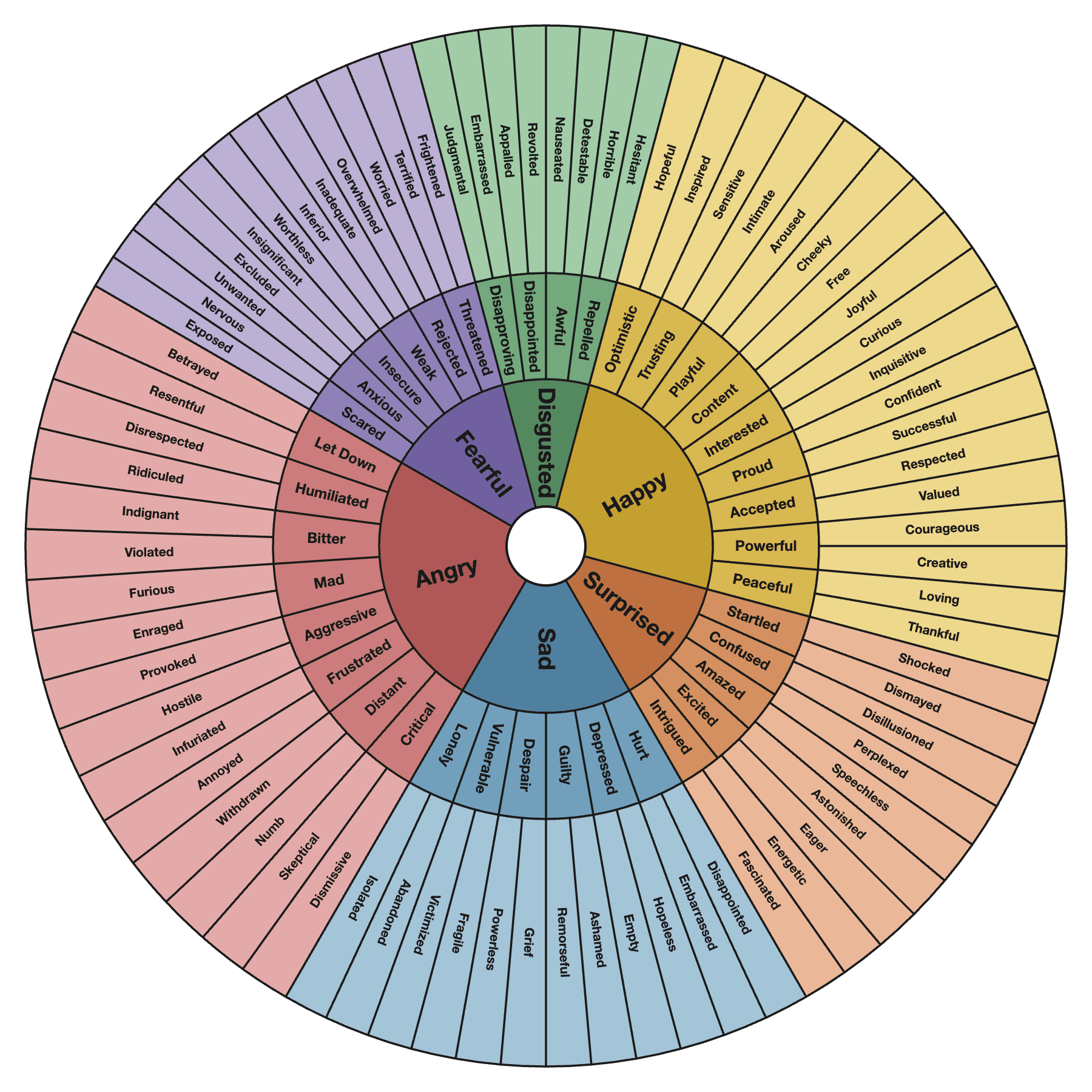
Emotions rarely appear at random - they tend to follow patterns linked to specific situations, environments, or thoughts. These patterns can be difficult to spot daily, but they become clearer when you start tracking them. One simple way to do this is through regular reflection or journaling. Writing things down helps turn vague feelings into something you can observe and understand.
Separate Thoughts From Emotions
One of the trickiest parts of recognizing emotions is that thoughts and feelings tend to travel together. You think you're naming what you feel, but you're describing what you think about a situation.
For example:
- "I feel like nobody respects me."
- "I feel like I'm going to fail."
- "I feel like they did it on purpose."
These might feel like emotions, but they're really just your brain trying to make sense of a situation. The feeling is underneath. Thoughts are often the brain’s attempt to explain or protect you from the emotion underneath. Learning to find it is what changes things.
Step 1. Observe. Notice the "I feel like…" statement. If your sentence includes "like", there's a good chance it's describing a thought rather than an emotion.
Step 2. Analyze. Pause and consider what feeling might be driving that thought. For example, are you feeling hurt? Lonely? Rejected?
Step 3. Edit. Try replacing the original thought with a clear emotion. For instance, "I feel like they don't care about me" can become "I feel hurt and disappointed."
This small shift can make a big difference. When you name the actual emotion, it becomes easier to understand what you need.
Try Drawing Your Emotion
Visual expression can bypass the need to immediately label emotions with words. Studies show that drawing can be a non-invasive, relaxing way to explore your feelings. When people externalize feelings through images, it often becomes easier to notice patterns and identify the emotion behind them.
Step 1. Pause and check in with yourself. Ask: What emotion might be present right now?
Step 2. Translate it into shapes or colors. Instead of words, use visual elements. For example, sharp lines might represent tension or anger, heavy dark shapes might reflect sadness, and scattered patterns could show nervousness or restlessness.
Step 3. Observe what you created. Look at the drawing and ask yourself: "Does this match how I feel? What emotion does this image remind me of?"
Let Music or Movement Guide You
Sometimes words aren't the right door into your emotions. Music and movement are.
Your nervous system responds to both before your conscious mind catches up. Emotions triggered by music show up in distinct parts of the body. A song can tighten your chest before you've registered why. A slow stretch can release tension you didn't know you were holding.
Next time you're unsure what you're feeling, try one of these:
- Put on a song and notice where you feel it in your body - not what you think about it, but what it does to you physically.
- Stretch or take a short walk and pay attention to what shifts. Does your jaw unclench? Do your shoulders drop?
- Sit quietly, close your eyes, and scan from head to toe. Tightness, warmth, heaviness - anything you notice is worth naming.
If exploring emotions this way feels more natural than writing or talking, that's useful information about yourself, too. Take a quiz and get your personalized self-discovery plan.
Music doesn't just surface emotions - it can move you through them. Dr. Andrew Huberman, neuroscientist at Stanford, explains why certain songs reduce anxiety, why your body starts moving before your brain decides to, and how to use music deliberately to shift how you feel:
What Now?
Recognizing your emotions takes honesty. And honesty isn't always comfortable. For many people, honesty with themselves is something they were never taught to feel safe doing.
But you don't need a breakthrough. You just need 10 minutes and one of the strategies above. A body scan in the car. A sentence in your notes app. A song you actually let yourself feel. Small things, done consistently, change how well you know yourself.
Start somewhere. The noticing is the practice.
References
- Putkinen, V., Sams, M., Nummenmaa, L., & Vuust, P. (2024). Bodily maps of musical sensations across cultures. Proceedings of the National Academy of Sciences, 121(6). https://doi.org/10.1073/pnas.2308859121
- Weng, H.-C., Huang, L.-Y., Imcha, L., Huang, P.-C., Yang, C.-T., Lin, C.-Y., & Li, P.-H. (2024a). Drawing as a window to emotion with insights from tech-transformed participant images. Scientific Reports, 14(1). https://doi.org/10.1038/s41598-024-60532-6
FAQ: How to Recognize Emotions
Can drawing pictures help me recognize my emotions?
Why should I sit quietly to check in with my emotions?
What are baseline moods, and why do they matter?
Can my heart rate reveal what I’m feeling?
What role does body language play in recognizing emotions?
Why is experiencing emotions important instead of ignoring them?