Emotional Availability: A Skill You Can Build




Your partner asks how your day was, and you say: "Fine." You mean it. You also haven't checked in with yourself since the alarm went off. By the time you sit down for dinner, you can feel that something is off, but you can't name what. The closer they get, the more you want to scroll your phone.
This is what most of us mean when we say we're tired. It's the exhaustion of going through a day without ever stopping to ask yourself how you're doing.
Emotional availability is the practice of closing that gap. It's about staying connected to your own feelings, so you have something to bring into the room when someone else shows up. The good news: this is a skill, not a personality. People who seem effortlessly open didn't win a genetic lottery. They built a habit, usually slowly, of paying attention.
Key Takeaways
- Emotional availability means showing up to yourself first, then to the people in front of you.
- It looks ordinary in practice: naming what you feel, listening without rescuing, sharing the small stuff.
- About 4 in 10 adults have an insecure attachment style, so this isn't a personal defect, but a wiring you can shift.
- You build it through small, repeated practices, not grand gestures.
What Is Emotional Availability?
Emotional availability gets confused with being endlessly open or emotionally intense. Most of the time, it's quieter than that. It looks like honesty and steadiness, plus enough safety inside you to stay present when feelings come up.
Most of the work is showing up to yourself first, then to the person across the table.
This is different from being talkative or affectionate. You can be both and still be hard to reach, because availability sits underneath those traits. The real question is whether your outside matches your inside, and whether you can stay steady when someone else's feelings come into the room.
When those two line up, people feel it. When they don't, people feel that too. They just can't always name what's off.
What Does Emotional Availability Look Like in Practice?
It looks ordinary. People who've built this skill tend to share four habits.
- Self-awareness. They can name what they're feeling, often within a few seconds. Not always the perfect word. A close one. Putting feelings into words has been shown to reduce activity in the brain's stress response within seconds, which is part of why naming matters.
- Empathy without rescuing. When someone shares something hard, they listen instead of jumping to advice. They can sit with the discomfort of not solving it.
- Consistency. What they say and what they do tend to match. Their warmth doesn't disappear when they're stressed - it just gets quieter.
- Vulnerability that fits the moment. They don't dump on strangers, and they don't withhold from close people. The size of the share matches the size of the relationship.
Why We Shut Down and Why That's Not a Character Flaw
Pulling back from closeness happens below conscious choice. When you've been hurt before, your nervous system learns to flag closeness as risk, and the shutdown often lands before you've named what's happening.
For many people, the shutdown feels confusing because it happens faster than they thought. You can want closeness deeply and still feel your body pulling away from it at the same time.
The cost of staying shut is bigger than it looks. When we numb the feelings we don't want, we lose access to the ones we do. You can't dim sadness without dimming joy on the same dial. Self-kindness during difficulty is one of the more reliable predictors of emotional recovery, and self-criticism does the opposite work over time.
If pulling back around closeness has been your default, our piece on dating an avoidant attachment style digs into where these patterns come from, with a tone that doesn't make you feel broken for having them.
How to Show Emotional Availability: Three Small Practices
You can't will yourself into being more available. The work happens in habits, repeated until honesty stops feeling risky in your body and your relationships. Once that shift happens, vulnerability follows on its own.
The three habits below are a good starting kit.
1. Run a Two-Minute Check-In Twice a Day
Set a phone reminder for late morning and late afternoon. When it goes off, ask one question: What am I feeling right now? Name it without judgment. Tired. Frustrated. Restless. Quietly excited. The label is the whole exercise.
Most people who try this for a week notice they were running on autopilot more than they thought. The check-in isn't profound. The daily reps build the muscle.
If naming feelings keeps slipping past you, Ethan Kross's 13-minute TED talk on harnessing your inner voice sits underneath the practice. He runs the Emotion & Self-Control Lab at Michigan and breaks down the science of why a quick label loosens the grip of a feeling.
2. Practice Low-Stakes Vulnerability
Big confessions get all the press. The real work happens in tiny exposures. Try sharing one small, real thing with someone safe today.
- "I'm a little drained this afternoon."
- "I'm excited about that podcast I sent you."
- "I felt stung by what they said in the meeting, and I'm still chewing on it."
The point is to recalibrate. Most of us avoid the small stuff because the brain treats every share like a high-stakes audition. Repeating low-stakes ones teaches it otherwise.
3. Listen Without Fixing
Next time someone tells you about something hard, your only job is to be present. Skip the advice. Skip the silver lining. A simple "that sounds hard" or "tell me more" does more for the relationship than the cleverest solution.
Across several studies, feeling known by a partner predicts relationship satisfaction more than knowing your partner or being able to fix their problems. Being heard is what people remember.
A Quick Emotional Availability Test You Can Run on Yourself
Five questions, yes or no, honest answers. Treat the result as a self-check to point you toward what to work on, well short of a clinical diagnosis.
What Is Emotional Availability in Relationships?
In relationships, emotional availability is the felt sense that someone is fully present with you. Phone face down. A "tell me more" before a "have you tried." It's hard to fake and easy to feel.
You probably know the opposite, too:
- The partner who answers "how was your day" with "fine" for the fifteenth night in a row.
- The friend who pivots to a joke the moment you bring up something heavy.
- The parent who responds to your stress by asking if you've eaten.
Most emotional shutdown patterns come from people who are tired, scared, overwhelmed, or running old protective scripts they never consciously chose.
If someone close to you seems shut down, pointing it out rarely helps. Modeling what you want to receive usually does. Try opening with your own small share, like "I had a weird afternoon, I'm still chewing on it."
When someone consistently can't stay emotionally present or responsive, your availability stops being a problem to keep solving alone. A therapist or couples counselor can help you work out whether the closed door is a chapter or the whole story.
Common Mistakes When Building Emotional Availability
A few patterns tend to slow people down.
- Confusing availability with constant disclosure. Pouring every feeling into every conversation tips over into overflow. Availability is honesty calibrated to the relationship, where what you share matches who you're sharing it with.
- Waiting for the right feeling before sharing. Most days don't bring a clean, articulate emotion. Share the muddy version. "I'm not sure what this is, but I'm a little off today" still counts.
- Treating it like a switch. You won't be available every Tuesday at 4 PM. Aim for a higher floor over a few months. Perfect days were never the goal.
- Going it alone after you've been hurt badly. Some patterns need professional support to shift. There's no badge for figuring it out solo when a therapist would help things move faster.
The Long Game
Most of the work happens in small moments. The pause before you say "fine," when you're not. The text you send a friend instead of holding it back. Thirty seconds to ask yourself what you're feeling before walking into a meeting. They're quiet wins, and they stack.
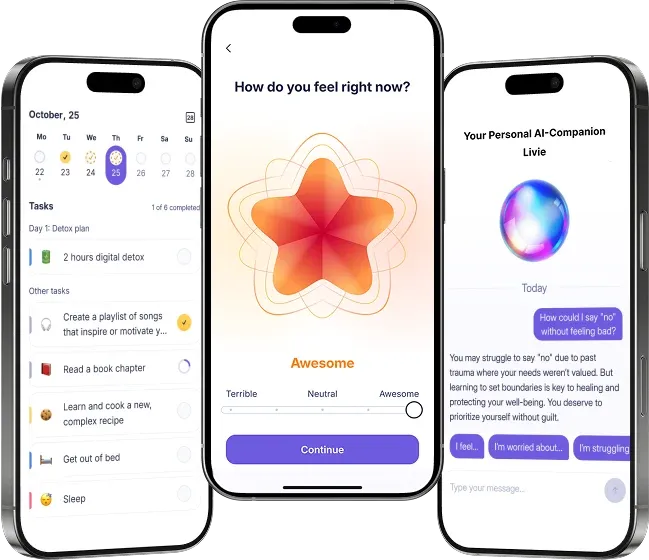
If you want a structured way to build the listening habit that sits underneath all of this, Liven's personalized plan starts with a short quiz and pairs daily check-ins with small reflection prompts. The practice becomes part of how you move through your day instead of one more thing on the list.
Sources
- Neff, K. D. (2023). Self-compassion: Theory, method, research, and intervention. Annual Review of Psychology, 74, 193–217. https://doi.org/10.1146/annurev-psych-032420-031047
- Sagone, E., Commodari, E., Indiana, M. L., & La Rosa, V. L. (2023). Exploring the association between attachment style, psychological well-being, and relationship status in young adults and adults: A cross-sectional study. European Journal of Investigation in Health, Psychology and Education, 13(3), 525–539. https://pmc.ncbi.nlm.nih.gov/articles/PMC10047625/
- Schroeder, J., & Fishbach, A. (2024). Feeling known predicts relationship satisfaction. Journal of Experimental Social Psychology, 111, Article 104559. https://www.sciencedirect.com/science/article/pii/S0022103123001166
- Yoshimura, S., Shimomura, K., & Onoda, K. (2024). Diminished negative emotion regulation through affect labeling and reappraisal: Insights from functional near infrared spectroscopy on lateral prefrontal cortex activation. BMC Psychology, 12, Article 613. https://doi.org/10.1186/s40359-024-02103-y
FAQ: Emotional Availability
What is the difference between emotional availability and vulnerability?
Can someone be emotionally unavailable and still love you?
How do I know if I'm emotionally unavailable?
Is being too emotionally available a bad thing?
How does attachment style relate to emotional availability?
Can therapy help with emotional unavailability?