Complex Emotions: What They Are and Why Naming Them Matters




You feel something heavy after a conversation ends well. You are relieved that a difficult situation is over, and also somehow miss it. You resent someone you love and feel guilty for the resentment. You are proud of a friend's achievement and privately wish it were yours.
These experiences are not contradictions or character flaws. Being able to hold two emotions at once is often a sign of emotional depth and maturity, not emotional instability.
The gap between what you feel and what you can articulate about that feeling turns out to have real consequences for well-being. This article breaks down what complex emotions are, why they are so hard to name, and what changes when you get better at naming them.
Key Learnings
- What you call sadness could be grief, longing, or disappointment. Emotional experience is far more layered than the handful of words most of us use to describe it.
- Naming what you feel precisely changes how well you handle it. Vague feelings linger. Named ones move.
- Feeling everything, even the hard stuff, is healthier than feeling only the easy parts.
- Telling frustrated from resentful, or anxious from disappointed, is a learnable skill.
What Are Complex Emotions, Exactly?
Most emotions are not single, clean things. Hate tends to involve fear, anger, and disgust at once. Grief moves between denial, sadness, and anger, sometimes in the same hour. Love holds joy, anticipation, and trust together. What we experience as one feeling is usually several things running at the same time.
It helps to understand the difference between emotions and feelings. Emotions are physical: the racing heart, the tight chest, the flush of heat. Feelings are what happen a second later, when your brain tries to make sense of those signals. Complex emotions involve multiple physical reactions firing at once, which is why they are so much harder to read than a simple feeling of hunger or cold.
The basic emotions most people know, happiness, sadness, fear, anger, surprise, and disgust, are just the surface. Daily emotional experience is far more layered, with feelings blending into each other in ways that resist simple labels.
There is no universal template, which is exactly why so many people struggle to identify what they are actually feeling.
Why They Are So Difficult to Name
Language is one reason. English doesn't have a word for the satisfaction of watching someone get what they deserve, or the specific ache of missing something you never quite had. Other languages do. The words you have set the ceiling on what you can describe, and for many complex emotions, the ceiling is low.
There is also the sheer effort involved. Mixed emotions, meta-emotions, and states like awe all require a level of self-observation that goes beyond noticing you feel bad. Feeling proud of a friend and envious at the same time means holding two truths that seem to cancel each other out. Most people would rather not, especially if they grew up in environments where certain emotions felt unsafe, inconvenient, dramatic, or unacceptable to express.
So they flatten it. They say they're fine, or just tired, or a bit off. It's easier. But the feeling doesn't go anywhere. It just stops having a name.
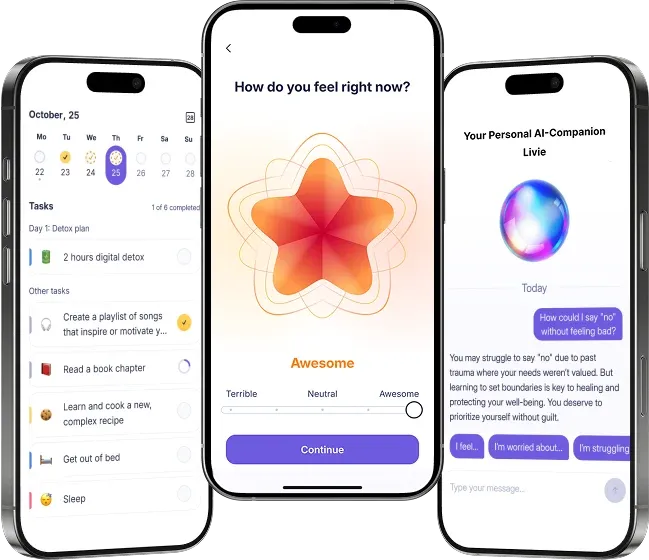
What Happens When You Can Name What You Feel
There is a meaningful difference between saying you feel bad and saying you feel ashamed. Or between saying you're stressed and recognizing you're actually scared. The more specific you can get, the more effectively you can respond.
The right label points you toward the right response. That's the only reason precision matters here. Shame needs something different than disappointment. Fear needs something different than exhaustion. A lot of people stay stuck because they've never learned what they're actually feeling underneath the surface tension. The capacity to handle the emotion is there. The vocabulary to name it is what's missing.
This also connects to something called emodiversity: the range of different emotions you experience over time.
People who feel a wider variety of emotions, including difficult ones, tend to have better mental and physical health. Not because they feel good more often, but because no single emotion gets to dominate long enough to do real damage. Someone who can feel sad, then curious, then hopeful within the same afternoon is less likely to get stuck than someone sitting inside one undifferentiated heaviness all day.
When a person experiences a wider range of distinct emotions, no single emotion dominates long enough to cause sustained damage. Prolonged undifferentiated sadness tends toward depression. The ability to also feel anger, or longing, or curiosity within that sadness may interrupt the spiral before it settles.
Dr. Lisa Feldman Barrett, one of the most cited neuroscientists in the world, explains why your emotions are not fixed reactions you are stuck with, and how the words you have for your feelings can shape what you feel:
Common Complex Emotions and What They Are Made Of
Understanding the components of specific complex emotions can make them easier to recognize and work with. Here is a complex emotions list that goes beyond the label and breaks down what is happening underneath each one:
| Emotion | What it is made of | What makes it tricky |
|---|---|---|
| Guilt | The belief that you did something wrong, plus genuine care about how it affected someone else. No empathy, no guilt. | People confuse it with shame, but they feel different. Guilt says: "I sent that message, and I shouldn't have." Shame says: "I am the kind of person who does things like that." Shame tends to spiral into depression. Guilt tends to motivate an apology. |
| Jealousy | Usually, a mix of fear of losing something important, anger toward whoever seems to be threatening it, and sadness about the relationship underneath. | The ingredients change depending on the situation. Jealousy toward a partner feels nothing like jealousy toward a colleague because the fear, anger, and sadness show up in different proportions each time. |
| Ambivalence | Genuinely wanting two opposite things at once. Loving someone and also feeling relieved when they leave. Wanting a job and dreading it equally. | Because it does not resolve, it creates a persistent low hum of discomfort. Most people respond by picking a side and suppressing the other, which does not make the other side go away. |
| Awe | The feeling of encountering something so vast that it forces you to update how you see the world. A mountain range, a piece of music, a moment of unexpected kindness. | It does not feel like a typical emotion, so people rarely name it. Awe reduces inflammatory markers, increases generosity, and makes time feel more spacious. But most people just call it a nice moment and move on. |
| Anticipatory grief | Mourning something before it is gone. A parent's declining health. A life chapter that is clearly ending. A relationship that is slowly changing beyond recognition. | Because when nothing has technically happened yet, it rarely gets named or treated as real grief. People often feel confused by their own sadness and receive far less support than they would after an actual loss. |
The Role of Emotional Granularity in Daily Life
Most people can tell when something feels off. What's harder is knowing whether it's disappointment, frustration, anxiety, or loneliness - four states that point toward completely different responses. Sometimes what looks like irritability is actually loneliness. Sometimes exhaustion is grief. Sometimes numbness is an overwhelm that’s been there for so long it stopped feeling noticeable.
Once you start developing emotional granularity, it gets better with practice.
The payoff is real. People who can put their emotions into words make fewer impulsive decisions in hard moments. Naming creates a small gap between feeling and reacting. In that gap, better choices become possible.
If you want a structured way to start building this skill, Liven's personalized plan meets you where you are, with tools and exercises designed around your specific emotional patterns.
References
- Dong, B., & Xu, G. (2022). An empirical study on the evaluation of emotional complexity in daily life. Frontiers in Psychology, 13, 839133. https://pmc.ncbi.nlm.nih.gov/articles/PMC8927077/
- Liang, Y., et al. (2023). Awe as a pathway to mental and physical health. Perspectives on Psychological Science, 18(2), 309–323. https://pmc.ncbi.nlm.nih.gov/articles/PMC10018061/
- Minusa, S., Yoshimura, C., & Mizuno, H. (2023). Emodiversity evaluation of remote workers through health monitoring based on intra-day emotion sampling. Frontiers in Public Health, 11, 1196539. https://www.frontiersin.org/journals/public-health/articles/10.3389/fpubh.2023.1196539/full
- Oh, H., Lee, D., & Cho, H. (2023). The differential roles of shame and guilt in the relationship between self-discrepancy and psychological maladjustment. Frontiers in Psychology, 14, 1215177. https://doi.org/10.3389/fpsyg.2023.1215177
- Oh, V. Y. S., & Tong, E. M. W. (2022). Specificity in the study of mixed emotions: A theoretical framework. Emotion Review, 14(3), 197–212. https://journals.sagepub.com/doi/abs/10.1177/10888683221083398
- ScienceDirect. (2025). Within-person changes in emotional complexity are associated with concurrent changes in mental health symptoms. https://www.sciencedirect.com/science/article/pii/S1697260025001164
FAQ: Complex Emotions
What do complex emotions mean?
Is it normal to feel two opposite emotions at the same time?
Why do complex emotions feel so hard to describe?
What is the difference between guilt and shame?
What is emotional granularity, and why does it matter?
Can you improve your emotional vocabulary as an adult?
What is emodiversity?
How are complex emotions different across cultures?
Why are human emotions so complex?