Best Mood Tracker App Picks: 5 Tools To Understand Your Feelings



You wake up with a heavy, uninvited fog in your mind. Not exactly sad, but definitely not okay. You blame the weather, a late email, a rough night of sleep, but honestly, you're just guessing. Without a clear way to track your emotions, understanding your own mind can feel like navigating a new city with no map.
This is exactly why so many people start searching for the best mood tracker app. The right mood tracking app helps you spot the pattern behind how you feel, not just the feeling itself.
Below is a breakdown of what the research says about mood tracking, the best apps to track feelings right now, and how to build the habit so it sticks.
Key Learnings
- Naming a specific emotion instead of a vague one shifts your brain from alarm mode into problem-solving mode, a pattern known as emotional granularity.
- Simple, low-effort tracking tools lead to far better long-term use than complex clinical setups.
- Linking your mood to daily activities and sleep reveals hidden behavioral triggers you'd otherwise miss.
Why Naming Your Feelings Works
To understand why an emotion tracker app helps at all, it's worth understanding what happens in your brain when you're stressed. Your amygdala, the brain's alarm system, goes into overdrive.
If you just tell yourself "I feel terrible," your brain stays stuck in generalized alarm. But if you can name the exact flavor of that feeling, maybe it's exhaustion or feeling overlooked, the load shifts to your prefrontal cortex, the part of your brain built for logic and problem-solving.
This is called emotional granularity, and the research backs it up. A 2026 study tracking participants over 28 days found that people with higher negative emotional granularity had significantly lower depressive symptoms and social anxiety. Learning to tell "restless" apart from "just bad" builds a real buffer against distress.
Mood tracking isn't only about naming the emotion. Contextual details matter too, like what you were doing, who you were with, how you slept.
If you want to dive deeper, Dr. Tracey Marks explains why naming your emotions matters in just under 6 minutes:
What to Look For in a Mood Journal App
Not every app on the market is built to support a real habit. The mistake most people make is picking the most complex, feature-packed tool available, then abandoning it within a week because it feels like homework.
Engagement research on mental health apps consistently shows that usage drops fast once an app feels like a chore. To build something you'll stick with, look for three things:
- Frictionless logging. You should be able to record your mood in under ten seconds. If it requires a full paragraph every time you feel anxious, you'll stop during a busy week.
- Contextual tracking. A good mood tracking app doesn't just ask how you feel, but also what you were doing, who you were with, and how you slept.
- Visual analytics. Clear, simple charts that show weekly or monthly patterns without requiring a statistics degree to read.
The Best Mood Tracker Apps Compared
Each of these apps takes a different approach to the same core problem, so the right pick depends on how much structure you want and how much you're willing to type.
| App | Core features | Best for |
| Liven | Mood Tracker, Journal, Smart Companion Livie, Today's Routine, Mood Breakdown analytics | Science-backed, low-effort daily habits |
| Daylio | One-tap icon logging, Year in Pixels visual map | Quick, icon-based tracking with no typing |
| How We Feel | Mood Meter framework, short video lessons from therapists | Building emotional vocabulary |
| Moodfit | CBT thought records, gratitude journal, breathwork, goal tracking | Structured, clinical-style tools |
| Bearable | Mood logging alongside symptoms, medication, sleep, and custom health factors | Tracking mood together with physical health |
Disclaimer: Features and app details above were last checked in mid-2026. Since apps update frequently, check each app's official page for the latest version before choosing one.
1. Liven, Best For Science-Backed, Low-Effort Daily Habits
Liven's Mood Tracker is built around quick emotional check-ins that take under ten seconds. You tap how you feel, and the app lets you add context: what you were doing, who you were with, how you slept. Over a few weeks, patterns emerge that would be invisible otherwise.
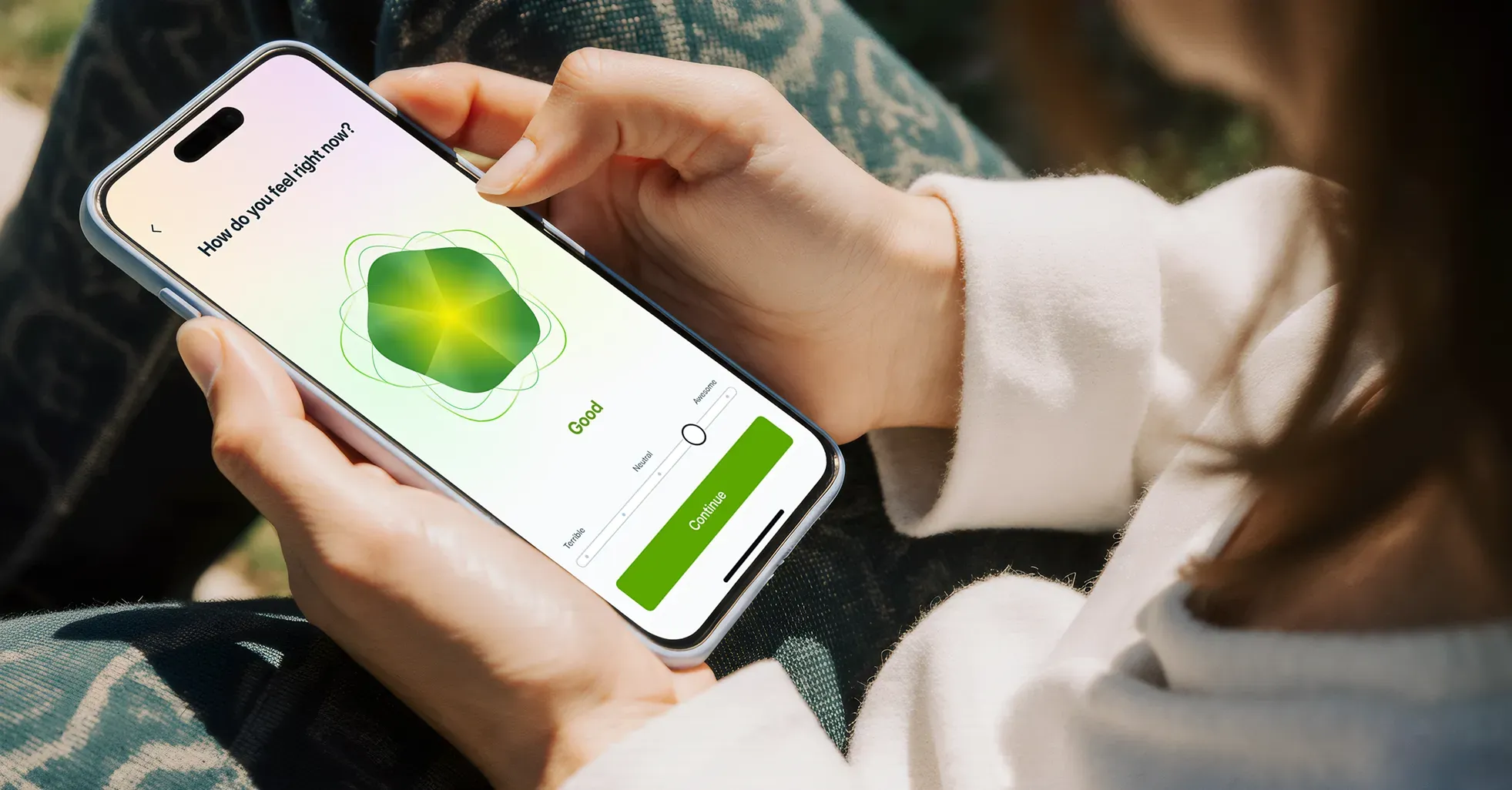
Say you notice your mood drops every Tuesday afternoon. Without tracking, you'd blame the day itself. With the data, you see it's actually because you skip lunch before your 2 PM meeting. Once you spot that link, you can fix it, instead of just living with Tuesday feeling terrible.
Liven also includes Journal for deeper reflection when you need it and a Smart Companion, Livie, that offers reflective prompts to help you process complex emotions in the moment.
2. Daylio, Best For Quick, Icon-Based Tracking
Daylio is built entirely around the one thing that kills most mood logs: friction. No text entry at all. You tap your mood (1-5 scale), then tap up to five activity icons (work, exercise, social, sleep, etc.) representing what your day looked like. It compiles this into a "Year in Pixels" visual heatmap where each day is a single colored square.
Over time, the pattern jumps out instantly. You can see at a glance that your mood consistently dips on Wednesdays, or that exercise days are visibly lighter colors than desk days. The entire interface is built around this one insight: mood data means nothing without context, and context doesn't require paragraphs.
3. How We Feel, Best For Building Emotional Vocabulary
How We Feel is a non-profit app built around the Mood Meter, a research-backed framework that maps emotions on two axes: energy (low to high) and pleasantness (unpleasant to pleasant). This means "anxious" and "overwhelmed" map to different spots on the grid, even though most people lump both under "stressed."
The app includes short video lessons from actual therapists and researchers (not just app designers) teaching you how to regulate each specific emotion once you've identified it. It's part mood journal, part education platform.
4. Moodfit, Best For Structured, Clinical-Style Tools
Moodfit is for people who want mood tracking to connect directly to behavior change. You set daily goals (sleep eight hours, do ten minutes of breathwork, practice gratitude), log your mood, and Moodfit shows you the correlation over weeks.
It includes CBT thought records, so when your mood drops, you can log the exact thought that triggered it, then use Moodfit's prompts to challenge that thought. Unlike apps that just track mood as a number, Moodfit treats mood as a direct output of your daily habits and thinking patterns. It's closer to a digital workbook than a diary.
5. Bearable, Best For Tracking Mood Alongside Physical Health
Bearable is built for people managing chronic conditions, medication, or any situation where mood doesn't move independently from the rest of your body. You log your daily mood on a scale, then add custom health factors you define: migraine days, medication doses, sleep hours, exercise, stress level, or any pattern you want to track.
The app then builds correlation charts showing exactly how these factors connect. Say you notice your mood drops after high-stress days, but only when you also skipped sleep. Bearable makes that connection visible by plotting them side by side. Or you realize a medication change three days ago is actually why this week feels flatter than last week, even though the timing wasn't obvious when it happened.
The point is moving from "my mood is worse today" to "my mood is worse on days when X, Y, and Z happen together," which fits the contextual tracking principle the research backs: mood data means more when it's tied to what else is happening in your life.
More Ways To Track Your Feelings
If none of the five above feel like the right fit, a few more specialized options are worth a look:
- Reflectly, best for AI-guided journaling prompts that adapt to your entries
- MoodKit, best for CBT-based mood improvement activities
- eMoods, best for tracking mood alongside bipolar disorder symptom patterns
Turning Your Mood Data Into Real Change
Tracking your mood is a diagnostic tool. The real value shows up when you actually use the data. If your app shows your mood consistently drops every Wednesday afternoon, that's a pattern worth investigating: is it a recurring stressful meeting, or did you skip lunch again?
A clinical trial protocol evaluating a self-monitoring app for mood disorders found that adherence to traditional paper-based self-monitoring homework sits around 50%, but simple digital tracking tools closed a meaningful part of that gap. The takeaway is practical: anchor your check-ins to something you already do, like right after your morning coffee or right before bed, instead of trying to remember on your own.
Some days will look rough on your mood chart. That's not failure, it's just data. Treat low-mood days with curiosity instead of judgment, and the tracking itself stays sustainable.



Moving Forward With Clarity
Mood tracking isn't about a perfect, unbroken streak of good days. Real value shows up when you stop running on autopilot and start noticing the small shifts, quiet triggers, and simple habits that bring you back to center.
If you're not sure yet which patterns are actually driving your mood, take Liven's quiz to get a clearer picture of where your energy is going before you commit to a tracking routine.
References
- Chan, G., Alslaity, A., Wilson, R., & Rajeshsingh, P. (2024). A longitudinal analysis of a mood self-tracking app: The patterns between mood and daily life activities. ResearchGate. https://www.researchgate.net/publication/378241512_A_Longitudinal_Analysis_of_a_Mood_Self-Tracking_App_The_Patterns_Between_Mood_and_Daily_Life_Activities
- ClinicalTrials.gov. (2025). The use of smartphone app (Kandoo) to enhance efficacy of brief behavioral activation in reducing mood disorder symptoms. U.S. National Library of Medicine. https://clinicaltrials.gov/study/NCT06825637
- Liu, S., Zabag, R., Xu, J., Wang, Y., Deng, W., Joormann, J., & Gadassi-Polack, R. (2026). Changes in emotional granularity under a population-level stressor predict social anxiety and depressive symptoms. Journal of Research on Adolescence, 36(1), e70131. https://doi.org/10.1111/jora.70131
- Milne-Ives, M., Homer, S. R., Andrade, J., & Meinert, E. (2023). Potential associations between behavior change techniques and engagement with mobile health apps: A systematic review. Frontiers in Psychology, 14, 1227443. https://doi.org/10.3389/fpsyg.2023.1227443
- Peake, A., Smith, C., Mandel, D., & Markham, A. (2024). Association between user engagement and clinical outcomes in smartphone apps for depression and anxiety: A systematic review and meta-analysis. NeuroImage Clinical, 41, 103638. https://doi.org/10.1016/j.nicl.2024.103638
- Shen, M., Thomas, S. J., Saleh, A., Zuberbier, J., & Tomlinson, G. (2024). Behavior change techniques used in self-management interventions based on mHealth apps for adults with hypertension: Systematic review and meta-analysis of randomized controlled trials. JMIR mHealth and uHealth, 12, e54978. https://doi.org/10.2196/54978
FAQ: Best Mood Tracker App
What is the best mood tracker app for beginners?
What's the difference between a mood journal app and a mood tracking app?
Can an emotion tracker app help with anxiety and depression?
How often should I use a mood tracking app?
Are mood tracker apps private and secure?
Can I use one of the best apps to track feelings alongside therapy?
Is Bearable a good choice if I have a chronic health condition?