Self-Validation: How to Trust Yourself Without Outside Approval




You finish a presentation, and the room is quiet. Two people nod; one is on their phone. Your boss says, "Fine." On the walk back to your desk, the inner monologue starts: Did they hate it? Was the joke flat? Why didn't anyone say anything?
By 8 PM, you've replayed it four times and posted a vague hopefully-someone-asks story on Instagram.
If that loop sounds familiar, you're in the company of most adults. For many people, needing outside approval is a nervous system adaptation. When approval, praise, or emotional attunement felt inconsistent growing up, the brain learns to read external validation as a signal of safety, belonging, or worth. Vanity and weakness have nothing to do with it.
Self-validation is the antidote: the skill of recognizing your own thoughts, feelings, and effort as legitimate without waiting for a verdict from someone else.
Key Takeaways
- Self-validation is accepting your inner experience as real and reasonable, even when others don't see it the same way.
- It is a learnable skill from Dialectical Behavior Therapy, not a personality trait you either have or you don't.
- Daily practices like naming feelings, journaling, and mood check-ins build the skill faster than reading about it.
- Long-term progress comes from consistency, which is where a structured plan helps more than willpower.
What Self-Validation Means
Self-validation means learning to stay connected to yourself, even before someone else confirms your experience. You're anxious before a meeting, and instead of telling yourself to calm down, you let the anxiety be a reasonable response to something: being watched, being judged, caring about how it goes.
That's it. You don't have to like the feeling. You don't have to act on it. You stop fighting yourself over having it in the first place.
The idea has a clinical home in Dialectical Behavior Therapy (DBT). Marsha Linehan, who developed DBT in the 1990s, described six levels of validation. They build from paying attention all the way up to treating someone (including yourself) as a whole person rather than a problem to fix. The last level is the one most of us miss. We notice a feeling, we name it, and then we still treat ourselves like something broken.
Practice it for long enough, and the emotional spikes get smaller and easier to ride out. One bad afternoon stops becoming a bad week.
The short version: self-validation is being a fair witness to what is going on inside you.
Why External Validation Feels Easier
Approval from other people lights up the brain's reward system in a way that praising yourself does not. Adults whose self-worth is tied to social media feedback (a pattern researchers call social media contingent self-esteem) are more vulnerable to problematic use and steeper self-esteem swings linked to their online activity.
The trade-off is that outside validation is inconsistent by design. Your friend is tired. Your manager is distracted. The algorithm changes. If your sense of worth tracks those signals, your mood tracks them too. Caring what other people think is part of being human. The shift that helps is taking in other perspectives while staying connected to your own.
Self-validation cuts the dependency. It doesn't make you immune to criticism or indifferent to praise. Instead, it widens the gap between what someone says and how rattled you feel afterward.
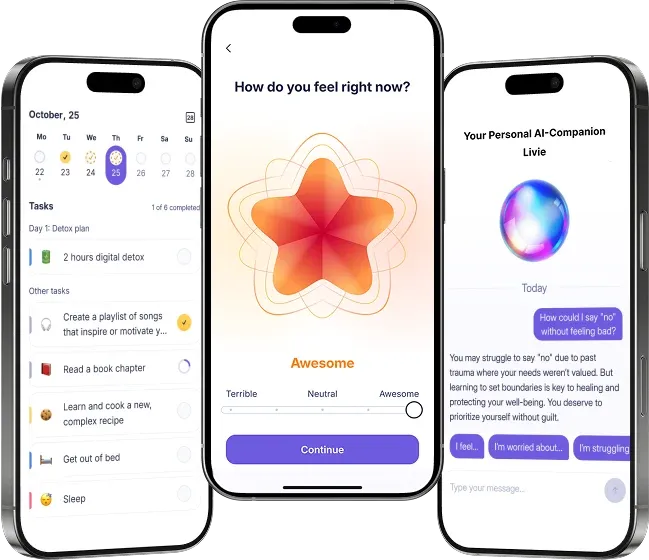
How to Practice Self Validation: A Daily Approach
Practicing self-validation is less about big breakthroughs and more about small, repeatable moves. The four below are the ones therapists tend to start clients with, and they work in any order.
Name What You Feel Without Judging It
Most of us grew up doing everything but sit with our feelings. We judged them, tried to fix them, talked ourselves out of them. We move from feeling to interpretation in under a second: I feel nervous becomes I'm being ridiculous.
Naming a feeling without attacking yourself for having it is often where self-trust starts. Anxious. Irritated. Disappointed. Research on affect labeling shows that putting a feeling into words reduces amygdala activation within seconds.
Separate the Feeling From the Story
You can feel embarrassed without the story being I'm an embarrassment. The feeling is information. The story is an interpretation. Write both side by side and notice which one you've been treating as fact.
Speak to Yourself the Way You'd Speak to a Friend
Kristin Neff's self-compassion research shows that self-kindness during failure predicts faster recovery and less avoidance than self-criticism does. A simple prompt: what would I say to a friend who told me this exact thing? Then say it to yourself. Out loud, if you can.
Track Patterns Over Time
You won't notice your own progress without a record. Logging mood and context across weeks shows you which situations pull you toward outside approval, and which ones you've started handling differently.
A Simple Self-Validation Worksheet You Can Use Today
If you're looking for a self-validation worksheet to start with, this five-prompt version covers the basics. Run through it in writing the next time you catch yourself spinning.
- Situation. What happened, in two sentences.
- Feeling. One word, or two if you need them. Resist the urge to explain.
- Context. What in your history or in the moment makes this feeling reasonable?
- Friend response. If a friend told you this exact thing, what would you say to them?
- Small next step. What is one action you can take in the next hour that respects the feeling without being run by it?
How to Find Self-Validation When You're Out of Practice
If you grew up in a home where feelings were dismissed or in a workplace that rewarded constant output, the muscle is going to feel weak at first. That is normal. Finding self-validation, in the early days, often starts with permission rather than performance.
Try this for one week. Every time you notice yourself reaching for someone else's reaction, pause and ask: What would I think about this if no one were watching? Don't grade the answer. The point is to notice that you have one.
Mental check-ins can speed this up. Validated self-assessments give you a structured way to see where you are without trusting only the loudest internal voice.
Common Mistakes to Avoid When Practicing Self-Validation
A few patterns slow people down more than they expect.
- Validating only the comfortable feelings. Self-validation includes anger, envy, grief, and resentment. If you only validate calm and gratitude, you've built a filter, not a practice.
- Confusing validation with agreement. Validating a feeling means accepting that it makes sense, not that the feeling is accurate or that you have to act on it. Jealousy can be reasonable even if your partner hasn't done anything wrong. Anger can be valid without an angry text being the right move. The feeling gets respect - what you do with it stays your decision.
- Skipping the body. Naming a feeling without checking where it sits in the body keeps the practice in your head. Notice the tight chest, the held breath, the clenched jaw. The body is often a more honest reporter than the narrative.
- Going it alone forever. Self-validation reduces dependency on outside approval. It does not replace therapy, friendship, or community. If self-criticism is constant or severe, work with a licensed professional.
How to Work on Self-Validation Long Term
Knowing how to work on self-validation is one thing. Keeping at it for six months is another.
Progress in self-validation often feels quieter than people expect. Sometimes it looks like spiraling for twenty minutes instead of three hours. Sometimes it looks like noticing self-criticism faster. Small moments of internal safety still count as progress. A structured path tends to help more than willpower at this stage.
Short, daily routines work better than long monthly resets. Ten minutes a day, repeated, beats a weekend retreat you forget by Wednesday. If you want a plan that adapts to where you are, Liven builds your personalized wellbeing management plan from a short quiz. It pairs daily lessons with mood check-ins and journal prompts, so the practice has a frame rather than a vibe.
If you want more on how small daily habits stick when willpower runs out, this piece on habit forming through Liven walks through the same model applied to broader well-being goals.
Sources
- Fujiwara, S., Ishibashi, R., Tanabe-Ishibashi, A., Kawashima, R., & Sugiura, M. (2023). Sincere praise and flattery: Reward value and association with the praise-seeking trait. Frontiers in Human Neuroscience, 17, Article 985047. https://doi.org/10.3389/fnhum.2023.985047
- Hernandez-Bustamante, M., Cjuno, J., Hernández, R. M., & Ponce-Meza, J. C. (2024). Efficacy of dialectical behavior therapy in the treatment of borderline personality disorder: A systematic review of randomized controlled trials. Iranian Journal of Psychiatry, 19(1), 119 to 129. https://doi.org/10.18502/ijps.v19i1.14347
- Martinez, A., Browne, L. J., & Knee, C. R. (2024). Conceptualizing social media contingent self-esteem: Associations between echo chambers, contingent self-esteem, and problematic social media use. Cyberpsychology: Journal of Psychosocial Research on Cyberspace, 18(3), Article 2. https://doi.org/10.5817/CP2024-3-2
- Neff, K. D. (2023). Self-compassion: Theory, method, research, and intervention. Annual Review of Psychology, 74, 193 to 217. https://doi.org/10.1146/annurev-psych-032420-031047
- Yoshimura, S., Shimomura, K., & Onoda, K. (2024). Diminished negative emotion regulation through affect labeling and reappraisal: Insights from functional near infrared spectroscopy on lateral prefrontal cortex activation. BMC Psychology, 12(1), Article 613. https://doi.org/10.1186/s40359-024-02103-y
FAQ: Self-Validation
What is self-validation in psychology?
Is self-validation the same as self-love?
How long does it take to build self-validation?
Can self-validation replace therapy?
What is the difference between self-validation and validation seeking?
Why do I struggle with self-validation?
Is self-validation selfish?
Where can I find a self-validation worksheet?