How to Deal With Boredom Without Reaching for Your Phone




You're staring at the same paragraph you've been trying to read for ten minutes. Your mind drifts. You check your phone, then the fridge, then your phone again. That restless, prickly feeling has a name: boredom. The first instinct is to run, to fill the space with anything that moves, scrolls, or clicks. What if boredom is not a hole to fill, but a message worth reading?
If you want to learn how to deal with boredom in a way that lasts longer than the next reel, the trick is to stop fighting the feeling and start listening to it. Boredom is your brain telling you that something is off. The work is to figure out what.
Key Takeaways
- Boredom is a signal, not a flaw. Your brain flags that something specific is missing, and the work is figuring out what.
- Most quick fixes fail because they treat every kind of boredom the same. Work boredom, class boredom, ADHD boredom, and chronic boredom each ask for a different response.
- The move that breaks the scroll loop: pause, name what the feeling wants, act on that instead of grabbing the nearest screen.
Boredom Is a Signal, Not a Failure
Most of us treat boredom like a personal failing. Proof we should be doing more, achieving faster, scrolling smarter. Your brain disagrees. It's tuned to notice when something has gone flat on you, and boredom is how it taps you on the shoulder.
There is a clear difference between the boredom of a quiet Sunday afternoon and the heavy, low-grade boredom that follows you for weeks. The first is healthy. The second is worth attention. Persistent boredom shows up alongside symptoms of depression, anxiety, and apathy, which is why how to deal with chronic boredom is a separate question from how to handle a slow Tuesday.
A Simple Way to Handle It: Listen, Interpret, Act
Most of us skip straight from "I feel bored" to "Let me find a distraction." With boredom, curiosity is the move. Ask what it's pointing toward, and you usually get an answer.
The Listen, Interpret, Act frame slows that loop down enough for the signal to come through.
| Step | What it sounds like |
|---|---|
| Listen | Pause for 30 seconds. Where do you feel the boredom in your body? Restless legs, tight jaw, heavy chest? |
| Interpret | Ask one question: What is this boredom telling me I need right now? Challenge, connection, rest, novelty, or meaning? |
| Act | Pick the action that fits the answer, not the action that is closest to your hand. |
The hardest step is the first one. Most of us never get past it, which is how scrolling becomes the default response to every kind of boredom, even the ones it makes worse.
How to Deal With Boredom at Work
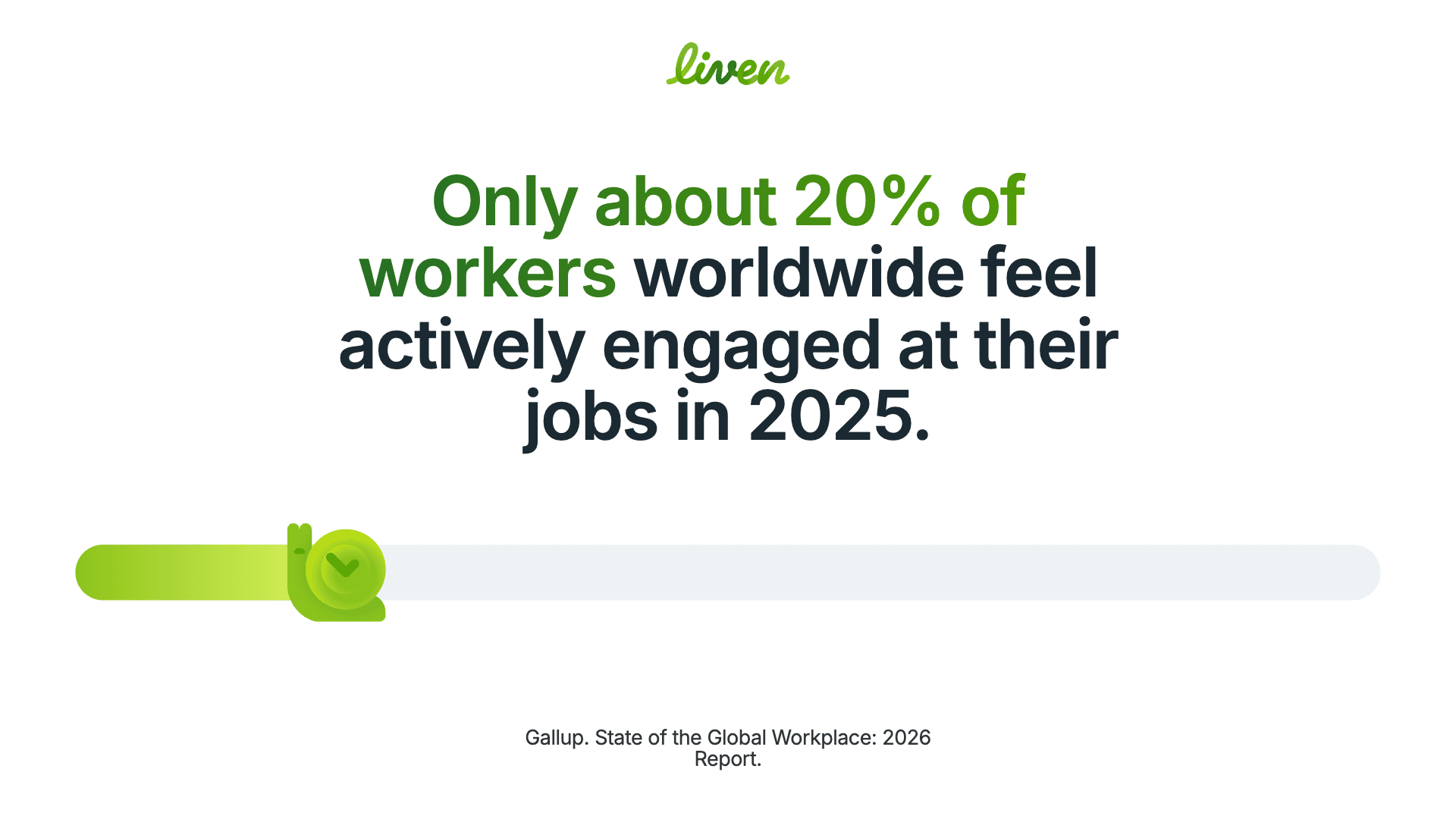
Workplace boredom usually comes from one of two places. Either the task is too easy, and your brain has nothing left to solve, or the task feels meaningless, and your brain has nothing left to care about. Only about a quarter of workers worldwide feel actively engaged at their jobs, so if you feel this way, you are far from alone.
A few things that help:
- Craft your role. Look for one small piece of your week that could become slightly bigger or slightly different. Volunteering for the kickoff meeting of a project you would not normally touch. Learning the shortcut your team keeps mentioning. The point is to give your brain something fresh to chew on.
- Set a micro-challenge. Turn a repetitive task into a game. Clear the inbox in 15 minutes instead of 25. Try to write the next status update in half the usual words. Small constraints wake the brain up.
- Name what is missing. If you have been bored at work for months, the issue is likely bigger than the task in front of you. It might be a missing sense of progress, of recognition, or of fit. Naming it is the first step toward changing it.
How to Deal With Boredom in Class
Class boredom has its own shape. You're stuck in a chair, the pace is set by someone else, and the material is moving either too slow or too fast for the way your brain works. Walking out isn't an option. Phone scrolling helps for two minutes and hurts for the rest of the day.
Try one of these the next time the clock stops moving:
- Turn passive listening into active translation. Try to summarize the lecturer's last point in one sentence you would actually say out loud to a friend. The translation step forces your brain to engage with the content, which is what boredom is asking for.
- Ask one question per class. Even a small one. Even silently to yourself. Questions reframe the material as a puzzle, and puzzles are more interesting than facts.
- Take notes by hand if you can. Handwritten notes engage more of the brain than typing does, partly because you have to choose what is worth writing down. That choice is a form of attention.
- Build in micro-recovery between sessions. Two minutes of looking out a window between classes resets your attention more than two minutes of phone-checking. Your brain needs space between inputs, not more inputs.
How to Deal With ADHD Boredom
For ADHD brains especially, boredom can feel physically uncomfortable, not just mentally annoying. Your reward system runs on a different gas. ADHD brains have a blunted response to ordinary stimulation, which is why the same staff meeting that holds a friend's attention can feel almost physically painful to sit through. If you've been blaming yourself for not finding the right hobby, that's worth letting go of.
The ADHD brain processes reward differently, and willpower doesn't change that. This article on dopamine and ADHD walks through the science in more detail.
The strategies below give your brain what it's asking for, rather than asking you to force yourself to care.
- Lean into novelty, not willpower. A new chair, a new playlist, a different cafe. Small changes in the environment can shift your brain out of a slump that no amount of pep talk can.
- Body double. Work next to someone, in person or on a video call, even if you're doing completely different things. The shared presence helps your brain stay on task without you having to force it.
- Stack high-interest with low-interest. Listen to a podcast you love while folding laundry. Pair tedium with stimulation rather than fighting them.
- Break tasks into 15-minute pieces. Long focus blocks are a setup for failure. Short blocks with built-in transitions match how the ADHD brain cycles between bursts of attention.
How to Deal With Chronic Boredom
Chronic boredom is the one that follows you. It does not go away when the situation changes. You take a vacation and feel bored in a new city. You change jobs and feel the same dull weight in a different chair. This kind of boredom is usually not about your schedule. It is about a missing sense of meaning or rest, and sometimes about something deeper.
Persistent boredom is closely tied to symptoms of depression, apathy, and anhedonia, so it is worth taking seriously rather than trying to power through. A few first steps:
- Check rest before checking stimulation. If you have been running for months, your brain might not need a new hobby. It might need actual rest. Not Netflix while checking email rest, but real rest where nothing is competing for your attention.
- Look at the connection. Long-term loneliness raises the risk of serious health outcomes, and the boredom that comes from disconnection often gets misread as a need for more activity. Sometimes the answer is a phone call, not a new project.
- Ask the meaning question, slowly. What did you care about a year ago? Five years ago? When did you last feel engaged for more than an hour? The answers are clues, not verdicts.
- Talk to someone. If chronic boredom is sitting on top of low mood, low energy, or a flat feeling that won't lift, you don't have to figure it out alone. A licensed therapist can help you find what is underneath.
Common Mistakes When Dealing With Boredom
Some go-to boredom moves look like solutions and make the feeling worse. The classic example: phone out, scroll for ten minutes, look up twitchier and lonelier than when you started. Here are the ones to watch for.
- Treating every kind of boredom the same way. Scrolling helps for two minutes and makes the underlying feeling louder. Match the response to the type.
- Adding more input when you need less. Your nervous system can't tell the difference between nothing interests me anymore and I've been emotionally overloaded for too long unless you slow down enough to listen.
- Skipping the body. A two-minute walk often does more for boredom than a thirty-minute think.
- Mistaking chronic boredom for laziness. When the heaviness won't shift for weeks, calling yourself lazy just adds shame to a feeling that's already heavy enough. Something beneath the surface is asking for attention, and pep talks don't usually uncover it.
If you want to know more about why filling every empty minute is one of the most common mistakes we make, Harvard professor Arthur C. Brooks walks through what your brain does when you let it sit still:
Boredom Isn't the Problem to Solve
Boredom isn't always asking for more stimulation. Sometimes it's asking for more aliveness.
Most of the time, boredom is pointing at something specific: a missing challenge, an actual person you've been meaning to call, or the plain fact that you're tired and the world won't leave you alone. Thirty seconds with the feeling, before the phone comes out, usually tells you which one.
The four types in this article aren't a strict checklist but starting points. Your boredom might be its own mix, and that's fine. The work isn't to label it perfectly. The work is to stop treating it like an enemy.
If you want a structured way to build that listening habit, Liven puts together your personalized well-being management plan from a short quiz. It pairs daily check-ins with small, brain-friendly actions, so the next time boredom taps you on the shoulder, you'll know what to say back.
Sources
- Gallup. (2023). State of the global workplace 2023 report. Gallup, Inc. https://www.gallup.com/workplace/349484/state-of-the-global-workplace.aspx
- Le Cunff, A.-L. (2024). Distractibility and impulsivity in ADHD as an evolutionary mismatch of high trait curiosity. Evolutionary Psychological Science, 10(3), 282 to 297. https://link.springer.com/article/10.1007/s40806-024-00400-8
- Sharpe, B. T., Trotter, M. G., & Hale, B. J. (2025). Sustaining student concentration: The effectiveness of micro-breaks in a classroom setting. Frontiers in Psychology, 16, Article 1589411. https://doi.org/10.3389/fpsyg.2025.1589411
- Seiler, J. P. H., Zerr, K., & Rumpel, S. (2023). High state boredom vastly affects psychiatric inpatients and predicts their treatment duration. Translational Psychiatry, 13, 380. https://www.nature.com/articles/s41398-023-02650-9
- Tagliaferri, G., et al. (2025). Connected by boredom: A systematic review of the role of trait boredom in problematic technology use. Brain Sciences, 15(8), 794. https://www.mdpi.com/2076-3425/15/8/794
- Wang, F., Gao, Y., Han, Z., Yu, Y., Long, Z., Jiang, X., Wu, Y., Pei, B., Cao, Y., Ye, J., Wang, M., & Zhao, Y. (2023). A systematic review and meta-analysis of 90 cohort studies of social isolation, loneliness and mortality. Nature Human Behaviour, 7, 1307 to 1319. https://www.nature.com/articles/s41562-023-01617-6
FAQ: How to Deal With Boredom
Why do I get bored so easily?
Is it okay to just be bored and do nothing?
How can I deal with boredom without my phone?
What's the difference between boredom and laziness?
Can chronic boredom be a sign of a mental health condition?
How do you deal with existential boredom?
What are some quick ways to beat boredom at work?
Is there a link between boredom and ADHD?