What Causes Lack of Motivation? The Science Behind Why You Can't Get Started




It's 2:00 PM on a Tuesday. The coffee has worn off, your most important task is staring you down, and you'd rather do anything else: scroll social media, organize your spice rack, stare at the ceiling. You call it a personal failing. But the real explanation is neurological.
Your brain is constantly running a cost-benefit analysis for every action you take. When it predicts that the effort required outweighs the potential reward, it hits the brakes.
Chronic low-grade inflammation, for example, can directly disrupt the brain's dopamine pathways - the very system that drives motivation and desire to act. When those pathways are dampened, getting started on anything feels harder than it should. That feeling of being stuck isn't a character flaw. It may be your body's stress response showing up in your brain chemistry.
Key Takeaways
- Lack of motivation is often rooted in your brain's reward system, specifically the neurotransmitter dopamine, not a character flaw like laziness.
- If a task seems too costly (high effort, high stress) for too little reward (no clear purpose, no immediate satisfaction), your brain will veto it to conserve energy.
- Burnout is characterized by energy depletion, cynicism, and reduced professional effectiveness, all of which directly sabotage motivation.
- You can't wait for motivation to strike. Taking one small, low-effort action can generate a small dopamine release, creating the momentum needed to keep going.
The Reason You Feel Unmotivated: Your Brain’s Reward System
Think of your brain as having a very pragmatic accountant living inside. This accountant's job is to manage your energy budget, and its favorite tool is a neurotransmitter called dopamine.
Dopamine is often misunderstood as the pleasure chemical, but it's more accurately the motivation chemical. Its primary role is to drive you to seek rewards. When your brain anticipates that doing something will lead to a good outcome, it releases dopamine, which creates the feeling of drive or desire.
But when that internal accountant looks at a task and sees a problem, the dopamine faucet stays off. This happens for a few key reasons:
1. The Reward Is Too Vague or Too Far Away
Your brain prefers immediate, predictable rewards. When you're working on a long-term project, the final payoff can feel abstract and distant. The perceived value of a reward decreases the longer you have to wait for it, a phenomenon known as temporal discounting.
If your brain can't clearly picture the reward for sending that difficult email or starting that daunting report, it calculates the effort as not worth it. That's why you suddenly feel an urgent need to check your inbox for the tenth time.
2. The Perceived Effort Is Too High
Sometimes, the problem is not the reward itself. When a task feels too big, complex, or emotionally draining, your brain's cost-benefit analysis flags it as a poor investment of energy. Overwhelm is a major motivation killer.
This is especially true when you're already running on empty. Burnout and work engagement have a significant negative correlation: the more burned out you are, the harder it becomes for your brain to muster the energy to start anything new.
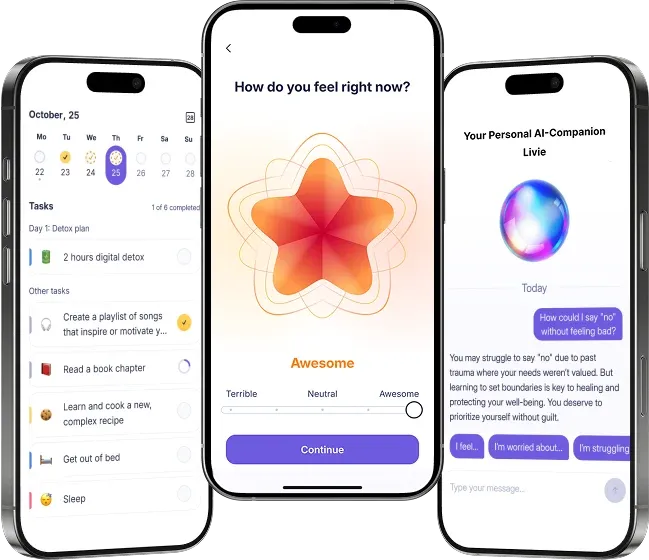
If you're feeling overwhelmed, tools that help you externalize and organize your thoughts can be incredibly effective. Writing things down gets them out of your head and into a place you can work with. Tools like journaling - whether in a notebook or apps like Liven - can help.
3. There's a Value Mismatch
Three things shape motivation: your brain, your environment, and what matters to you. Even with the right neurochemistry and the right mindset, it plummets when the tasks you're doing don't align with what you care about. If you're in a job that doesn't connect with your personal values or strengths, every workday can feel like a battle against your own brain.
Autonomy, competence, and relatedness are three universal psychological needs that fuel intrinsic motivation:
- Autonomy: The feeling of control and choice over your actions.
- Competence: The feeling that you are good at what you do.
- Relatedness: The feeling of connection to others.
When your work environment undermines these needs (think micromanagement, unclear expectations, or a toxic team), your intrinsic motivation dries up.
How to Work With Your Brain, Not Against It
Understanding the neuroscience of motivation shifts the goal from forcing yourself to do things to creating the right conditions for your brain to want to do things.
The tips below are grouped by the three patterns we just covered, so you can start with the one closest to your situation.
If The Reward Feels Too Vague or Too Far Away
Track your progress visibly. Dopamine doesn't only fire when you reach a goal. It fires for signals of progress along the way, a finding from decades of reward-learning research. The brain treats cues of forward movement as rewards in themselves, which is why visible markers work so well. A checked box, a filled-in square, a paperclip moved from one jar to another: each one is concrete proof you're moving, and the marker itself becomes a small reward. Try a simple checklist, a physical token system, or Liven's Mood Tracker to watch your consistency build.
Temptation bundling. Pair a task you're avoiding with something that already gives you a dopamine boost. Listen to your favorite podcast only while you're cleaning the kitchen, or enjoy a great cup of coffee only while you're tackling your morning emails. Pairing enjoyable activities with necessary ones strengthens habit formation by making less desirable behaviors feel like a gateway to something you genuinely look forward to.
Manage your reward baseline. Scrolling and notifications give your brain a steady stream of quick, intense rewards. Over time, that raises the bar for what feels worth doing, so longer-term, less stimulating goals start to feel flat and harder to begin.
If The Effort Feels Too High
Focus on the first 5 minutes. The biggest hurdle is often just starting. Commit to working on a dreaded task for only five minutes. This lowers the perceived effort so much that your brain's accountant is more likely to approve it. Often, once you start, the momentum carries you forward. It can feel like unfinished tasks tug at us until they're done. Psychologists call this the Zeigarnik effect, named after Bluma Zeigarnik, who in the 1920s noticed that waiters remembered unpaid orders far better than paid ones. Even the smallest start creates a mental pull toward completion.
If The Work Doesn't Feel Like It Matters Enough
Reconnect the task to something you care about. When work feels meaningless, no reward structure can fix it. Take 30 seconds to write down what finishing this task makes possible: for your future self, your team, or someone you love. A thin connection to something you value is often enough to make a flat task feel worth starting. If you genuinely can't think of anything, that's useful data too. The task may not deserve your time, and that's a different conversation.
Conclusion: Your Motivation Is a Messenger
If you take one thing away from this, let it be this: lack of motivation is a message. It might be your body telling you it needs rest. It might be your mind telling you that a goal is too vague or doesn't align with your values. Or it might be your nervous system telling you that you're burned out and need to change your environment.
Instead of judging the feeling, ask what it might be telling you. Is this exhaustion asking for rest? Is this resistance asking for a smaller starting point? Is this emptiness asking for work that actually means something to you?
By understanding the biological and psychological forces at play, you can stop fighting yourself and start creating the conditions for your natural drive to return.
Want to Go Deeper?
If you want to go deeper into the science, Stanford neuroscientist Andrew Huberman has a 32-minute episode on this exact topic. Short enough to fit into a walk or commute, and worth the time if the dopamine framing in this article clicked for you:
Sources
- Bekhbat, M., Goldsmith, D. R., Woolwine, B. J., Haroon, E., Miller, A. H., & Felger, J. C. (2023). Functional connectivity in reward circuitry and symptoms of anhedonia as therapeutic targets in depression with high inflammation. Molecular Psychiatry, 28(3), 1280–1289. https://doi.org/10.1038/s41380-022-01879-8
- Fremling, L., Phillips, L. A., Bottoms, L., Desai, T., & Newby, K. (2025). Comparing positive versus negative intrinsic rewards for predicting physical activity habit strength and frequency during a period of high stress. Applied Psychology: Health and Well-Being. https://pmc.ncbi.nlm.nih.gov/articles/PMC11793929/
- Gallup. (2024). U.S. employee engagement hits 11-year low. https://www.gallup.com/workplace/643286/engagement-hits-11-year-low.aspx
- Jiménez, P., et al. (2022). Burnout and work engagement: A meta-analysis. International Journal of Environmental Research and Public Health, 19(15), 8969. https://www.mdpi.com/1660-4601/19/15/8969
- Milkman, K. L., Minson, J. A., & Volpp, K. G. (2014). Holding the hunger games hostage at the gym: An evaluation of temptation bundling. Management Science, 60(2), 283–299. https://doi.org/10.1287/mnsc.2013.1784
- Nayak, P., & Bhave, A. (2024). Self-determination theory and workplace outcomes: A conceptual review and future research directions. Behavioral Sciences, 14(6), 428. https://www.mdpi.com/2076-328X/14/6/428
- Schultz, W. (2016). Dopamine reward prediction-error signalling: A two-component response. Nature Reviews Neuroscience, 17(3), 183–195. https://doi.org/10.1038/nrn.2015.26
- Sharpe, B. T., & Spooner, R. A. (2025). Dopamine-scrolling: A modern public health challenge requiring urgent attention. Perspectives in Public Health. https://journals.sagepub.com/doi/10.1177/17579139251331914
- World Health Organization. (2022). ICD-11: International classification of diseases, 11th revision. https://icd.who.int/en
- Zhang, P. Y., & Ma, W. J. (2024). Temporal discounting predicts procrastination in the real world. Scientific Reports, 14, 14642. https://pmc.ncbi.nlm.nih.gov/articles/PMC11199680/
FAQ: What Causes Lack of Motivation?
Why do I feel lazy and unmotivated all the time?
What causes sudden lack of motivation?
What causes lack of motivation and energy?
What causes lack of motivation at work?
How do I get my motivation back?
What causes lack of motivation in students?