How to Stop Scrolling and Reclaim Your Focus




Your focus throughout the day is often dictated by one simple factor: whether your phone is within reach. What starts as a quick check can spiral into hours of scrolling, leaving your attention fragmented and your mind overstimulated. Most of what you consume fades quickly anyway, but it still chips away at your ability to focus.
In this article, we’ll explore practical strategies to help you break this cycle and spend your days with better focus and intention.
Key Learnings
- Scrolling habits are reinforced by the brain’s dopamine reward system and constant novelty.
- Recognizing emotional and situational triggers is the first step toward behavior change.
- Small tips, routines, and environmental adjustments can significantly reduce screen time.
Why Do We Scroll?
When you start scrolling through a feed, your brain receives small bursts of reward with every new post. Each swipe promises something new, which could be anything: a political take, an attractive person, a relatable meme, etc.
Over time, your brain begins to associate your phone with these quick emotional boosts. Even if the content itself isn’t meaningful, the anticipation keeps the cycle going. That’s why a simple habit can quickly turn into long stretches of scrolling. Moreover, highly stimulating content raises the baseline for what feels engaging, making less stimulating activities feel flat or boring by comparison.
Many people turn to social media to cope with boredom, fatigue, or anxiety, using it as a quick distraction or a way to unwind. For some, it can feel genuinely relaxing in the moment. But research suggests that for certain people, frequent passive scrolling may be associated with higher anxiety symptoms over time, and that those who already feel anxious may be more likely to use social media in ways that maintain, rather than relieve, that feeling.
Understanding Your Triggers
The first step is noticing when the urge to reach for your phone appears. Try to ask yourself:
- Do I start scrolling when I feel bored?
- Do I scroll to avoid awkward social interactions?
- Do I check my phone after a stressful meeting or conversation?
- Do I scroll immediately after waking up or before going to sleep?
According to studies, such psychological triggers, sometimes also called habit cues, can be grouped into two broad categories: internal (emotional) and external (situational and environmental).
Internal triggers arise from thoughts, emotions, and physical states, while external triggers can be broken down further into situational and environmental factors. Situational triggers are tied to specific contexts or moments, whereas environmental triggers stem from external cues like surroundings, objects, or sensory input.
In our context, they often show up as:
- Emotional (internal) triggers: feelings like stress, loneliness, or anxiety that drive the urge to reach for your phone.
- Situational triggers: idle or transitional moments, such as commuting, waiting, or taking breaks.
- Environmental triggers: external cues like notifications, screen lights, or simply having your phone within reach.
A useful tip to stop scrolling is to pause when the urge appears. Instead of unlocking your phone immediately, take a few deep breaths and notice what you’re feeling. Even a short pause can interrupt the automatic cycle. Over time, these small moments of awareness help retrain the brain.
Practical Strategies to Stop Scrolling
The most reliable way to scroll less is to make scrolling slightly less automatic. Small changes to your phone setup and your physical space can do more than any motivation push. The strategies below offer a few different angles to work from, so start with the one that feels easiest and build from there.
Set Clear Boundaries
One of the simplest ways to stop scrolling is to define clear boundaries around your phone use. You may decide to avoid social media during certain hours, keep your phone outside the bedroom, or disable nonessential notifications. You can also try to set time limits on certain apps.
When your phone stops constantly interrupting you, the urge to scroll naturally decreases.
Pause Before Unlocking Your Phone
A simple but powerful strategy is to create a short pause before unlocking your phone. Ask yourself: “Why am I checking my phone right now?”
This question helps you see whether you’re acting intentionally or habitually. It serves as a small mental checkpoint that can significantly reduce unconscious scrolling. For many people trying to stop doomscrolling, this pause becomes a turning point.
Focus on Growing Emotional Awareness
Scrolling feels powerful because it amplifies emotional responses. Short-form content is designed to trigger those reactions, as content creators have only seconds to capture your attention through emotional hooks. As you continuously scroll through such content, you may not consciously notice it, but you’re repeatedly triggering comparison, anxiety, or frustration.
This pattern is reinforced by a dopamine-driven addictive loop, as each new post or notification delivers a small reward, encouraging you to keep scrolling in search of the next hit.
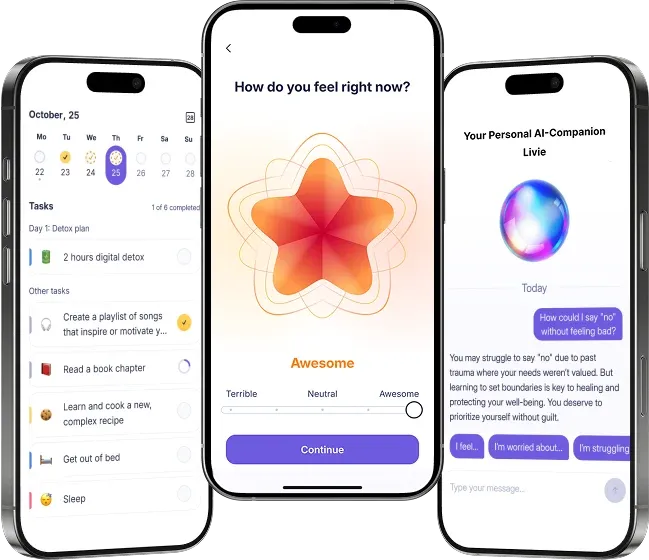
Building emotional awareness helps you pause, recognize what you’re feeling, and respond intentionally rather than keep scrolling. Tools like Mood Tracker and Mood Breakdown in the Liven app can support this by helping you track emotions and identify overall patterns in your behavior.
Replace the Scrolling Habit
Scrolling usually fills small gaps in the day. When those idle moments appear, the brain reaches for the familiar behavior. Replacing the habit is one of the most effective behavior change hacks. Instead of reaching for your phone, try alternatives that provide a similar mental reset:
- Reading a few pages of a book
- Stretching or walking briefly
- Writing a quick journal entry
These activities give your mind a break without pulling you into endless feeds. And if you're interested in learning more, here is a useful guide on how to do a dopamine detox and reset your brain with healthier habits.
Redesign Your Environment
Sometimes the easiest way to stop scrolling is by changing your environment rather than relying on willpower. Small adjustments can reduce automatic engagement:
- Keep your phone out of reach while working.
- Place a book on your bedside table instead of your phone.
- Put your phone face down and on silent when spending time with others.
- Use non-digital alternatives for simple tasks like calculations or note-taking to avoid unintentional scrolling.
These changes may seem minor, but they can meaningfully reduce how often you reach for your phone instinctively. Research suggests that even hearing a notification sound may prompt the brain to recruit extra cognitive resources just to stay on task. This means that your attention is working harder in the background, even when you don't pick up your phone.
Try to remove unnecessary attention-grabbing cues from your environment wherever possible. Over time, these adjustments help create a space that encourages intentional use rather than automatic scrolling.
What to Try Next
The most useful next step is simply to start, not with every strategy at once, but with one small change that feels doable. Notice what tends to trigger the urge to scroll, see if you can create a little more space between the impulse and the action, and give yourself room to adjust without pressure. This kind of shift tends to happen gradually rather than all at once, and that is completely normal.
If tracking your emotional patterns feels useful, the Liven app has a Mood Tracker and Journal that may help you spot when you're most likely to reach for your phone. Whatever you try, what matters most is the direction you're moving in.
References
- Godard, R., & Holtzman, S. (2023). Are active and passive social media use related to mental health, wellbeing, and social support outcomes? A meta-analysis of 141 studies. Journal of Computer-Mediated Communication, 29(1). https://doi.org/10.1093/jcmc/zmad055
- Harvey, A. G., Callaway, C. A., Zieve, G. G., Gumport, N. B., & Armstrong, C. C. (2021). Applying the science of habit formation to evidence-based psychological treatments for mental illness. Perspectives on Psychological Science, 17(2), 572–589. https://doi.org/10.1177/1745691621995752
Reviews.org. (2025). Cell phone usage stats 2025: Americans check their phones 205 times a day. https://www.reviews.org/mobile/2025-cell-phone-addiction/
- Upshaw, J. D., Stevens, C. E., Ganis, G., & Zabelina, D. L. (2022). The hidden cost of a smartphone: The effects of smartphone notifications on cognitive control from a behavioral and electrophysiological perspective. PLOS ONE, 17(11), e0277220. https://doi.org/10.1371/journal.pone.0277220
FAQ: How to Stop Scrolling
How do I stop mindless scrolling?
What is doomscrolling and how do I stop it?
Why is it hard to stop scrolling?
How does emotional awareness help reduce scrolling?
Will stopping scrolling improve focus?