Dopamine Detox Benefits for Daily Balance




It’s easy to get used to constant input in today's world: scrolling, switching between apps, checking messages, and watching something in the background. Even when you’re resting, your attention is still active. Over time, this can make it harder to focus or feel satisfied with simple things.
This is due to a chemical in your brain called dopamine, which plays a role in motivation, attention, and the experience of pleasure. Every time you engage with something stimulating, like scrolling or switching between apps, your brain gets a small dopamine response.
When your brain is repeatedly exposed to high levels of stimulation, it can start to feel like too much, ultimately leading to dopamine overload. Giving your system a break from such constant input can help it reset and feel more balanced again.
This is where the idea of a dopamine detox comes in.
Key Learnings
- Dopamine detox helps reset your sensitivity to constant stimulation, making focus and everyday activities feel easier again.
- Reducing digital input reduces attention fragmentation, so you can stay focused on one task without feeling pulled away.
- Taking breaks from high-stimulation content helps lower mental overload and constant restlessness.
- A dopamine detox creates space between impulse and action, helping you regain control over habits like scrolling.
- Over time, it supports a more stable mood and energy, rather than the constant highs and lows of stimulation.
What a Dopamine Detox Is and What It Does
A “detox” is a cleansing process. A dopamine detox, therefore, is a type of fasting for your brain. A dopamine detox involves reducing constant, high-intensity stimulation for a period of time. This might mean stepping back from social media, fast-paced content, or anything that keeps your attention constantly engaged.
What this does is give your brain space to reset its sensitivity. Instead of relying on quick bursts of stimulation, your system starts responding more to slower, everyday experiences again.
A quick note: Dopamine detox is not a clinical or scientific term. No such process exists in neuroscience. We use it here as a popular shorthand for a set of practices that help your nervous system step back from overstimulation and recharge. Think of it less as a detox and more as a reset.
Let's look into the key benefits of a dopamine reset.
Improves Focus by Reducing Attention Fragmentation
Now let’s explore some specific benefits of a dopamine detox. The first thing you’ll experience is improved focus and concentration.
When your attention is constantly switching, your brain doesn’t fully settle into any one task. Studies show that frequent task switching and digital interruptions can reduce productivity and increase cognitive load.
A dopamine detox helps by removing some of those inputs. With fewer distractions, your attention has a chance to stabilize. You may notice that tasks feel less effortful, and it may become easier to stay with one thing at a time.
Makes Everyday Activities Feel More Rewarding Again
When your brain gets used to high levels of stimulation, slower activities can start to feel dull. Repeated exposure to highly stimulating content can make slower activities feel less engaging by comparison. This is why simple activities like reading, cooking, or even having a conversation can start to feel less interesting.
A dopamine detox helps lower that threshold again. As your system adjusts, you begin to notice more subtle forms of reward. A quiet moment feels more noticeable. A task feels more complete. Conversations feel more present.
This doesn’t mean everything suddenly becomes exciting. It means your ability to experience satisfaction becomes more balanced. You’re no longer dependent on constant stimulation to feel engaged.
Reduces Mental Overload and Restlessness
Each piece of information, each scroll, each notification requires a small amount of attention. Individually, it doesn’t feel like much. But over time, it adds up. This phenomenon isn't new either. Back in the 1990s, the tech writer Linda Stone called this continuous partial attention, where your mind is always slightly engaged but never fully settled. This state is linked to mental fatigue, reduced clarity, and increased restlessness. And with the new, more addictive and distracting technologies we have today, this can get worse.
A dopamine detox can create a break in that cycle. When you reduce input, your mind has fewer things to process. There’s more space between thoughts. You may start to notice moments of quiet that weren’t there before.
At first, this can feel uncomfortable. Your mind might look for stimulation out of habit. But if you stay with it, that restlessness often softens. Over time, your baseline shifts. Instead of feeling constantly “on,” your system begins to settle more easily.
Helps Regulate Impulses and Habits
Digital platforms use features like infinite scroll and unpredictable rewards to hijack your brain's dopamine system, making phone-checking feel automatic and compulsive.
A dopamine detox interrupts that addictive loop. By creating distance from these triggers, you give yourself a chance to notice the impulse before acting on it. Instead of reacting immediately, give a small pause.
That pause matters. Over time, it helps you become more aware of your habits. You begin to see patterns more clearly, like when you reach for stimulation out of boredom, stress, or habit rather than intention. This may not directly eliminate impulses, but it changes your relationship with them. You can gain more choice in how you respond.
Supports Emotional Stability and Mood Regulation
When your brain is constantly moving between high levels of stimulation, your mood can start to fluctuate more. You may feel engaged and energized while consuming content, but slightly low or restless when that stimulation stops. This creates a pattern of highs and lows that can feel subtle but persistent.
A dopamine detox helps smooth that pattern. By reducing constant stimulation, your system has a chance to stabilize. Your mood becomes less tied to external input and more grounded in your internal state. You may notice fewer sharp shifts and a more even sense of energy throughout the day.
Summary of Key Dopamine Detox Benefits
Here's everything we covered, side by side. Find yourself in the left column, and you'll see what shifts once you give your brain a break:
| If this sounds like you... | What a dopamine detox shifts |
|---|---|
| You can't get through a task without switching tabs or checking your phone | Better focus. With fewer inputs competing for your attention, your brain can finally settle into one thing. |
| Nothing feels enjoyable unless it's fast-paced or stimulating | Simple things feel good again. Your reward threshold recalibrates, so slower activities stop feeling flat. |
| Your mind feels busy even when you're supposed to be resting | Less mental noise. With less to process, the background hum of partial attention starts to fade. |
| You open apps or pick up your phone without meaning to | More control over habits. Distance from your triggers creates a pause between impulse and action, enough to catch the habit. |
| You feel flat or low whenever you stop consuming content | Steadier mood and energy. When stimulation stops driving how you feel, the highs and lows smooth out. |
How to Do a Dopamine Detox
You don't need to delete every app or disappear into the woods for a week. A reset works better as a series of small, repeatable choices than one heroic cleanse you abandon by day three. Start here.
- Start with a short window, not a full week. Pick one evening or one weekend morning to go without high-stimulation input: no social media, no doomscrolling, no background video. Clinicians who work with this suggest beginning with brief, manageable breaks rather than going cold turkey, since extreme restriction tends to backfire.
- Turn off non-essential notifications. Each ping pulls a small slice of attention and invites a check you didn't plan. Switching off everything that isn't a real person needing you removes the triggers before they fire.
- Build phone-free zones into your day. The first 30 minutes after waking and the last 30 before bed are the easiest to protect and the most worth protecting. Keep the phone out of the bedroom if you can.
- Do one thing at a time. Constant task-switching raises cognitive load and chips away at productivity. Close the extra tabs. Finish one task before opening the next.
- Replace the input, don't just remove it. A reset is easier when the gap gets filled with something slower. A walk outdoors is one of the most reliable swaps: in a randomized study, people who walked in nature showed stronger neural markers of focused attention afterward than those who walked through a city.
- Sit with the restlessness. When the urge to reach for your phone shows up, notice it and let it pass instead of acting on it. That pause is the whole point. It's also where the discomfort lives at first, and it does fade.
Create a More Sustainable Rhythm
A dopamine detox retrains your brain to find joy in stillness, so when you do engage, it feels more real and exciting.
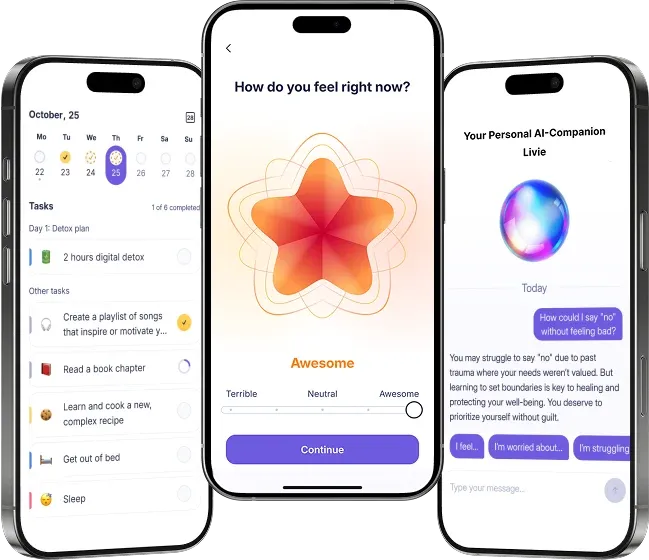
If you want support while making these life changes to regulate your dopamine, the self-discovery app Liven can help you stay aware of what's shifting. The Mood Tracker and Journal can help you see how your focus, energy, and mood respond over time. The To-Do feature can help you plan small, intentional breaks from stimulation and build habits that feel manageable rather than forced.
With time, these small adjustments add up. You may start to feel more present in what you're doing, more satisfied with simple moments, and less pulled by constant input.
References
Cleveland Clinic. (2024). What is a dopamine detox, and does it work? Cleveland Clinic Health Essentials. https://health.clevelandclinic.org/dopamine-detox
Hasan, M. K. (2024). Digital multitasking and hyperactivity: unveiling the hidden costs to brain health. Annals of Medicine and Surgery, 86(11), 6371–6373. https://doi.org/10.1097/MS9.0000000000002576
Mohd Saat, N. Z., Hanawi, S. A., Hanafiah, H., Ahmad, M., Farah, N. M. F., & Abdul Rahman, N. A. A. (2024). Relationship of screen time with anxiety, depression, and sleep quality among adolescents: a cross-sectional study. Frontiers in Public Health, 12, 1459952. https://doi.org/10.3389/fpubh.2024.1459952
Sudimac, S., et al. (2024). Immersion in nature enhances neural indices of executive attention. Scientific Reports, 14, 1845. https://doi.org/10.1038/s41598-024-52205-1
Tam, K. Y. Y., & Inzlicht, M. (2024). People are increasingly bored in our digital age. Communications Psychology, 2(1), 106. https://doi.org/10.1038/s44271-024-00155-9
FAQ: Dopamine Detox Benefits
What are the main dopamine detox benefits?
How long should a dopamine detox last?
Does a dopamine detox mean avoiding all pleasure?
Can a dopamine detox improve focus and productivity?
Is dopamine overload a real thing?
What activities should you avoid during a dopamine detox?