
BetterHelp Alternatives: Finding the Right Mental Health Support for You



Written by
Nadine M., Editorial Team Lead at Liven


Online therapy has grown fast over the past decade. Cost, format, therapist availability, and what you need from mental health support all play a role in whether a platform clicks. Some people find that traditional talk therapy on a subscription model works well. Others discover they want something more flexible or suited differently to daily life.
BetterHelp is one of the most widely known platforms, with over 30,000 licensed therapists. But being the largest doesn't make it the right fit for everyone. If you're exploring alternatives, the most useful first step isn't picking another platform, it's figuring out what kind of support you need. That answer shapes everything else.
Key Learnings
- The most useful first step is identifying whether you need licensed clinical therapy or consistent daily mental wellness support.
- For those who need licensed therapy, there are insurance-compatible platforms and nonprofit networks.
- For those who want daily mental wellness support between sessions, app-based tools built on CBT principles can offer self-help and emotional regulation support.
Why People May Leave BetterHelp
BetterHelp was founded in 2013 with the goal of removing traditional barriers to therapy and making mental health care more accessible. Co-founded by Alon Matas and Danny Bragonier, the platform was acquired by Teladoc Health in 2015 and has since grown into the world's largest online therapy service.
Today, BetterHelp operates in 210 countries and offers services in over 60 languages. For many people, it works well. Still, users across review platforms and community forums report a few friction points worth knowing about before you decide what's right for you:
- Cost. BetterHelp typically charges between $70 and $100 per week, billed in 4-week cycles, which adds up to $280–$400 per month as of May 2026. Most plans are not covered by insurance. Some users report that this price point becomes hard to sustain long-term, particularly without employer support or financial aid.
- Privacy. In 2023, the Federal Trade Commission confirmed that BetterHelp shared users' health data with third-party advertising platforms, affecting approximately 7.8 million users. As a result, the FTC issued a $7.8 million settlement.
Therapy or Daily Wellness Support?
Most BetterHelp alternative articles will hand you a list of other online therapy platforms. Before you pick one, it's worth sitting with an honest question: What were you looking for when you signed up?
If you are managing a diagnosed mental health condition, processing trauma, or dealing with severe depression or anxiety, a licensed professional is the right approach. No app can replace clinical care.
But if you signed up because you were stressed, burned out, sleeping badly, or feeling anxious about life in general, that's a different situation.
So let's explore some alternatives to BetterHelp.
BetterHelp Alternatives for Clinical Therapy
If licensed therapy is what you need, the platforms below offer some differences from BetterHelp. Each serves a slightly different situation, so the right pick depends on what's been frustrating you most.
1. Talkspace
Best for: People who want flexible, insurance-covered therapy with messaging support between sessions
Session length: 30–45 minutes (live video); unlimited messaging available throughout the week
Services: Individual therapy, couples therapy, teen therapy, psychiatry and medication management
Cost: $69–$109/week without insurance, billed monthly. Talkspace is in-network with most major insurance providers, including Cigna, Aetna, Optum, Medicare, and TRICARE. Most insured users report paying a copay of $15 or less per session.
Talkspace centers the experience around ongoing communication. Alongside scheduled video or audio sessions, users can send text, audio, and video messages to their therapist throughout the week, which is useful for people who want support between appointments. It also offers psychiatry services for those who need medication evaluation or management.
2. Alma
Best for: People who want to choose their own therapist and use insurance
Session length: 50 minutes (standard)
Services: Individual therapy, couples therapy, psychiatry and medication management; virtual and in-person options available
Cost: $130–$380 per session out of pocket, depending on the provider. Alma accepts most major commercial insurance plans. A cost estimator tool is available on the platform before booking.
Unlike subscription-based platforms, Alma works more like a therapist directory with built-in insurance support. You browse providers, filter by specialty and availability, and book a free 15-minute consultation before committing. With over 24,000 therapists across all 50 states, it's a strong option for people who want more control over the matching process.
3. Open Path Collective
Best for: People without insurance or with high deductibles who need affordable access to a licensed therapist
Session length: 50 minutes (standard)
Services: Individual therapy, couples therapy, family therapy; virtual and in-person options available across all 50 U.S. states and Canada
Cost: One-time $65 membership fee, then $40–$70 per session for individuals; $40–$80 for couples and family therapy. Open Path does not accept insurance.
Open Path is a nonprofit network of licensed therapists who choose to offer reduced-rate sessions to clients in financial need. There's no subscription, no recurring fee beyond the one-time membership, and no expiration on access. Sessions are priced on a sliding scale and reserved for people who genuinely can't afford standard private practice rates, which can run $150 or more per session.
4. Psychology Today Therapist Finder
Best for: People who want direct control over finding a therapist without committing to a platform
Session length: Varies by therapist (typically 45–60 minutes)
Services: Connects users to therapists, psychiatrists, treatment centers, and support groups across all specialties; filters available for insurance, sliding scale fees, in-person vs. virtual, specialty, and location
Cost: Free to use the directory. Session costs are set by individual therapists and vary widely.
Note that Psychology Today's finder is directory. That makes it useful in a different way: you're searching for a specific person rather than signing up for a service. Filtering by insurance acceptance or sliding scale availability gives you a clearer picture of actual costs before you reach out to anyone.
BetterHelp Alternative for Daily Mental Wellness Support
If what you're looking for is consistent support in everyday life rather than weekly sessions, Liven is worth considering.
5. Liven
Best for: People managing everyday mental load, burnout, or worry; habit-building and emotional regulation
Session length: Micro-practices typically run 5–15 minutes and are designed to fit into a daily routine
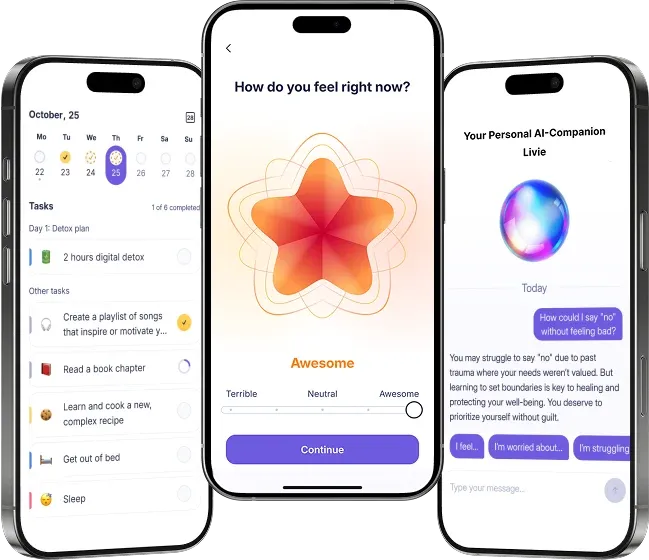
Services: Guided programs rooted in cognitive behavioral principles, daily micro-practices, habit tracking, emotional regulation tools, and personalized wellness plans
Cost: starting at $7.99 per week
The Liven app is built around the idea that mental wellness is a daily practice. Through science-backed micro-practices and CBT-informed tools, Liven helps support emotional regulation, turn off the emotional autopilot, and build habits that last.
Liven is not a clinical therapy service and is not designed to replace one. For people looking for consistent daily support for emotional regulation, it can offer structure between the sessions or be a standalone self-help tool.
Focus on Choose the Right Fit
A few honest questions worth asking before committing to something new:
- Are you managing a diagnosed condition or processing a specific trauma? Then, you can go with a licensed therapist. Talkspace or Alma may work for you if cost or insurance compatibility is the core issue.
- Is affordability the main problem? Open Path Collective or an insurance-accepting platform will serve you better than swapping one expensive subscription for another.
- Do you want consistent daily support rather than weekly structured sessions? A daily wellness app may give you the routine and structure. If that resonates, get your personalized plan for a calmer mind with Liven and see what a daily practice built around your needs looks like.
- Did the data privacy situation concern you? That's a completely valid reason to look elsewhere. Before signing up for anything new, read the privacy policy and check whether the platform shares health data with third parties.
References
- American Psychological Association. (2023). Stress in America 2023. https://www.apa.org/news/press/releases/stress/2023/collective-trauma-recovery
- Federal Trade Commission. (2023). FTC returns $7.8 million to consumers who were deceived by BetterHelp's sharing of sensitive mental health data. https://www.ftc.gov/news-events/news/press-releases/2023/07/ftc-returns-78-million-consumers-who-were-deceived-betterhelps-sharing-sensitive-mental-health-data
- Linardon, J., Cuijpers, P., Carlbring, P., Messer, M., & Fuller-Tyszkiewicz, M. (2019). The efficacy of app-supported smartphone interventions for mental health problems: A meta-analysis of randomized controlled trials. World Psychiatry, 18(3), 325–336. https://doi.org/10.1002/wps.20673
FAQ: BetterHelp Alternatives
Does BetterHelp accept insurance?
Is BetterHelp or its alternatives suitable for teenagers?
What is the difference between a therapist and a counselor?