Stress Addiction: Signs, Causes, and How to Break the Cycle




Do you feel more comfortable under pressure than at rest? You might notice that stillness feels vaguely wrong. A free afternoon somehow ends up full. And when nothing urgent is happening, something in you goes looking for it.
For many people, the absence of stress is uncomfortable because, over time, the body and brain have come to rely on it. That's what stress addiction looks like in practice.
Key Learnings
- Your brain can become dependent on stress hormones like cortisol, adrenaline, and dopamine, the same way it craves a substance.
- Common signs include an inability to rest without guilt, constant overcommitting, and feeling "off" or flat during calm periods.
- The roots often go back to childhood, high-pressure environments, or a culture that rewards busyness over balance.
- Breaking the cycle is possible, and it takes building a daily practice of emotional regulation.
How Does Stress Addiction Manifest Itself?
Stress addiction is a psychological and physiological pattern where a person becomes habituated to the hormones their body releases during stress, particularly cortisol, adrenaline, and dopamine. Over time, stress stops being a response to circumstances and becomes a default state that the brain actively seeks out.
It doesn't look like a typical addiction. There's no substance, no obvious harm in the short term, and often a lot of external praise. People who are addicted to stress are frequently the most productive, driven, and reliable people in the room. That's exactly what makes it so easy to miss.
Stress addiction is not an official diagnosis and doesn't appear in the DSM-5 or ICD-11. But the underlying mechanisms, such as tolerance, compulsive seeking, and withdrawal symptoms when the behavior stops, mirror those of recognized behavioral addictions.
Think of it less as a label and more as a useful lens: a way to understand why you keep saying yes when everything in you wants to say no.
What's Happening in Your Brain According to Neuroscience
To understand stress addiction, you have to understand what stress gives you.
When your brain perceives a threat, it triggers the HPA axis (hypothalamic-pituitary-adrenal axis), flooding the body with a cocktail of hormones.
Adrenaline sharpens your focus and raises your heart rate, delivering a burst of energy and urgency. Cortisol clears the path by suppressing non-essential functions and directing glucose to your muscles and brain. And crucially, dopamine, often called the reward chemical, reinforces the behavior that triggered the response.
Even when stress feels miserable, the neurological reward wired into it is real. The brain doesn't distinguish between a lion in the savanna and a flooded inbox; it just knows that responding to the threat feels focused, purposeful, and alive.
Repeated exposure raises your tolerance. The baseline that once felt calm now feels boring. You need a bigger stimulus to feel the same result, and the cycle deepens.
How Stress Becomes a Habit
Stress addiction doesn't happen overnight. It builds through a loop that's surprisingly easy to step into:
- Trigger →
- Stress hormone surge →
- Dopamine reward →
- Relief (temporary) →
- Tolerance builds →
- Seek the next trigger
What makes this loop sticky is that the behaviors it reinforces often look positive from the outside: working hard, being dependable, never saying no, pushing through. The costs are disrupted sleep, fraying relationships, and a nervous system that never fully rests.
9 Signs You Might Be Addicted to Stress
Not all of these will apply as stress addiction exists on a spectrum. But if several resonate, it's worth paying closer attention.
Here are the most common signs to look for:
- You feel restless or anxious when things are calm.
- You can't say no, even when your plate is full.
- Rest comes with guilt.
- You create urgency where none exists.
- You're exhausted but can't wind down.
- You struggle to be present during slow, quiet moments, especially with people you love.
- Vacations don't feel restorative for the first few days.
- You associate busyness with worth.
- Stillness feels like something is wrong.
Where Does Stress Addiction Come From?
Childhood and Early Experiences
For many people, a chronically stressed nervous system is a learned baseline.
Growing up in a home with high conflict, emotional unpredictability, or constant pressure trains the nervous system to treat stress as the normal operating mode. For these individuals, calm feels like the quiet before the storm.
Culture and the Hustle Identity
Even without a stressful childhood, modern culture is remarkably good at cultivating stress addiction. Overwork is framed as ambition. Exhaustion is worn as a badge of honor. People compare their packed schedules the way others compare salaries.
When busyness becomes identity, slowing down feels like failure, and the idea of less stress can seem threatening.
The Cost of Living on High Alert
Here's the paradox: stress addiction works, until it doesn't.
Short bursts of stress are genuinely useful. They sharpen focus, improve performance, and motivate action. The problem is that chronic stress has the opposite effect over time.
- Physically: Sustained cortisol elevation contributes to sleep disruption, weight gain (especially around the midsection), weakened immunity, high blood pressure, and increased cardiovascular risk.
Psychologically: Anxiety disorders, burnout, emotional numbness, and depression are all closely linked to chronic stress. The nervous system was never designed to stay switched on indefinitely.
- Relationally: When you're running on adrenaline, presence is the first casualty. It's hard to listen, connect, or be curious about another person when your brain is constantly scanning for the next threat.
The irony, as research from Yale's Stress Center shows, is that chronic stress dysregulates the very hormonal systems it relies on, meaning stress addiction eventually undermines the focus and productivity it was supposed to deliver.
A Practical Framework on How to Break the Cycle
Breaking a stress addiction is about learning to regulate your nervous system so that stress becomes a response, not a default, and calm becomes something you can actually tolerate.
Step 1: Name the Pattern
Awareness is the doorway. Stress addiction is invisible when it's just how I am. The moment you recognize it as a learned pattern, you create the possibility of changing it. Ask yourself:
Am I stressed because the situation demands it, or because I'm uncomfortable without it?
Step 2: Track Your Emotional Triggers
Most stress addicts don't realize how predictably their patterns are triggered. A particular type of conversation. An empty hour in the diary. A moment of stillness after a long to-do list.
Keeping a mood journal can surface these patterns faster than years of vague self-reflection. Over time, the data reveals what's actually driving the cycle, not just what's happening at the surface.
Step 3: Try to Rewire Your Nervous System
The goal is to gradually raise your tolerance for calm by practicing it in small doses.
Some evidence-based approaches that help:
- Slow, diaphragmatic breathing - activates the parasympathetic nervous system (the "rest and digest" counterpart to fight-or-flight) within minutes
- Progressive muscle relaxation - releases the physical tension that chronic cortisol creates
- CBT-based thought work - challenges the beliefs that link worth to busyness or rest to laziness
- ACT (Acceptance and Commitment Therapy) - builds the ability to sit with discomfort without immediately acting on it
But regulation doesn't always have to mean a formal practice:
Step 4: Build a Daily Regulation Routine
This is the piece most advice leaves out. Tips work in the moment. Routines rewire the baseline. The nervous system responds to repetition. Ten minutes of intentional self-regulation practice, done consistently, does more than an occasional wellness weekend.
That means:
- Checking in with your emotional state regularly.
- Noticing patterns.
- Taking small, structured actions that build your relationship with yourself over time.
Your Personalized Plan for a Calmer Mind
Breaking stress addiction is about having a system that makes it easy to do it, especially when your default is to reach for the next deadline instead.
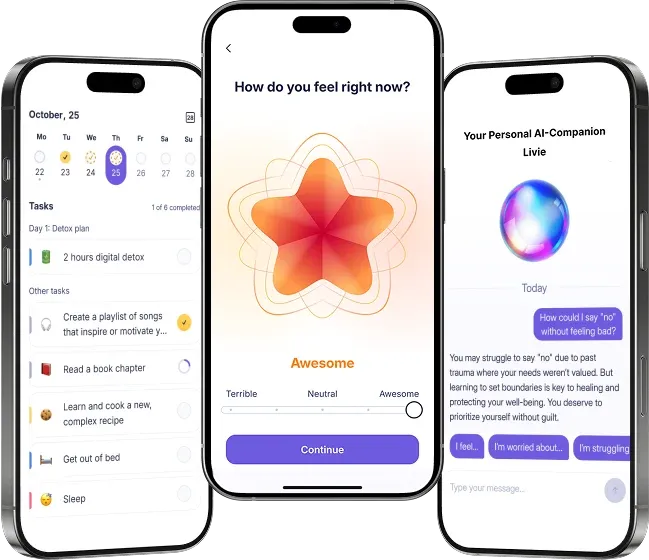
This is where Liven comes in. Developed in collaboration with the Medical Board of Health Professionals and informed by validated frameworks, including CBT, ACT, DBT, and Positive Psychology, Liven creates a daily, 10-minute well-being routine tailored to where you are emotionally and the patterns you're working through.
In your first week, you'll start noticing your patterns. After a month, you'll recognize what's actually triggering your stress response, and you'll have tools to respond differently. After three months, the healthier habits start to feel natural.
You can start your personalized plan for a calmer mind today - it takes less than 5 minutes.
References
- Chu, B., Marwaha, K., Sanvictores, T., Awosika, A. O., & Ayers, D. (2024). Physiology, stress reaction. In StatPearls. StatPearls Publishing. https://www.ncbi.nlm.nih.gov/books/NBK541120/
- Lembke, A. (2021). Dopamine nation: Finding balance in the age of indulgence. Dutton.
- Psych Central. (2022). Can I be addicted to stress? https://psychcentral.com/stress/addicted-to-stress
- Satyjeet, F., Naz, S., Kumar, V., Aung, N. H., Bansari, K., Irfan, S., & Rizwan, A. (2020). Psychological stress as a risk factor for cardiovascular disease: A case-control study. Cureus, 12(10), e10757. https://doi.org/10.7759/cureus.10757
- Sinha, R. (2008). Chronic stress, drug use, and vulnerability to addiction. Annals of the New York Academy of Sciences, 1141(1), 105–130. https://doi.org/10.1196/annals.1441.030
- Su, H., Ye, T., Cao, S., & Hu, C. (2024). Understanding the shift to compulsion in addiction: Insights from personality traits, social factors, and neurobiology. Frontiers in Psychology, 15, 1416222. https://doi.org/10.3389/fpsyg.2024.1416222
- Vandenabeele, R., Joosen, M. C. W., & van Dam, A. (2025). Chronic stress in relation to clinical burnout: An integrative scoping review of definitions and measurement approaches. Frontiers in Psychology, 16, 1712340. https://doi.org/10.3389/fpsyg.2025.1712340
Note: Based on publicly available information as of April 2026. This article is for informational purposes only and does not constitute medical or psychological advice. If you are experiencing significant distress, please consult a licensed mental health professional.
FAQ: Stress and Addiction
How does childhood affect stress addiction?
What's the difference between being productive and being addicted to stress?
Can stress addiction lead to burnout?
How long does it take to break an addiction to stress?
Is there an app that can help with stress addiction?
Can stress management therapy help with addiction recovery?