What Therapy For Body Image Issues Helps? 5 Approaches to Choose From




We all do it: open the phone just to check something quickly and twenty minutes later fall down a rabbit hole of before-and-afters, "what I eat in a day" videos, and strangers' vacation photos. That low-grade discomfort about your body that you mostly manage to ignore? Now it's back, louder.
If this pattern sounds familiar, and you've ever wondered whether therapy could actually help, check out this honest breakdown of the therapy for body image issues to consider.
Key Learnings
- Body image patterns are shaped over time through thoughts, emotions, experiences, and social influences, and these patterns can change.
- Five therapies, five angles: thoughts, emotions, values, inner critic, self-compassion.
- Small daily exercises matter more than picking the perfect approach.
- Tools like mood tracking, journaling, and structured self-reflection can help you continue the work between sessions.
5 Therapy Approaches That Work for Body Image
All five are research-backed and tackle the same core problem - just from different angles.
1. Cognitive Behavioral Therapy (CBT)
CBT is built on a simple, powerful idea: your thoughts, feelings, and behaviors are all connected. And when you change one element of the triad, the others change automatically.
CBT targets what therapists call cognitive distortions: things like all-or-nothing thinking ("I look terrible in everything"), catastrophizing ("everyone noticed"), or mental filtering (only absorbing the negative feedback).
CBT Exercise to Try: The Thought Record
When a negative body-image thought hits, it helps to write it down somewhere - a journal, the notes app, or a digital journal like the one in Liven. The exercise looks like this:
- The situation (what happened?)
- The automatic thought (what did your brain say?)
- The emotion it triggered and its intensity (0-10)
- The evidence FOR that thought
- The evidence AGAINST it
- A more balanced alternative thought
- How you feel now (0-10)
Check out the example of a situation analysis on paper:
| Situation | Automatic Thought | Emotion & Intensity (0-10) | Evidence FOR | Evidence AGAINST | Balanced Alternative Thought | Emotion After Reframing (0-10) |
| Scrolling social media | “Everyone else looks better than me.” | Insecurity - 8 | People in photos look fit and polished. | Influencers curate and edit their images. I’m comparing my everyday life to highlight reels. | “These posts show edited moments. My worth isn’t defined by comparisons.” | Insecurity - 4 |
2. Dialectical Behavioral Therapy (DBT)
DBT was originally developed for individuals with chronic emotion dysregulation, particularly those with borderline personality disorder.
For people whose body image issues are tangled up with eating disorders, mood dysregulation, or intense self-criticism, DBT's skills-based approach gives practical strategies to reach for right away.
Best therapy for body image issues programs often combine DBT skills with other approaches for exactly this reason: emotion regulation can't wait for a scheduled therapy session.
DBT Exercise: TIPP for Intense Emotional Moments
When body image distress feels physically overwhelming (heart racing, ruminating, can't stop), TIPP is a useful tool to have. The four parts are:
- T - Temperature: splash cold water on your face
- I - Intense exercise: move for 5 minutes
- P - Paced breathing: exhale longer than you inhale (try 4 counts in, 6 out)
- P - Progressive muscle relaxation: tense and release each muscle group from feet to head
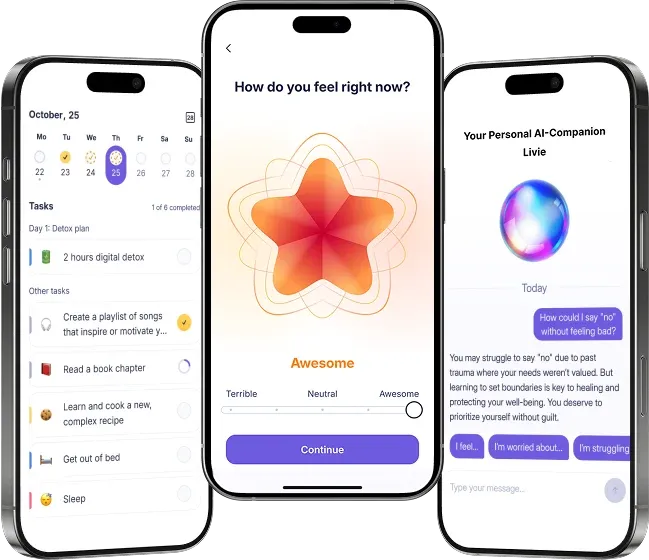
💡 Tip: Check in with Liven's Mood Tracker to log what you're feeling and add some context. As time goes on, patterns will emerge, namely, what triggers these spirals, what helps, and what doesn't.
3. Acceptance and Commitment Therapy (ACT)
In ACT, there is a cognitive defusion technique: you focus less on changing thoughts directly and more on changing how you relate to them. You notice the thought without fully identifying with it: “I notice I'm having the thought that my body looks horrible.”
Cognitive defusion happens when negative thoughts have less pull over what you do and how you feel. Skills like noticing your thoughts, separating from them (cognitive defusion), and shifting where you focus can help loosen the grip of difficult thoughts.
ACT also asks you to get clear on your values because they give your life direction.
Defusion is easier to grasp once you've seen it in motion. This short video walks through what cognitive defusion looks like in practice and gives a few small techniques you can try.
Try This ACT Exercise: The Values Compass
A good starting point is jotting down 3-5 things you genuinely care about that have nothing to do with how you look. These might be connection, creativity, learning, humor - whatever is real for you.
Once your values are on paper, it can help to pick one small action for the week that reflects them. If connection is on your list, that might look like keeping the dinner plans you were already looking for an excuse to cancel. Or it can be sending the thinking of you text to the friend you've been avoiding since you stopped feeling good in photos.
4. Internal Family Systems Therapy (IFS)
Internal Family Systems is a newer model in body image therapy, but it's gaining ground fast, especially with people whose self-criticism feels older than the issue itself.
The core idea of the IFS approach is that your psyche is a system of parts, each with its own perspective, history, and role. One of these parts is the Inner Critic, and understanding what it's trying to do is the first step in reducing its grip.
Try This IFS Exercise: A Conversation with Your Inner Critic
Find a quiet moment and get your journal. Write to your inner critic as if it were a separate character: “Hey, I notice you have a lot to say about how I look. What are you worried about? What are you trying to protect me from?”
Often, the critic's job is to protect you from embarrassment, rejection, or judgment. Write down its answer - you might be surprised what you’ll get there.
5. Compassion-Focused Therapy (CFT)
CFT was created for a very specific kind of pain: the relentless self-criticism that often sits underneath body image struggles. If part of you already knows your inner voice is cruel, CFT is the approach that takes that seriously.
Your brain has two settings that matter here: a threat system (which body image struggles tend to live in) and a soothing system (which most of us underuse). CFT trains the soothing one through practices such as compassionate self-talk, imagining a wise, kind version of yourself, and learning to let kindness in without batting it away.
Try This CFT Exercise: The Compassionate Letter
The exercise is a letter to yourself about your body image struggles, written from the perspective of a deeply wise, caring friend who knows your full history and loves you without condition. No performed positivity. Just warmth, without judgment.
Then it gets read back. Noticing what it feels like to receive that is the whole point.
Therapy for Body Image Issues, Compared
Five approaches, five different ways into the same problem. Use this as a quick map to find the one that sounds closest to what's actually going on for you.
| Approach | The angle it takes | Sounds like a fit if... | What you'd actually do | Example thought it tackles |
|---|---|---|---|---|
| CBT | Challenge the thoughts your brain keeps repeating | Your inner monologue runs on a loop of self-criticism you can almost predict | Thought records, evidence checks | "Everyone in this room is judging my arms." |
| DBT | Calm the body so the mind can catch up | Body image distress feels physical - racing heart, can't-stop-thinking, sometimes tangled with food | TIPP, distress tolerance skills | "I hate this so much I need to do something extreme right now." |
| ACT | Stop wrestling with the thoughts and move toward what matters | You've been waiting until you fix yourself to actually live | Cognitive defusion, values mapping | "I'll go to the beach when I lose 10 pounds." |
| IFS | Meet the inner critic instead of fighting it | The harsh voice sounds older than the issue itself, maybe even like someone you grew up with | Parts work, dialoguing with the critic | "You're disgusting, and you've always been." |
| CFT | Train the brain to receive kindness | Shame is the loudest feeling, and self-compassion feels foreign or fake | Compassionate self-talk, compassionate letter | "Other people deserve grace. I don't." |
Final Thoughts: Where Do You Go From Here?
There's no single right answer, and your path will look different from anyone else's. Starting matters. So does finding the right therapeutic approach for you. If one doesn't fit, the next one might - switching is part of the process, not a sign you're failing at it.
Your self-discovery doesn't have to pause between therapy sessions. Try the Liven app (Google Play or App Store) to track your mood and journal, or get more insights on the Liven blog.
References
- Assaz et al. (2023). Cognitive defusion in acceptance and commitment therapy. Behavior Therapy. https://doi.org/10.1016/j.beth.2022.06.003
- Buys, M. E. (2025). Exploring the evidence for Internal Family Systems therapy. Clinical Psychologist. https://doi.org/10.1080/13284207.2025.2533127
- Carter et al. (2023). Compassion-focused therapy for body weight shame in obesity. Behavior Therapy. https://doi.org/10.1016/j.beth.2023.02.001
- Lammers et al. (2026). DBT and CBT for binge-eating disorder. International Journal of Eating Disorders. https://doi.org/10.1111/eat.70000
- Seekis, V., & Kennedy, R. (2023). TikTok beauty and self-compassion videos and appearance shame. Body Image. https://doi.org/10.1016/j.bodyim.2023.02.006
FAQ: Therapy for Body Image Issues
How do I find a therapist for body image issues if I don't live in a big city?
Can therapy actually change how you feel about your body long-term?
How long does therapy for body image issues take to work?
What's the difference between therapy for body image and therapy for an eating disorder?
Is body image therapy covered by insurance?
Can I work on body image issues without therapy?
What should I expect in the first body image therapy session?
How do I know if a therapist is the right fit for body image work?
Can men get therapy for body image issues?
Does body image therapy work for teens?