How to Practice Vulnerability Without Losing Yourself




There's a moment most people recognize. You're about to say something honest, something that matters, and something in you pulls back. You soften it. Or swallow it entirely. And afterward, the conversation moves on, but something between you and the other person stays exactly where it was.
That pull is protection. And protection has a cost. For a lot of people, that cost is connection.
Learning how to practice vulnerability is one of the more counterintuitive things you can do for your relationships and your mental health. Going in, it feels risky. Coming out, it tends to feel relieving. This article gives you a practical framework for doing it, in daily life and in the relationships that matter most.
Key Takeaways
- You don't become close and then open up. You open up and then become close.
- Staying guarded feels safe, but costs you the connection you're trying to protect.
- Vulnerability means letting someone see the real version of you, not the managed one.
- Emotional openness is a skill that gets easier the more you practice it.
What Does It Mean to Be Vulnerable?
Vulnerability has nothing to do with being emotional in public or telling people your secrets. The real version is quieter: letting someone see something real about you, a fear, a need, a feeling you haven't polished into something acceptable, without knowing how they'll respond.
That uncertainty is the whole thing. If you already knew it would go well, there'd be nothing at stake.
For many people, vulnerability feels hard because the nervous system has once learned that honesty has a cost. The body remembers, even in a room that's safe now. Connection didn't go anywhere. The system is just slow to trust new evidence.
Brené Brown, whose research on vulnerability has shaped how most people talk about it, describes it as the birthplace of love, belonging, and connection. The science is more specific: when people share vulnerable feelings and receive attuned responses, the emotional bond between them strengthens in ways that other kinds of sharing do not replicate.
This is why two people can talk every day and still feel distant. Surface-level conversations keep things comfortable. They don't build closeness.
Why Vulnerability Feels So Hard
Most of us learn early that showing too much is dangerous. Maybe an emotion was dismissed. Maybe it was used against you. Maybe you watched someone you respected keep everything contained and decided that was the right way to be.
Whatever the origin, the result tends to be the same: your nervous system registers vulnerability as a threat and pulls you back toward something safer.
Emotional suppression reduces short-term discomfort but has real long-term costs for intimacy. When one person withholds consistently, their partner tends to feel shut out, even if they can't name why. The connection erodes. This is how two people who genuinely care about each other end up feeling alone in the same relationship.
Knowing why something is hard doesn't mean you're stuck with it. The nervous system learns from experience. New experiences build new patterns.
How to Practice Vulnerability Daily
You don't need a significant emotional conversation to practice this. Vulnerability is a muscle. It gets stronger through low-stakes repetition before you try anything heavy.
Start With Yourself
Before you can be vulnerable with someone else, you need to be honest with yourself. That means naming what you actually feel, not the edited version.
When something bothers you, resist the impulse to immediately reframe it as fine. Sit with it long enough to name it. Disappointed? Scared? Embarrassed? The more specific you get, the more you understand what's happening inside you.
Notice What You Automatically Hide
Pay attention to what you routinely downplay. "I'm fine" when you're not. "It doesn't matter" when it does. "No worries" when there are some.
Most of these are habits of self-protection that started somewhere useful. They ran on autopilot for so long you stopped noticing them. Noticing them is the first step.
You don't need to replace every one of them with a vulnerable disclosure. Just notice them. That awareness creates a small pause, and in that pause, you have a choice.
Take One Small Step Per Day
Pick something minor and say it honestly. Tell a friend that a conversation last week left you feeling overlooked. Tell a colleague you're nervous about the presentation. Text someone that you've been thinking about them.
None of these is dramatic. That's the point. Vulnerability builds through repeated small moments, not grand gestures. Closeness accumulates. It doesn't arrive in a single brave act.
Write Before You Speak
Sometimes the words aren't there yet. Writing them down first, in a notebook or in Liven's Journal, helps you figure out what you feel before you have to say it to someone else. What stays stuck in your head often becomes clearer on the page.
How to Practice Vulnerability in a Relationship
Relationships are where vulnerability matters most and where it feels most dangerous. The closer someone is, the more their response matters, and the more there is to lose.
Before we get into how to practice vulnerability in your relationships, watch this 6-minute breakdown of why it matters so much in the first place:
Say What Is Underneath The Surface Feeling
Most arguments aren't about the thing they appear to be about. Frustration usually has fear underneath it. Criticism usually has disappointment underneath it. Anger usually has hurt underneath it.
The surface feeling is easier to express because it's more defended. The one underneath is more honest and more connected.
Emotion-Focused Therapy describes this as moving from a hard emotion, like anger or withdrawal, to the softer feeling underneath that actually invites connection. "You never make time for me" is a complaint. "I feel lonely, and I miss spending time with you" is an invitation.
One version closes things down. The other opens them up.
Name Your Needs Directly
Vulnerability means asking for what you need rather than expecting the other person to figure it out. That feels uncomfortable because it creates the possibility of being told no.
Unspoken needs tend to become resentment. Spoken ones become the possibility of being met.
Start small. "I need a bit of reassurance right now." "I need you to just listen, not fix anything." "I need to know this matters to you." These aren't demands. They're honest disclosures of where you are.
Share Something Before You Have Resolved It
A lot of people wait until they've processed something completely before mentioning it to a partner or friend. That way, they don't have to be seen in the messy middle.
You do not have to fully process, perfectly word, or neatly package your emotions before you're allowed to be honest about them. Sharing something unresolved, something you're still figuring out, tells the other person: I trust you with my process, not just my conclusions.
That takes more courage. It also tends to produce more closeness.
Acknowledge The Vulnerability Out Loud
If saying something feels hard, you can name that, too. "This is hard for me to say," or "I'm not sure how to put this, but I want to try," is itself an act of vulnerability. It says what's happening without requiring you to have everything figured out.
People tend to be more generous with honesty when they can see how much it costs to offer it.
What to Do When It Goes Badly
Sometimes you'll be vulnerable, and the response will be clumsy, dismissive, or hurtful. Worth being honest about, because it happens.
A bad response doesn't mean vulnerability was the wrong choice. It may mean the timing was off, the person was dealing with their own difficulties, or that this is a pattern worth paying attention to.
Notice whether it's a one-time miss or a repeated issue. A partner who regularly can't receive your honest emotions is telling you something important about what the relationship can hold. That doesn't automatically make either person bad or wrong, but it can offer important insight into whether emotional safety, openness, and mutual support are truly possible within the relationship dynamic.
Vulnerability also gets easier with practice. The first few times feel enormous. The tenth time feels manageable. The stakes don't get lower. Your nervous system just builds evidence that it can survive.
Where to Start if You Don't Know How
If all of this feels abstract or daunting, the most effective starting point is usually a lower-stakes relationship, not your closest one.
Tell a coworker something honest about how a meeting went. Text a friend to let them know you've been struggling. Say something in a conversation that you'd normally keep to yourself.
Notice how it feels. Notice what happens. That data is more useful than any abstract advice on vulnerability.
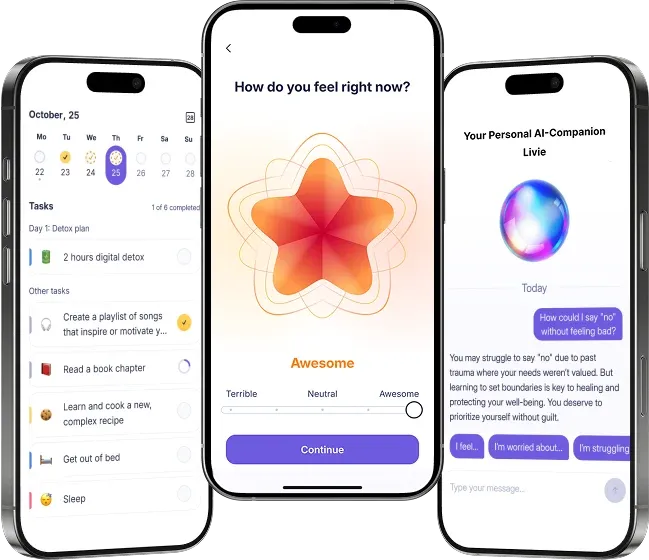
If you want a more structured place to build this skill, Liven's personalized plan is built around your specific patterns: where you tend to close up, what tends to trigger it, and what small practices tend to shift it over time.
Sources
- Costello, M. A., Bailey, N. A., Stern, J. A., & Allen, J. P. (2024). Vulnerable self-disclosure co-develops in adolescent friendships: Developmental foundations of emotional intimacy. Journal of Social and Personal Relationships, 41(9), 2432–2454. https://pmc.ncbi.nlm.nih.gov/articles/PMC11781371/
- Epstein, R., Newland, A., & Reid, C. (2025). Preliminary experimental support for a vulnerability theory of emotional bonding. Scientific Reports. https://www.ncbi.nlm.nih.gov/pmc/articles/PMC12623801/
- Mu, W. (2025). Attachment avoidance and intimacy decline: The mediating role of expressive suppression. Asian Journal of Family Therapy. https://journals.kmanpub.com/index.php/aftj/article/download/4554/8335/24202
- Stress in America 2025: A Nation Divided. (2025, November). American Psychological Association. https://www.apa.org/news/press/releases/2025/11/nation-suffering-division-loneliness
FAQ: How to Practice Vulnerability
What does it mean to practice vulnerability?
Why is vulnerability so difficult for some people?
How do I practice vulnerability in a relationship?
How do I practice vulnerability daily?
What if the other person responds badly?
Is vulnerability the same as oversharing?
Can vulnerability be practiced alone?
How long does it take to get more comfortable with vulnerability?