How to Explain Your Feelings When You Don’t Know Where to Start




Your heart is pounding, your thoughts are racing, and there’s a heavy lump in your throat. You know you’re feeling something big, but when the person you love asks, “What’s wrong?” the only answer you can find is, “I don’t know.”
If this sounds familiar, you’re not alone. The ability to translate our complex inner world into words is a skill, not an instinct. And it’s a skill worth building. In fact, the simple act of naming our emotions can calm down the amygdala, the brain’s alarm system, making those big feelings less overwhelming.
This article gives you a simple, science-backed framework for how to explain your feelings when they're loud, but your words are quiet.
Key Takeaways
- Feelings are physical first. Before you can explain an emotion, you have to notice its physical signals, like a tight chest or a racing heart. This is the first step to understanding what’s going on.
- Naming feelings calms your brain. Psychologists call it affect labeling. Putting a specific name to an emotion, like 'disappointed' instead of just 'bad,' can reduce its intensity.
- Use a simple script. You don’t need a poetic speech. A simple structure like “When you do X, I feel Y, because Z” can build a bridge from your feelings to their understanding.
- It’s a skill, not a personality trait. Learning to express your feelings is like building a muscle. It gets stronger and easier with practice.
Why Is It So Hard to Explain My Feelings?
If you find it difficult to articulate your emotions, it's not a personal failing. Our brains are wired for survival, and for many of us, that has meant learning to suppress or hide our feelings to avoid conflict, judgment, or vulnerability.
There's even a term for this difficulty: normative male alexithymia. While it has male in the name, the concept applies to anyone socialized to believe that expressing emotion is a sign of weakness. Emotional suppression by either partner measurably weakens relationship quality for both people.
Beyond social conditioning, there are other common reasons:
- Fear of being misunderstood. You worry the other person won't get it, or worse, will use your vulnerability against you.
- You were never taught how. Many of us grew up in families where emotions were simply not discussed or didn’t always feel emotionally safe to express. We never developed the vocabulary.
- You're overwhelmed. When a feeling is too intense, the logical, language-producing part of your brain can get hijacked or can temporarily go offline under stress. Intense stress impairs the prefrontal cortex, the region responsible for executive function and communication. That's one reason overthinking during conflict tends to make things worse: your brain literally can't access the words it needs.
The good news is that you can learn to work with your brain, not against it. It starts with a simple, three-step process: Notice, Name, and Navigate.
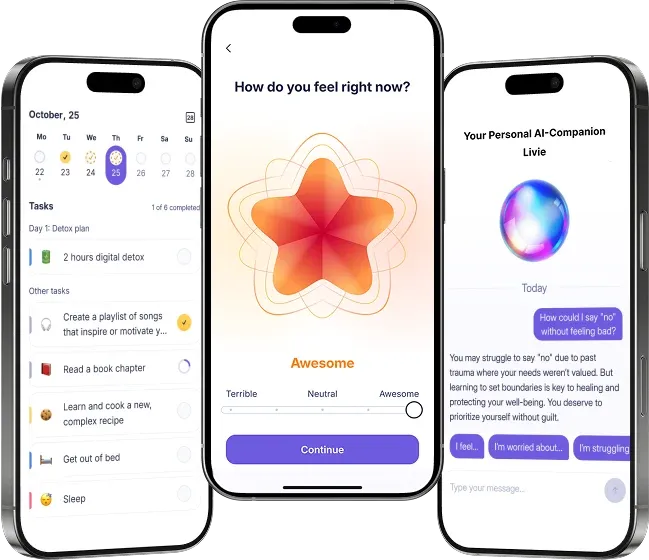
A 3-Step Framework for Explaining Your Feelings
Instead of waiting for the perfect words to magically appear, use a structured approach to move from confusion to clarity.
1. Notice the Feeling in Your Body
Before an emotion has a name, it has a physical address. Anxiety might live in your chest. Anger might burn in your stomach. Disappointment might feel heavy on your shoulders. The first step is to become a curious observer of these physical sensations, without judgment.
This practice is called interoception: your ability to sense your body's internal signals. People with stronger interoceptive awareness were significantly better at regulating their emotions under stress.
Start with a 60-second body scan. Pause and mentally move from head to toe. Where do you feel tension? Heat? Hollowness? Heaviness? Just notice it, without trying to fix anything.
2. Name It to Understand It
Once you've noticed the physical sensation, the next step is to give it a name. This is more than saying you feel bad or stressed. The goal is emotional granularity: the ability to use precise, specific words for your feelings.
People who are able to describe their emotions more specifically show better adaptive coping and mental health outcomes across clinical and non-clinical settings. They're also better at choosing the right solution for their emotional state. After all, the fix for feeling disrespected is very different from the fix for feeling ignored.
To expand your vocabulary: instead of sad, could it be lonely, grieved, or melancholy? Instead of angry, could it be frustrated, betrayed, or resentful? An emotion wheel can open up words you didn't know you were missing.
If you want to see this in action before trying it yourself, this video from the Gottman Institute is worth watching. Dr. John and Dr. Julie Gottman have spent over 40 years researching what makes relationships work, studying more than 3,000 couples in the process:
3. Navigate the Conversation
Now that you've noticed the sensation and named the emotion, you're ready to communicate it. This is often the scariest part, but you don’t need to explain yourself perfectly to deserve understanding. You just need a simple, clear, non-accusatory starting point. Before you dive in, Liven's guide on how to have difficult conversations that strengthen your relationship walks through how to set the stage, so the conversation goes somewhere useful.
A proven formula comes from non-violent communication and relationship therapy:
"I feel [your specific emotion] when [the specific, observable behavior] because [the need or value of yours that is being affected]."
Here's what that looks like in practice:
| ❌ Instead of | ✅ Try |
|---|---|
| "You never listen to me." | "I feel lonely when I'm talking about my day and see you on your phone, because it makes me feel like what I'm saying isn't important to you." |
| "You're making me so angry." | "I feel frustrated when the plans we made change at the last minute, because I value predictability and it throws off my whole day." |
| "You always criticize everything I do." | "I feel discouraged when I share something I worked hard on and the first response is what went wrong, because I need to feel like my effort is seen before we get to the feedback." |
| "You never want to talk about anything real." | "I feel disconnected when we spend the evening without really talking, because closeness matters to me and I miss that." |
This structure keeps the focus on your undeniable experience rather than on your partner's intentions, which can be debated.
Connection Starts With Clarity
Learning how to explain your feelings is one of the most meaningful things you can do for yourself and for the people around you. It's not about broadcasting every emotion. It's about having the tools to share the ones that matter, when they matter.
By practicing Notice, Name, and Navigate, you build a bridge between your inner world and the people in it. Every time you try, you're telling yourself and the people you love that your feelings are valid and that you are worthy of being understood.
If you need a gentle place to start, take our 3-minute quiz and get a personalized plan to understand your feelings with more clarity and care.
References
- Cameron, C. D., Payne, B. K., & Sinnott-Armstrong, W. (2022). Interoception and the regulation of emotion: A meta-analysis. Psychological Bulletin, 148(7-8), 493–521. https://psycnet.apa.org/record/2022-77112-001
- Hoult, L. M., Wetherell, M. A., Edginton, T., & Smith, M. A. (2025). Positive expressive writing interventions, subjective health and wellbeing in non-clinical populations: A systematic review. PLOS One. https://doi.org/10.1371/journal.pone.0308928
- Ozomaro, B., Wein, P. Y., Miller, S., Ospina, L. H., Goodman, M., Torous, J., & Kimhy, D. (2025). Emotional granularity in health and psychopathology: A scoping review. Journal of Psychosomatic Research. https://www.sciencedirect.com/science/article/abs/pii/S0022395625004881
- Sasaki, E., Overall, N. C., Chang, V. T., & Low, R. S. (2022). A dyadic perspective of expressive suppression: Own or partner suppression weakens relationships. Emotion, 22(8), 1989–2003. https://doi.org/10.1037/emo0000978
- Shamay-Tsoory, S. (2022). Affect labeling: The role of timing and intensity. PLOS ONE, 17(12), Article e0279303. https://doi.org/10.1371/journal.pone.0279303
FAQ: How to Explain Your Feelings
How do I explain my feelings to my boyfriend without starting a fight?
What if I don't know what I'm feeling?
How can I explain my feelings for someone without making it awkward?
Is it okay to explain my feelings over text?
What if they react badly or get defensive?