Healing from Abusive Relationships: The Path Toward Self-Trust and Emotional Safety



Some days, you miss them to the point that you pick up the phone to text them. Sure, you don’t text them because you promise yourself you won’t, but still, you think of them as your home. Other days, you feel rage, or relief, or nothing at all.
Healing from abusive relationships is one of the most complex things a person can go through because the patterns within them can make leaving feel psychologically difficult.
Wherever you are in this process, it takes strength to face it. Patience with yourself and the right tools can help you make sense of what happened.
Let’s go through this together.
Key Learnings
- Trauma bonding, dopamine cycles, and nervous system dysregulation explain why leaving feels like withdrawal.
- Rebuilding identity and boundaries is the core of recovery.
- Therapy, emotional tracking, and consistent self-care routines create stability after chaos.
Why Healing from Abuse Feels So Hard
Healing from abuse is complex because the brain, the body, and the sense of self all take damage.
Trauma Bonding
Abusive relationships follow a cycle of tension, explosion, and reconciliation. Each reconciliation triggers a dopamine release, which is the same chemical involved in addiction. Your brain starts associating your partner with reward, even when that reward only follows punishment.
Gaslighting and Identity Erosion
When someone systematically contradicts your reality with "You're too sensitive" or "That never happened," your brain begins to doubt its own signals. Gaslighting erodes your preferences, your memories, and your ability to trust your own feelings.
The longer you stay in the relationship, the more confused you feel, and the tighter the grip shame and self-blame have on you.
Nervous System Dysregulation
Chronic stress can keep your nervous system in a heightened state of fight, flight, or freeze. That's why, long after you've left, you might still flinch at a raised voice or shut down when conflict arises.
Dr. Bessel van der Kolk's research shows: the body keeps the score.
How to Reclaim Yourself After the Chaos
This stage of healing from abusive relationships is about rebuilding your identity and your internal compass.
1. You’re Allowed to Miss Them and Grieve
It's okay that you miss them. Why? Because even the worst relationships have some good moments like the inside jokes and the good mornings, and that’s exactly what your brain is missing.
Amidst all that, remember that you're grieving a future that was never actually available. Because a secure, consistent attachment cannot coexist with abuse.
What To Do When Nostalgia Strikes
- Write a letter, but don't send it. Give yourself closure. Get everything out: what you miss, what you're angry about, what you wish had been different.
- Name what you actually miss. Oftentimes, we miss a feeling or a role, not the actual person.
- Reality-test the memory. Maybe you remember that time they surprised you with your favorite coffee order - a small but meaningful gesture that felt like love. But now, when you think back, try to remember what followed: the cold silences or the criticisms after.
- Set a nostalgia window. Ten minutes a day to feel it. Then close it. You can literally set a timer on your phone for that.
2. Rebuild Your Sense of Self
Your likes, wants, and needs matter. They form the foundation for your personalized plan for healthier relationships, where you no longer have to reorganize yourself around someone else.
Make a "Before" list
Write down things you used to love, care about, or do before the relationship. Music you listened to, hobbies you dropped, people you stopped seeing, dreams you put on hold.
Pick one and do it this week to begin the practice of choosing yourself.
By the way, in one study, women who survived abuse stated that holding onto hobbies, passions, or work to remember who they are beyond the abuse helped them stay connected to who they truly were, despite the control and harm they were experiencing.
Re-Discover Your Identity With Small Choices
Get curious. But instead of asking "Who am I?" (which is enormous), ask, "What do I want for dinner tonight?" or "What would I do this Saturday if no one had an opinion about it?"
3. Learn to Say “This Is How I Want to Be Treated”
In other words, set good boundaries.
After abuse, they may feel foreign or even mean. They're not. Boundaries are part of the foundation of every healthy relationship.
If it feels safe and realistic in your situation, limiting or ending contact can support your recovery. Continued contact can sometimes keep you in a cycle of hope and disappointment. In cases where contact is necessary, such as co-parenting, keeping it structured and minimal may help.
Now try the Non-Negotiables Exercise.
Create a three-column table:
| Abusive behavior | How it made me feel | What healthy looks like |
| Went through my phone | Violated, controlled | Partner trusts and respects my privacy |
This is just an example. Fill it in honestly and keep it somewhere you can return to it when things feel blurry.
4. Practice Self-Care and Self-Love
Yes, we know, that sounds hard at first. But self-care will help you rebuild a relationship with yourself that feels safe and reliable.
#1: Try Affirmations But Make Them Believable
"I am worthy of love" is hard to receive when you don't believe it yet. Start small with "I'm learning to trust myself" or "I'm allowed to take up space.” Repetition, not performance, is the point.
#2: Build Simple Anchoring Routines
After a relationship defined by chaos and unpredictability, consistency is your medicine. A morning walk at the same time. A coffee break at 2 pm. A short evening wind-down.
#3: Work on Your Mind-Body Connection
A review of 11 studies shows that mind-body practices like yoga and trauma-sensitive movement help trauma survivors reconnect with their bodies and build self-compassion. And because you build interoception (the ability to notice internal signals), you gradually learn to regulate a nervous system that's been on high alert for too long.
5. Find a Therapist Who Really Understands Trauma
Many survivors find that healing from abusive relationships accelerates when they feel genuinely witnessed during individual or group therapy sessions.
| Therapy | Best for |
| Eye Movement Desensitization and Reprocessing (EMDR) | When your body reacts before your mind catches up |
| Trauma-Focused Cognitive Behavioral Therapy | When you keep telling yourself it was your fault |
| Body-Based Therapies | When something feels off in your body, even if you can’t explain why |
| Dialectical Behavior Therapy | When your emotions feel overwhelming or hard to manage in the moment |
Final Thoughts: How Long Does It Take to Heal?
Healing from abusive relationships doesn't follow a clean timeline or a tidy checklist. It's about becoming someone who knows their worth, trusts their instincts, and builds a life that reflects both.
That's a longer road than anyone wants, but it's one worth walking. And you don't have to walk it alone.
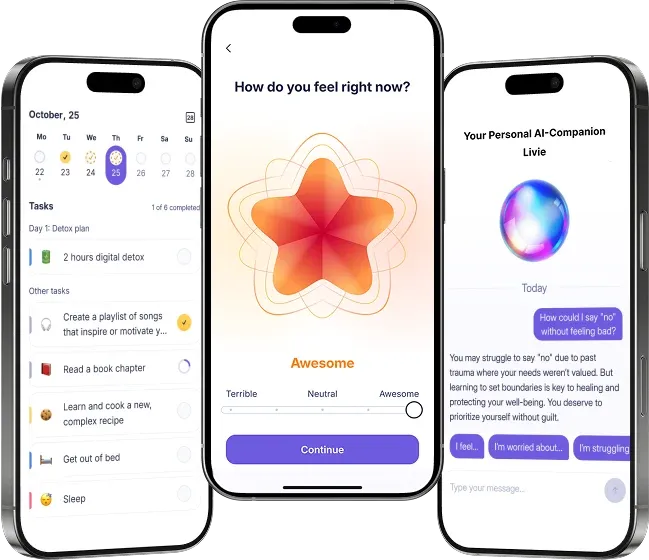
Whenever you're ready to go deeper, Liven can meet you there. Explore more insights on the Liven blog, take wellness tests to check in on your emotional state, or open the Liven app (Google Play or App Store) to start building a routine that supports you.
References
- Big Think & Big Think Creative Studio. (2025). Your reality narrows after trauma. [Video]. YouTube. https://www.youtube.com/watch?v=IMsAmWA7so0
- Kelsall-Knight et al. (2026). Understanding resistance among survivors of domestic violence and abuse. Violence Against Women, 32(2), 417–434.
- Nixon, M. A. (2024). Exploring women’s experiences of healing from sexual trauma through engagement in mind–body practices. Counseling & Psychotherapy Research. https://doi.org/10.1002/capr.12747
FAQ
How long does healing from abusive relationships take?
Why do I still miss someone who abused me?
What are the first steps to healing from abusive relationships?
Can therapy really help with healing from abusive relationships?
How do I stop blaming myself?
Is it normal to feel worse before feeling better when healing from abusive relationships?