Somatic Breathwork for a Calmer Nervous System
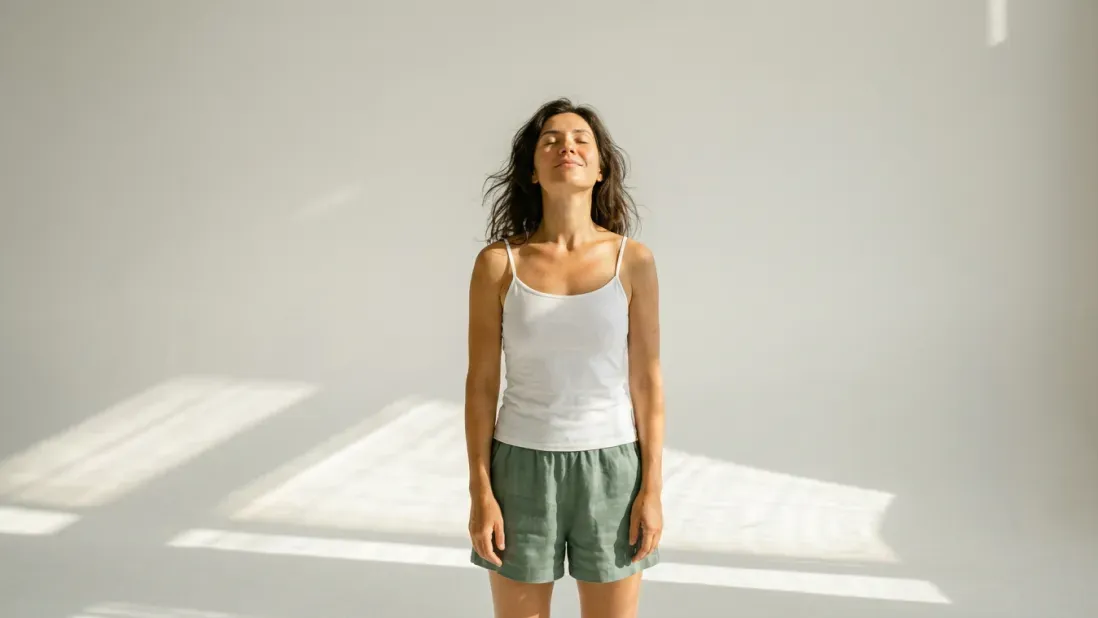



Most people know slow breathing helps with stress. Fewer understand why. And fewer still know how to use the breath as a deliberate tool for nervous system regulation, not just to calm down in the moment but to gradually shift the patterns a chronically stressed body has locked in.
That's the line between somatic breathwork and general relaxation breathing. The techniques look similar. The attention behind them is different. Somatic breathwork treats the breath as a direct pathway into the body's nervous system and its capacity to return to a regulated baseline. This guide covers how that works, which techniques are most reliable, and how to practice safely.
Key Takeaways
- Somatic breathwork is intentional breathing practiced with body awareness, aimed at regulating the autonomic nervous system rather than achieving relaxation alone.
- Breath is the only autonomic function under voluntary control, which makes it a uniquely accessible entry point into nervous system regulation.
- Extended-exhale breathing is the most consistently supported technique for shifting the system toward parasympathetic activation.
- Working with stored stress or trauma-response patterns calls for slower pacing, smaller doses, and built-in pauses so activation doesn't outpace settling.
- Short, consistent practice produces more durable change than occasional intensive sessions.
What Makes Breathwork Somatic
Somatic simply means body-based. These approaches help you notice physical sensations, such as tightness, warmth, pressure, or changes in your breathing.
Somatic breathwork is a way of engaging with breath practices that keeps body awareness at the center, not a separate technique.
Many breathing exercises focus on the rhythm of the breath itself (the count, the ratio, the rhythm). Somatic breathing also invites you to notice what is happening in your body as you breathe. You notice where the breath lands, whether there's resistance or ease, what sensations arise and shift. The breath becomes a tool for interoception, not only a lever for relaxation.
The distinction matters most for people carrying stored stress or chronic tension. For them, the body is where the most useful information lives, and a practice that keeps attention there pays off.
Why Breath Is the Master Key to Your Nervous System
The autonomic nervous system governs heart rate, digestion, immune response, and stress regulation. Its sympathetic branch fires the fight-or-flight response. Its parasympathetic branch supports rest, digestion, and recovery once safety has been registered.
Most autonomic functions can't be directly controlled. You can't decide to lower your heart rate. Breath is different. It's the one autonomic function also under voluntary control.
When you deliberately slow your breathing, especially by extending the exhale, you stimulate the vagus nerve, the main pathway of the parasympathetic system. Slow diaphragmatic breathing produces consistent improvements in heart rate variability (HRV), a direct measure of parasympathetic tone. Higher HRV means a nervous system that can shift more smoothly between engagement and rest. It's one of the clearest biological markers of nervous system health.
Adapting Breathwork When Stored Stress Is in the Picture
Standard advice (breathe deeply, breathe slowly, find your calm) assumes a nervous system ready to receive that instruction. For someone carrying significant stored stress or a trauma-response pattern, that assumption often falls apart.
When the nervous system is in chronic high alert or stuck in a freeze response, certain breath practices can increase activation rather than reduce it. Deep, forceful breathing can trigger hyperventilation responses or surface difficult material faster than the person is prepared to integrate.
Breathwork still belongs in the picture for nervous systems like this. What helps is a gentler version of the same practice. Slow down the breath and the spaces between exercises. Work in shorter bursts, three or four cycles instead of ten, with quiet pauses between. Pay attention to what your body is doing. If a pattern starts to feel agitating instead of settling, that's a signal to stop and ground, not something to push through.
Before you start, give yourself a baseline by looking around the room, feeling your back against the chair, or noticing a part of your body that feels neutral. That's the floor you work from.
In trauma-informed work, slow breath practice often comes before any processing. It builds body awareness and distress tolerance, which are the two foundations that make the rest of the work possible.
What the Research Says
Two findings from the breathwork research are worth knowing:
Five minutes daily of extended-exhale breathing produces larger improvements in mood and physiological arousal than the same dose of mindfulness meditation over a month.
And the stress-reduction effect holds across diverse populations and techniques, which means consistency matters more than the specific method.
Breathwork tends to outperform meditation in head-to-head trials because it's mechanical, not cognitive. The slow exhale activates the vagus nerve, whether your mind cooperates or not, which is why even a distracted five minutes still works.
For a closer look at how breath and brain talk to each other, here's Dr. Tracey Marks explaining the neuroscience behind it.
6 Somatic Breathwork Techniques to Try
Start with the first two and build gradually.
- Oriented belly breathing. Place one hand on your belly and one on your chest. Take a normal breath and notice which hand rises first. Aim for the belly to expand on the inhale, with the chest following gently. Once that's established, bring attention to where the breath enters and lands. Three to five minutes with genuine attention is somatic breathwork. The technique is simple. Attention is the active ingredient.
- Extended-exhale breathing. Inhale through the nose for four counts. Exhale slowly for six to eight counts. Don't force the exhale. Let it empty unhurried. A slower exhale can help the body shift toward a calmer state. You may notice your heart rate ease for a moment as the parasympathetic nervous system becomes more active. Practice five to ten cycles and rest before continuing.
- Cyclic sighing. The technique that showed the strongest effect in the Stanford trial. Take a full inhale through the nose. At the top, take a second short sniff to fill the lungs completely. Then release a long, slow exhale through the mouth. Five cycles take about a minute and produce noticeable shifts in mood and arousal.
- Box breathing with sensation tracking. Inhale for four counts while noticing the sensation of the breath entering. Hold for four while noticing what stillness feels like. Exhale for four while following the breath leaving. Hold for four while noticing the emptiness. Repeat four to six cycles. The hold phases are the somatic element. Use them to actively notice temperature, tension, and subtle movement.
- Pendulated breath awareness. Begin by noticing where the breath gets restricted, perhaps in the chest, throat, or belly. Spend two or three cycles noticing it there, without trying to change it. Then shift attention to a place where the breath moves freely, perhaps the sides of the ribs or the feel of air at the nostrils. Oscillate for five to ten minutes. This teaches the nervous system that restricted areas aren't dangerous and that ease is accessible nearby.
- Coherent breathing. Inhale for five to six counts. Exhale for five to six counts. Maintain the rhythm for ten to twenty minutes. The body enters a state where the natural oscillations of heart rate align with the breath. Slower to produce acute effects than cyclic sighing but tends to produce more sustained changes in baseline HRV over weeks of practice.


What to Know Before You Practice With Stored Stress
A few principles apply if you're using breathwork while working with significant stored stress.
- Activation isn't always progress. Fast or forceful breathing and intense catharsis can produce strong activation. That isn't inherently useful. Slow and gentle tends to be more supportive than intense.
- Stay in your window of tolerance. If a technique is pushing you outside the range where you can engage without becoming overwhelmed or shut down, that's feedback to slow down or switch to something gentler.
- Ground before and after. Use orienting or noticing physical contact for a minute on each side of the practice. This creates a container.
- Holotropic breathwork, rebirthing breathwork, and other high-intensity connected breathing aren't designed for unsupervised use. Liven's nervous system reset guide covers the broader regulatory context that breathwork fits into.
Building a Daily Breathwork Practice
Frequency matters more than duration. Five minutes daily does more for the nervous system than thirty minutes once a week.
A simple six-minute structure: one to two minutes of oriented belly breathing to settle in, two to three minutes of your chosen regulation technique, and one minute of noticing what shifted. Done consistently, it builds something real.
When to Get Professional Support
Somatic breathwork is safe for most people as a self-practice. If you have a clinical trauma diagnosis, starting inside a clinical relationship gives you the co-regulation that makes the work safer. If breathwork consistently leaves you more activated than settled, if you experience panic or dissociation during or after sessions, or if the practice begins surfacing material you can't process on your own, those are signals to find professional guidance.
Start With One Practice Today
The breath is doing the work of keeping you alive, whether you pay attention to it or not. Somatic breathwork adds intention and attention, using a process already happening to consciously support a nervous system that's working hard.
You don't need to breathe perfectly or do it for long. The body responds to the direction of your attention and the consistency of the invitation more than to any specific technique.
The hardest part of any practice is choosing where to begin. Liven's quiz removes that step and gives you a starting point in about two minutes.
Sources
- Balban, M. Y., Neri, E., Kogon, M. M., Weed, L., Nouriani, B., Jo, B., Holl, G., Zeitzer, J. M., Spiegel, D., & Huberman, A. D. (2023). Brief structured respiration practices enhance mood and reduce physiological arousal. Cell Reports Medicine, 4(1), Article 100895. https://doi.org/10.1016/j.xcrm.2022.100895
- Fincham, G. W., Strauss, C., Montero-Marin, J., & Cavanagh, K. (2023). Effect of breathwork on stress and mental health: A meta-analysis of randomised-controlled trials. Scientific Reports, 13(1), Article 432. https://doi.org/10.1038/s41598-022-27247-y
- Haller, H., Mitzinger, D., & Cramer, H. (2023). The integration of yoga breathing techniques in cognitive behavioral therapy for post-traumatic stress disorder: A pragmatic randomized controlled trial. Frontiers in Psychiatry, 14, Article 1101046. https://doi.org/10.3389/fpsyt.2023.1101046
- Siebieszuk, A., Płoński, A. F., & Baranowski, M. (2025). Breathwork for chronic stress and mental health: Does choosing a specific technique matter? Medical Sciences, 13(3), Article 127. https://doi.org/10.3390/medsci13030127
FAQ: Somatic Breathwork
What is somatic breathwork?
Is somatic breathwork the same as breathwork therapy?
Can breathwork help with stored stress and trauma-response patterns?
What's the best somatic breathing technique?
How long should a somatic breathwork session be?
What does the vagus nerve have to do with breathwork?
Can breathwork make stress feel worse?
How is somatic breathwork different from meditation?
Should I practice on my own or with a practitioner?