How to Express Feelings for Authentic Connection




You may know exactly what you feel, but the moment you try to explain it, the words disappear. Your throat tightens. Your thoughts get messy. Something important has been sitting inside you for a long time, but when it’s finally time to say it, it feels like there’s a wall between your heart and your voice.
The roots can be in a fear of being misunderstood, emotional processing difficulties, or simply not having the right labels for what has gathered inside.
Finding the path to expression is a skill we need to build gently. This article will show you simple, proven ways to share what matters with the people you love - without pressure, shame, or the fear of getting it wrong.
Key Learnings
- Finding words for what you feel is a skill that gets built one shaky sentence at a time, and you don't need to start fluent.
- Specific labels bring their own relief, even before you say them out loud (resentful lands differently from stressed).
- Strong emotions are chemical surges, and a 90-second pause is usually the difference between an honest reply and one you'll regret later.
- Asking someone if they have the bandwidth before you share something heavy turns a confrontation into a collaboration.
How to Express Feelings Safely
A few small practices make hard feelings easier to share. The five below are the ones therapists tend to teach first, and each one fits a slightly different moment.
Use Emotional Wheel
Sometimes, the reason we can't express how we feel is simply that we haven't found the right word for it yet. We often default to big labels like angry, sad, or stressed, but these are often just the surface of a much deeper ocean.
Think of it like trying to paint a masterpiece with only three colors - you're bound to miss the nuances. The skill of recognizing and naming your emotional experiences, also called emotional granularity, is often viewed as a meaningful contributor to well-being. That's why exploring it through tools like the Emotional Wheel can give you a richer vocabulary for what you experience.
These tools are available online (for example, the Feelings Wheel), and you can use them immediately or save a picture to your phone. If you have a diary or even a basic notebook, put a printed Emotional Wheel there.
Try the 90-Second Rule
Have you ever said something in the heat of the moment that you immediately wished you could take back? That's because emotions are essentially a chemical surge in the body. By giving yourself time to consider your first response, you ensure you won't say something that could cause misunderstanding and heartache.
This rule can be useful when you're emotionally overwhelmed and suspect you might not be quite objective.
- Pause. If your emotions are running high, and you feel the telltale signs of a rash emotional reaction, stop yourself and pause before responding.
- Check-in. Ask yourself, "Am I in the right frame of mind to respond?"
- Take a step back. If your response to the previous question isn't "Yes," allow yourself a 90-second pause.
- Return. Approach the person or situation again, with a calmer mind.
Check Their Bandwidth
How to express feelings to someone you like without overwhelming them? People don't always know how to have difficult conversations because they are afraid of bothering others.
We've all experienced the emotional dump - that moment someone catches you the second you walk through the door with a heavy confession when you're already exhausted. Even the best-expressed feeling can fall flat if the listener isn't in a place to receive it.
If you have been wondering how to express your feelings to your partner, parent, or close friend, a good place to start is by asking for permission to be honest. By asking for emotional consent, you ensure that your vulnerability receives the attention it deserves. It turns a potential confrontation into a collaborative moment.
You can try something like, "I have some feelings I'd like to share with you. Do you have the headspace for a 10-minute talk, or should we find a better time later this evening?"
If they're ready now, they're mentally prepared. If they'd rather wait, you've avoided a situation where you feel ignored, and they feel overwhelmed.
Use the "I" Statements
Perhaps you've already heard this tip: when sharing with someone how something makes you feel, using "I" statements keeps things open. When we start a sentence with "You..." (e.g., "You always make me feel..."), the other person's brain often enters a defensive fight-or-flight mode. They stop taking anything in.
How to express your feelings in words with an "I" statement, then? A golden formula that can help you express your feelings authentically, but without causing defensiveness is:
I feel [specific emotion] when [non-judgmental observation of the event] because I need [the underlying value or need].
For example, instead of: "You're so inconsiderate with your mess!" Try, "I feel overwhelmed when the kitchen is cluttered because I need a calm environment to relax after work."
Burn or Release the Feeling
Sometimes we need to go through the feeling without a filter and then let go. In such a case, burning or releasing that emotion can be a good outlet. It begins with writing: translating a messy feeling into a linear sentence forces your brain to organize the chaos.
- Write it down. Write exactly how you feel without worrying about being nice or fair. You are expressing your emotions, so you don't have to find any logic or explanation behind them. Feelings are raw. They don't have to make sense.
- Reflect. Look at what you wrote and find the core need. (e.g., "I'm mad he was late" becomes "I value my time and feel disrespected.”) Even if you cannot immediately place the need, acknowledge what you think might fit.
- Let it go. You don't have to send the letter. The act of writing and reflection has already given you a release. Some people like to store these letters, while others prefer to rip the paper and throw it out. A ritualistic act of burning the paper might be one of the most effective forms of emotional release. Take the paper and burn it safely. If relief comes from watching it burn, allow it in.
Begin When You're Ready
Your feelings are the most honest thing you've got. Learning to express them takes time - and it's okay if the words come out shaky at first. Vulnerability is what makes a real connection possible, with others and with yourself. What you feel is valid, and you're allowed to still be figuring it out.
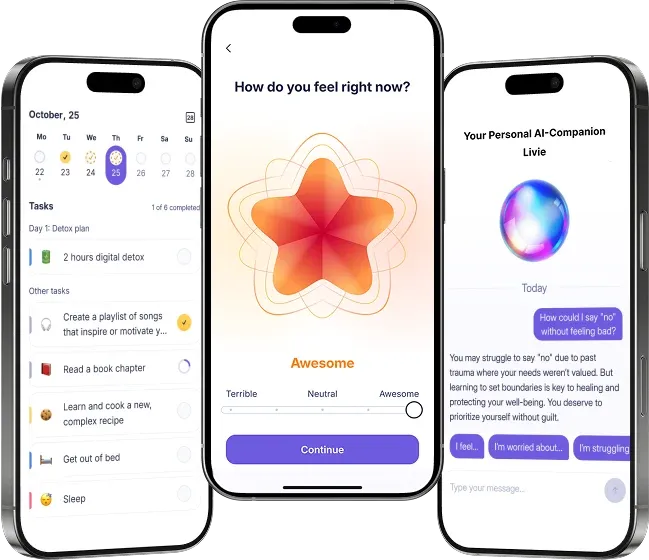
To keep this momentum going, why not try one small, healthy activity today? Whether it's logging your emotions in the Liven's Mood Tracker or simply practicing saying "I" statements, these tiny acts of emotional maintenance are what build a life of clarity and connection. You've got this, and your feelings are worth the breath it takes to speak them.
References
Liu, S., Zabag, R., Xu, J., Wang, Y., Deng, W., Joormann, J., & Gadassi‐Polack, R. (2026). Changes in emotional granularity under a population‐level stressor predict social anxiety and depressive symptoms. Journal of Research on Adolescence, 36(1). https://doi.org/10.1111/jora.70131