What Is My Purpose in Life? How to Find Your Direction



At some point, usually at 2 AM, or mid-commute, or while washing dishes, the question shows up uninvited: What is my purpose? It's one of the most human things you can ask. For a lot of people, this stirs things up. It can feel destabilizing before it feels clarifying.
Most of us were handed the same idea growing up: find your purpose, then build your life around it. Think of purpose less as a destination and more as a compass - one whose needle shifts as you do.
In this article, you'll learn what purpose means, why so many people feel stuck searching for it, and a few practical ways to start uncovering yours.
Key Learnings:
- Life purpose rarely arrives as a single clear answer - it unfolds gradually, through honest reflection, real experiences, and a willingness to experiment.
- Most of what we believe about success and meaning was shaped by family, culture, or past experiences - not always by personal choice. Tracing those roots helps you figure out what matters to you.
- Small, low-pressure experiments and paying attention to your emotions can be surprisingly revealing. They show you which activities leave you feeling energized versus drained.
- Purpose is better understood as a flexible direction guided by values rather than a fixed lifelong goal.
How to Find Your Purpose in Life
There's no universal answer here - purpose is deeply personal. But the strategies below can serve as a compass for your own exploration.
Take the First Dive Alone
Most of our daily habits and convictions run on autopilot - shaped by social pressure more than personal choice. When the noise around you gets too loud, sometimes the most useful thing you can do is step away from it.
This one takes a little planning, but it's worth it.
Go on a solo retreat. Leave your phone on the highest shelf, turn Wi-Fi off, and find a place where no one knows you. No agenda, no performance - just you.
And yes, you'll probably get bored. That's the point. Boredom is one of the most underrated states: it lets your mind wander into questions you've never had the quiet to ask. It's where self-awareness begins.
It's not a task of survival but rather of mind-wandering and searching for the main sources of emotional and spiritual need. As you do this mental experiment, reflect and journal: What do you miss the most? Have you noticed any striking associations? Is there an activity that seems to come naturally to you?
Record, write, and allow this reflection to slowly work its way into your mind.
Map Your Beliefs and Their Origin
When thinking about your purpose, it can help to pause and look at the beliefs guiding your choices. Most beliefs feel natural because you've had them long enough to lose track of where they came from.
Start by writing down a few beliefs that shape how you see life. For example:
- "God should always come first"
- "Success means a perfect job with a lot of money"
- "Helping others is what gives life meaning."
Then, next to each belief, gently ask yourself where it might come from:
- Did I learn this from my parents or culture?
- Was this shaped by my religion or community?
- Did this belief form after a specific experience?
Many people, particularly those influenced by their loved ones, internalize their beliefs. Once you can tell your own values from the ones you absorbed without thinking, deciding what matters gets a lot less murky.
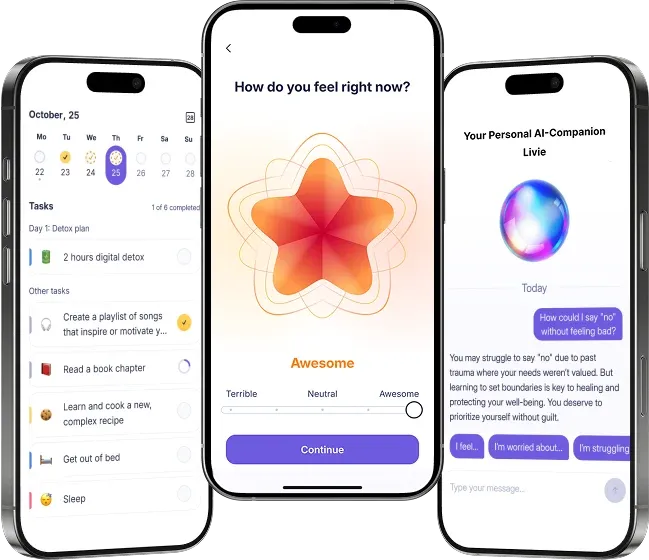
If you need someone to challenge your beliefs, Liven's Smart Companion Livie can ask thought-provoking questions.
Examine Your Emotional Patterns
Rather than only thinking through the question, pay attention to how it feels.
Your sense of purpose doesn't stay fixed. It shifts from day to day depending on what you're doing and how you're feeling. Tracking those shifts is one of the most practical ways to spot what matters to you.
For a better analysis, try questions such as, "When do I feel most like myself?" or "What situations drain me vs. energize me?"
Sometimes, such self-explorations are too difficult. If you want to begin but aren't sure how to start this reflective journey, you can take a quiz to get your personalized self-discovery plan and start when you're ready.
Run Small Purpose Experiments
Do you feel as if each time you try a new hobby, your rational brain tries to make the best out of it, pushing you to perfection? If that's the case, chances are you're not pursuing them out of passion but out of inner perfectionism. It's tempting to believe that purpose arrives as a clear answer. But more often, it reveals itself through action.
Instead of waiting to figure it out, you can start by running small, low-pressure experiments. Think of these as short trials where each experience gives you data about what feels engaging, meaningful, or draining.
Try a few of these experiments:
- Spend a few hours volunteering for a cause that interests you. A local food bank, an animal shelter, a neighborhood clean-up. Something small enough to try once, meaningful enough to notice how it feels.
- Take an online class in a topic you've been quietly curious about. Ceramics, urban gardening, behavioral economics, bread baking. It doesn't have to be career-relevant to be worth trying.
- Reach out to someone whose work you find interesting and ask about their path. A person on LinkedIn whose work catches your eye, a friend of a friend who made an unexpected career shift, someone whose writing you've followed for years.
- Say yes to something you'd usually hesitate to try. The dinner with people you don't know yet, the workshop your colleague keeps mentioning, the trip you've been almost booking for two years.
After each experiment, ask yourself:
- "Did I feel energized, neutral, or drained while doing this?"
- "What part of this experience made me care the most?"
- "Would I want to do this again, even in a small way?"
Explore Your Roles
One person wears many hats at once. We're siblings, parents, children, professionals, dreamers, volunteers, and so much more. Holding multiple social roles can enrich our sense of self, as long as we find ways to integrate them.
Try to write down a list of your roles, all that you can imagine. For example, you may have a mom role and a CEO role, and these roles might seem contradictory. After you complete the list, analyze, in written form, how each of these became associated with you.
If you don't know whether a certain role suits you, talk about this role aloud, as if having a dialogue. You might notice yourself becoming increasingly detached when discussing some roles, while maintaining a more active stance when thinking about the others.
Accept a Direction, not a Final Answer
Our purpose isn't usually a specific sentence with a clear-cut goal at the end. But when we try to formulate it, it can feel awkward. Instead of asking, "What is my one true purpose?", it can be more helpful to ask, "What direction feels right for me right now?"
A direction is flexible. It leaves room for growth, change, and new information. It also allows you to move forward even when you don't feel completely certain.
Map out your values and consider which of them you want to carry with you. For example, if you notice that you are a passionate nature lover, spend time outdoors, and have a strong stance on the environment, you already have a specific direction to look in.
You can try adding colors to highlight each value. It'll give you a more visual representation of where you might be directed. Feel free to practice this exercise once a week for a month: write your values and principles each time, and check whether anything has changed.
Purpose is one of those questions that never really gets old. If you want to keep exploring, this conversation between psychoanalyst Dr. James Hollis and Andrew Huberman is worth your time:
Your Life Decision
Your purpose is, essentially, what you intend to do with your life. It's the person you intend to be and what values you want to protect. Will your purpose change as years go by? Of course. But isn't that the point? To live dynamically and explore yourself over time, making choices each day. Today, you can have a clearer view of yourself. Tomorrow, your path may change and get more mixed up. The goal will change, but you, the seeker, will be the person walking.
Additional Resources
If this article got you thinking, a few places to keep exploring:
📖 Man's Search for Meaning by Viktor Frankl. Written by a psychiatrist and Holocaust survivor, this is the book psychologists keep coming back to when the conversation turns to purpose. His central idea is simple: more than comfort or pleasure, people need to feel that their life means something. Not a light read, but one of those books that tends to stay with you.
🎬 Live to 100: Secrets of the Blue Zones on Netflix. Dan Buettner travels to the places on earth where people live the longest and asks why. In Okinawa, the answer keeps coming back to ikigai: a quiet, everyday sense of purpose. Four episodes, visually beautiful, and a good reminder that purpose doesn't have to be dramatic to matter.
References
- Huberman Lab. (2024, May 13). Dr. James Hollis: How to find your true purpose & create your best life [Video]. YouTube. https://www.youtube.com/watch?v=SyWC8ZFVxGo
- Manzi, C., Last Name, A. B., & Last Name, C. D. (2024). Multiple social identities and well-being: Insights from a person-centred approach. British Journal of Social Psychology, 63, 792–810. https://doi.org/10.1111/bjso.12704
- Pfund, G. N., Burrow, A. L., & Hill, P. L. (2024). Purpose in daily life: Considering within-person sense of purpose variability. Journal of Research in Personality, 109, 104473. https://doi.org/10.1016/j.jrp.2024.104473
FAQ: What Is My Purpose?
What is life's purpose?
Is it normal not to know my purpose?
Can my purpose change over time?
How do I start discovering my purpose?
Does finding a purpose affect mental health?
What if I never find one clear purpose?