
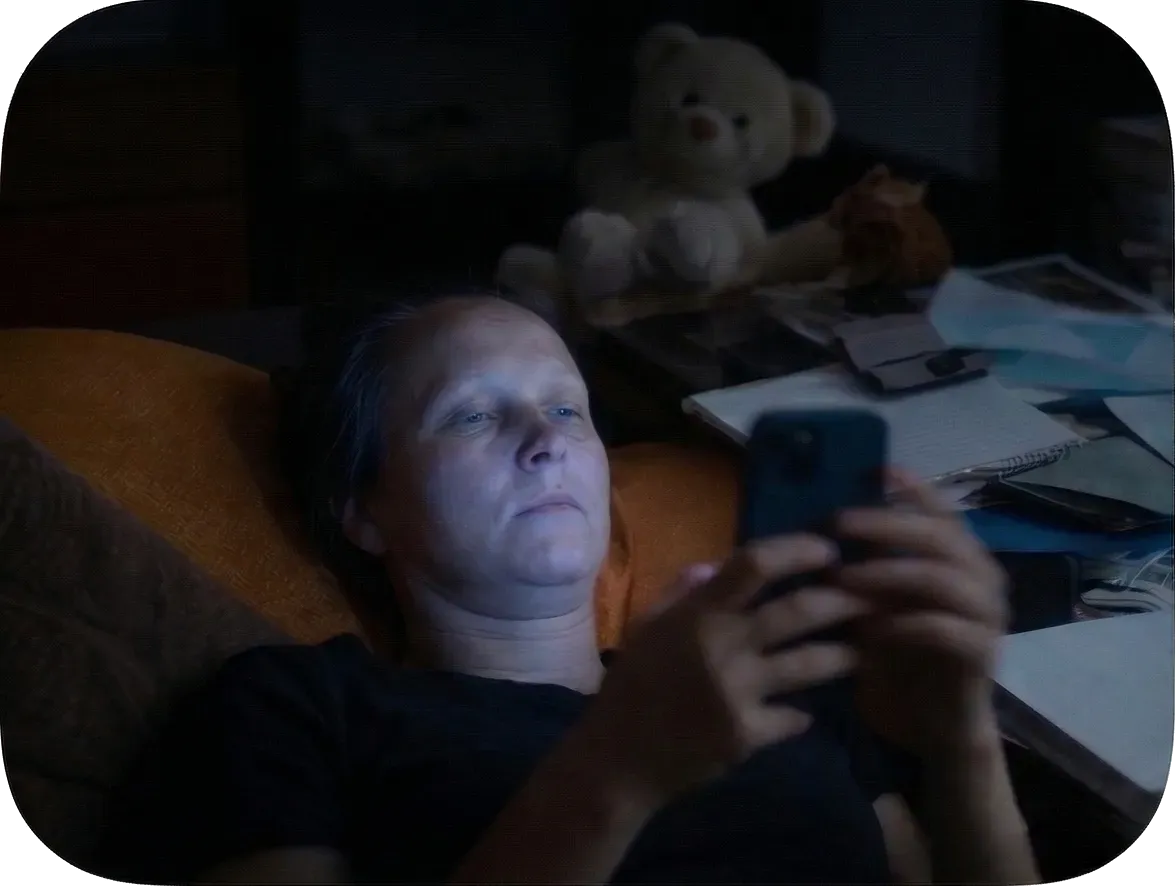
Overstimulation test
See whether your everyday habits around reward and stimulation have tipped out of balance, and learn practical ways to build healthier ones.
By clicking "Take test", you agree to the Terms of Use, Privacy Policy, Subscription Policy and Cookie Policy
Do you constantly chase the next thrill, scroll endlessly, or struggle to feel satisfied even after getting what you wanted? You're not alone, and your brain isn't broken. You may have slipped into a pattern around reward and stimulation that's quietly working against you.
Dopamine is the brain chemical tied to motivation, reward, and desire. Repeated engagement with highly rewarding activities can become habitual or difficult to control for some people and may make less stimulating activities feel less appealing by comparison. Over time, those patterns can take a toll on your well-being and your ability to enjoy ordinary life.
Liven's overstimulation test helps you spot your specific pattern, for example, Seeker, Achiever, or Soother, and maps the behaviors keeping the cycle going. It can take about 3 minutes, and you'll come away with a clear picture of what's happening and some practical next steps.
What Is "Dopamine Addiction"?
Dopamine is one of the brain's main chemical messengers. It plays a central role in reward, anticipation, and motivation. When you eat something you enjoy, connect with someone you love, or reach a goal, dopamine helps reinforce that behavior and nudges you to do it again.
"Dopamine addiction" is a popular phrase rather than a medical diagnosis, and it doesn't mean you're addicted to the chemical itself. It describes a pattern in which the reward loop leans heavily on high-stimulus activities, such as social media, food, gambling, substances, or work. Only certain behavioral patterns that are difficult to control, such as gambling and gaming disorder, currently have formal diagnostic recognition.
Heavy, repeated stimulation can, over time, make the reward system less responsive. With repeated substance use and possibly some severe compulsive behaviors, the brain’s reward and learning systems can adapt. The mechanisms vary considerably depending on the substance, behavior, and individual. That can set up a loop: you need more stimulation to feel the same reward, and quieter moments start to feel uncomfortable.
The following four areas can be useful prompts for self-reflection, but they are not diagnostic criteria:
- Control: difficulty controlling how much or how often you engage in a behavior
- Compulsion: a strong urge to engage even when you don't want to
- Cravings: intense desire for the stimulus between episodes
- Consequences: continuing the behavior despite negative effects on relationships, health, or daily life.
Please note that this test isn't a clinical diagnosis and doesn't measure your dopamine or any other brain chemistry. It's a behavioral self-reflection designed to help you notice which pattern is most active in your life right now.
Signs You Might Be Stuck in a Dopamine-Driven Pattern
These patterns show up differently for different people. Some chase novelty and stimulation. Others numb out or grind compulsively. Here are some of the most common signs to look for:
- You check your phone compulsively, even when you know nothing important is there.
- You feel restless or irritable when nothing stimulating is happening.
- You binge on food, content, or activities, then feel empty or regretful afterward.
- Ordinary moments, like a walk, a conversation, or a quiet evening, feel boring or not enough.
- You use a behavior or substance to manage your mood rather than to enjoy it.
- You find yourself escalating over time, needing more of the same stimulus for the same effect.
- You've tried to cut back on a habit and found it harder than expected.
- You seek risk, novelty, or intense experiences to feel alive.
- You feel low, flat, or unmotivated without your usual source of stimulation.
- Your habits have led to disrupted sleep, strained relationships, and poor focus, yet you keep going.
You don't need to tick every box. If several of these feel accurate, you may be running a pattern that's costing you a lot of energy.
Types of Dopamine-Driven Patterns
Liven's quiz uses four informal patterns to organize common habits and motivations. These categories may overlap and are not clinical diagnoses or measures of dopamine activity.
The Seeker
Seekers are driven by novelty, stimulation, and the thrill of the new. The dopamine hit comes from the chase. Seekers may jump between hobbies, relationships, or jobs. They tend toward impulsive decisions, risk-taking, and boredom in stable situations. Endless scrolling, substance use, and constant content consumption are common Seeker behaviors.
At their best, Seekers are creative, energetic, and adventurous. When the pattern tips out of balance, the constant pursuit of the next thing can leave them unable to feel satisfied with what they already have.
The Achiever
Achievers get their dopamine from productivity, success, and outside validation. The reward comes from completing, winning, or being recognized. Achievers often look high-functioning on the surface but run on a treadmill of goals that never quite delivers lasting satisfaction. When there's nothing left to achieve, they can feel surprisingly empty or on edge.
Overwork, perfectionism, compulsive goal-setting, and the inability to rest without guilt are hallmarks of the Achiever pattern. The brain has learned that productivity is the most reliable source of reward.
The Soother
Soothers use dopamine to ease discomfort rather than to chase pleasure. Food, alcohol, scrolling, or other numbing behaviors become the go-to tools for managing stress, loneliness, boredom, or emotional pain. The behavior is less about chasing a high and more about avoiding a low.
Soothers often describe their habits as things they do without thinking, a default response to inner tension. Over time, the numbing behavior can become a dominant way of coping, which can make it harder to ride out difficult feelings on your own.
The Worrier
Worriers are driven by worry rather than reward. Checking behaviors, reassurance-seeking, doomscrolling, and rumination all offer a temporary sense of control that briefly settles the nervous system. The relief is the reward, not the activity itself.
Worriers often experience high stress and low self-confidence, which can create a feedback loop: worry triggers seeking behavior, the seeking behavior brings momentary relief, and the underlying worry tends to grow stronger over time. Easing the Worrier pattern usually means working directly with the stress response, not just the surface behavior.
How Does Our Overstimulation Test Work?
The test includes a set of questions about your everyday behaviors, emotional patterns, and responses to reward, boredom, and stress. There are no trick questions and no right or wrong answers. Honest responses give you the most useful results.
After you finish, you'll get a full summary of your profile across four dimensions:
- Mental load — how much you're carrying and how heavy it currently feels.
- Stress resistance — how easily your system settles and bounces back after pressure.
- Exhaustion level — how drained you feel after long stretches of staying "on."
- Physical cost — the ways stress tends to show up in your body, like tension or restlessness.
Liven's quiz is a nonclinical self-reflection tool inspired by concepts commonly addressed in CBT and DBT. Its results are not validated measures of addiction, stress, self-confidence, or brain chemistry.
Keep in mind that your results are not a clinical diagnosis, and they don't measure your brain chemistry. They're a self-reflection tool designed to build awareness and give you clear direction. If you think you may be dealing with a substance use issue or a clinical mental health condition, please reach out to a licensed professional.
How to Shift the Pattern
There's no single fix here. What works is a steady set of changes that gives you room to find a new baseline over time. Here's where to start:
- Step back from your highest-stimulation inputs (social media, processed food, streaming) for 24 hours. This won't reset anything overnight, but it builds awareness of how much you've come to rely on outside stimulation.
- Before acting on an impulse, pause for 10 minutes. Over time, this helps strengthen your ability to sit with the urge rather than react to it.
- A habit you simply drop tends to creep back. Figure out what the behavior was meeting (stimulation, comfort, escape) and find a healthier way to meet that same need.
- Move your body. Regular physical activity, including walking, may support mood, energy, and overall well-being.
- Practices like mindfulness, Yoga Nidra, breathwork, and progressive relaxation help your nervous system become more comfortable with quiet, rather than reaching for stimulation.
- Evidence-based treatment for substance-related concerns may include CBT, motivational approaches, medication, peer support, or other specialized care. DBT may be useful when difficulties with emotion regulation are also present.
- Treat your results as a map. Knowing your type points you to the triggers to watch for and the strategies most likely to work for you.
Summary
Dopamine isn't your enemy. It's the system your brain uses to pursue what matters. Difficulties can develop when certain rewarding activities become compulsive, crowd out other parts of life, or continue despite harmful consequences.
Liven's overstimulation test gives you a clear map: your type, your triggers, and a direction forward. Whether you're a Seeker, Achiever, or Soother, understanding your pattern is the most practical first step toward changing it. Your brain built this cycle through repetition, and it can learn a new one with steady practice.
FAQ
Can You Be Addicted to Dopamine?
Technically, no. You can't be addicted to your own neurotransmitter. What happens is that certain behaviors or substances repeatedly trigger the dopamine reward system, leading to compulsive, hard-to-control patterns. The phrase "dopamine addiction" describes that pattern, not a dependency on the chemical itself.
Can This Tell Me if My Dopamine Is "Low"?
No quiz can measure your brain chemistry. That said, things like persistent low motivation, difficulty feeling pleasure, fatigue, trouble concentrating, and a constant search for stimulation are worth paying attention to. They can overlap with other things going on in your life, so for a clear picture, it's best to speak with a doctor or mental health professional. A behavioral self-reflection like this test can help you notice the pattern in the meantime.
What Is a Dopamine Detox?
"Dopamine detox" is a popular term for temporarily stepping back from high-stimulation activities like social media, processed food, streaming, gambling, and substances. The science behind the exact "detox" idea is mixed, and you're not literally flushing anything out. Temporarily limiting certain activities may help you observe your habits, reduce automatic use, and decide whether longer-term boundaries would be helpful. It does not detox or reset dopamine.
Is This the Same as a Diagnosed Condition?
Not quite. Every day, dopamine-driven habits can develop in anyone through environment and routine. Diagnosed conditions are different: they involve differences in how the brain works that a quiz simply can't assess. If you suspect something clinical is going on, a formal assessment with a licensed professional is the right next step. This test is a starting point for awareness, not a substitute for that.