
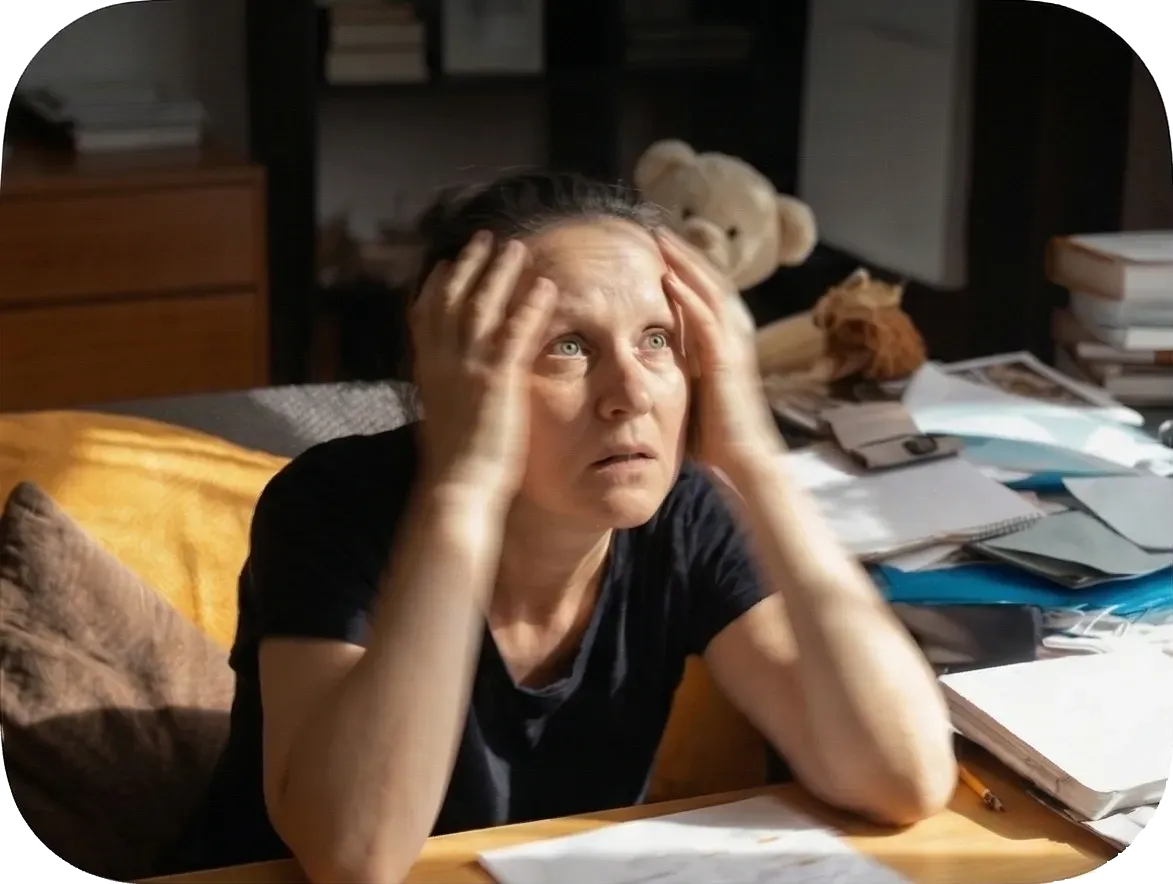
Anxiety test
Discover how anxiety may be affecting your daily life and learn practical ways to manage worry and stress
By clicking "Take test", you agree to the Terms of Use, Privacy Policy, Subscription Policy and Cookie Policy
Feeling constantly worried, restless, or on edge? Anxiety is one of the most common mental health experiences in the world, and it often goes unrecognized because it doesn’t always look the way people expect.
Our free anxiety quiz is designed for anyone who wonders whether what they’re feeling is normal stress or something more persistent. It measures behavioral, emotional, and physical patterns and takes about 3 minutes to complete.
You’ll get a personalized result showing where you fall on the anxiety spectrum, what your patterns suggest, and practical next steps grounded in evidence-based approaches. Note that the results are not a clinical diagnosis.
What Is Anxiety?
Anxiety is the brain and body’s built-in alarm system. When it’s working well, it sharpens your focus, motivates action, and helps you respond to genuine threats. When it misfires, it starts treating ordinary situations as emergencies, and it doesn’t turn off.
The key distinction between normal worry and an anxiety disorder comes down to intensity, persistence, and impact. Everyday stress tends to be tied to a specific situation and fades when that situation passes. Anxiety disorders, by contrast, are characterized by worry that feels difficult or impossible to control, that occurs across many areas of life, and that interferes with how you work, sleep, or relate to people around you.
According to the National Institute of Mental Health (NIMH), an estimated 19.1% of U.S. adults experience an anxiety disorder in any given year, and 31.1% will experience one at some point in their lives.
Common Anxiety Symptoms
Anxiety expresses itself differently in different people. Some experience it mostly in their body. Others notice it most in their thoughts, or in the situations they start quietly avoiding. Many experience a combination of all three.
Physical symptoms
The body’s stress response, triggered by the amygdala, produces real, measurable physical changes. Common physical symptoms of anxiety include:
- Racing or pounding heart
- Muscle tension and stiffness, particularly in the shoulders, jaw, and neck
- Shortness of breath or a feeling of tightness in the chest
- Sweating, trembling, or feeling hot
- Nausea, stomach upset, or changes in digestion
- Fatigue
- Headaches
Emotional symptoms
- Excessive or uncontrollable worry
- Irritability
- A persistent sense of dread or that something is about to go wrong
- Feeling overwhelmed by decisions that feel manageable to others
- Difficulty tolerating uncertainty
Behavioral symptoms
- Avoidance
- Difficulty concentrating
- Procrastination driven by fear
- Reassurance-seeking
- Sleep disruption
No single symptom confirms an anxiety disorder. The pattern across these categories, and how much it’s getting in the way of the life you want, is what matters most.
How Our Anxiety Test Works
Liven’s free anxiety test is built on the GAD-7 (Generalized Anxiety Disorder 7-item scale), one of the most widely used and validated tools for anxiety screening in clinical settings worldwide.
Scores from the GAD-7 are interpreted as follows:
- 0–4: Minimal anxiety
- 5–9: Mild anxiety
- 10–14: Moderate anxiety
- 15–21: Severe anxiety
Liven’s version builds on this foundation by adding questions that capture behavioral patterns, avoidance tendencies, and how anxiety is showing up in your day-to-day life.
Your results are personalized to your score range and include: a clear explanation of what your level means, the patterns most prominent for you, and evidence-based strategies matched to where you are right now.
Important: This test is a self-assessment tool, and not a clinical diagnosis. It is not a substitute for evaluation by a licensed mental health professional. If your results indicate moderate or severe anxiety, or if your symptoms are significantly affecting your life, we recommend speaking with a therapist or your doctor.
Types of Anxiety Disorders
Anxiety is not a single condition. It’s a family of related disorders, each with distinct features:
Generalized Anxiety Disorder (GAD) is the most common form. It involves persistent, excessive worry across multiple areas of life, such as health, finances, relationships, or work, that is difficult to control and present on most days.
Social Anxiety Disorder involves intense fear of social situations where a person might be judged, embarrassed, or scrutinized. It goes well beyond shyness. Many people with social anxiety avoid situations they would otherwise want to be in and experience significant distress in anticipation of them.
Panic Disorder is characterized by recurrent, unexpected panic attacks: sudden surges of intense fear accompanied by physical symptoms such as racing heart, chest tightness, shortness of breath, or dizziness. The fear of having another attack often becomes its own source of anxiety.
Specific Phobias are intense, irrational fears of particular objects or situations, such as heights, flying, or needles, that consistently provoke a fear response and lead to avoidance.
OCD-related and trauma-related conditions, including Obsessive-Compulsive Disorder and Post-Traumatic Stress Disorder, share features with anxiety disorders and are closely linked, though they are classified separately in the DSM-5.
Understanding which type of anxiety resonates with your experience is part of what this anxiety self-assessment is designed to help you figure out.
How to Manage Anxiety
Anxiety responds well to consistent, targeted effort. The most effective strategies work by changing the patterns, both in thought and behavior, that maintain the anxiety loop. The good news is that these patterns are learnable, and they’re reversible.
Use CBT techniques to challenge anxious thinking. Cognitive Behavioral Therapy is the most extensively researched psychological treatment for anxiety. CBT works by helping you identify the thought patterns that feed anxiety, evaluate whether they’re accurate, and replace them with more grounded responses. Common CBT techniques include thought records, cognitive restructuring, and behavioral experiments.
Build a tolerance for uncertainty. A significant driver of anxious behavior is the need for certainty in inherently uncertain situations. Emotion Regulation Therapy and DBT both address this directly. Techniques like distress tolerance and radical acceptance help build flexibility in the face of the unknown, so that uncertainty no longer triggers the same alarm response.
Regulate the body as a way into the mind. Deep diaphragmatic breathing, progressive muscle relaxation, and Yoga Nidra-based protocols activate the parasympathetic nervous system and directly reduce the physiological symptoms of anxiety. Practiced consistently, they lower the baseline activation of the stress response.
Break the avoidance cycle, step by step. Avoidance is one of the main engines that keeps anxiety going. Gradual exposure, done at a manageable pace, teaches the brain that the feared situation doesn’t actually require an emergency response. Each time you engage with something you’ve been avoiding and come through it okay, the anxiety loses a little of its grip.
Establish lifestyle foundations. Sleep quality, exercise, alcohol intake, caffeine, and social connection all have a significant and well-documented effect on baseline anxiety. For many people, addressing even one or two of these areas produces a noticeable shift in how they feel day to day.
Seek professional support when you need it. When anxiety is moderate to severe, persistent, or has narrowed your life significantly, working with a licensed therapist gives you the structure, individualization, and accountability that self-directed strategies can’t fully replicate. Taking this anxiety screening test can help you understand your current level and make a more informed decision about whether professional support is the right next step.
FAQ
How do I know if I have anxiety or just stress?
Stress is usually tied to a specific situation and eases when the situation resolves. Anxiety is more persistent: it can attach itself to new concerns as old ones pass, show up without a clear trigger, and remain even when things are objectively fine. If your worry feels constant rather than situational, and it’s affecting your sleep, concentration, or daily decisions, that’s worth taking seriously. The difference also shows up in your body. Stress tends to feel reactive; anxiety tends to feel like a low-level current that’s always running. This do I have anxiety quiz is designed to help you see that distinction more clearly.
Can anxiety go away on its own?
Mild anxiety often fluctuates on its own, especially when a specific stressor passes. But anxiety that’s rooted in learned avoidance patterns, chronic stress, or heightened neurological reactivity rarely fully resolves without some kind of intentional change. Left unaddressed, the avoidance behaviors that provide short-term relief tend to expand and reinforce the anxiety over time. The encouraging side: anxiety is one of the most treatable mental health conditions. With the right approach, even moderate to severe symptoms can shift meaningfully. The key is finding strategies that target the patterns and keep the anxiety in place.
What is the GAD-7 test?
The GAD-7 (Generalized Anxiety Disorder 7-item scale) is a validated clinical screening tool and is widely used by GPs, psychiatrists, and therapists worldwide to screen for generalized anxiety disorder and measure symptom severity. It asks about seven core symptoms experienced over the past two weeks, including uncontrollable worry, restlessness, irritability, and difficulty relaxing. Scores range from 0 to 21, with thresholds at 5 (mild), 10 (moderate), and 15 (severe). Liven’s free GAD-7 test online draws on this validated structure and adds behavioral and contextual questions for a more complete picture of how anxiety is showing up in your life.
When should I see a therapist for anxiety?
If anxiety is regularly disrupting your sleep, your work, your relationships, or your ability to do things you want to do, it’s a good time to talk to a professional. The same applies if you’ve tried self-directed strategies without much improvement, or if your anxiety is accompanied by panic attacks, significant avoidance, or low mood. You don’t need to be in crisis to benefit from therapy. Many people see meaningful improvement in a relatively short course of CBT or another evidence-based approach. If your results from this anxiety test indicate moderate or severe symptoms, that’s a reasonable signal to take the next step toward professional support.