
💬 Ask Shanen Norlin about How to Deal with Health Anxiety [Licensed Therapist Column]
![💬 Ask Shanen Norlin about How to Deal with Health Anxiety [Licensed Therapist Column]](https://cdn.theliven.com/blog-strapi/5e2e00358d9ffe0fa66c87ff057b4f48.webp)


Written by
Nadine M., Editorial Team Lead at Liven


You notice a headache. Then you notice you're noticing it. By the time you've Googled the symptom, convinced yourself it's serious, gotten reassurance from a doctor, and felt relieved for approximately 48 hours before the cycle starts again, that's health anxiety, and knowing the difference changes what you do about it.
Figuring out how to deal with health anxiety is harder than it sounds, partly because it masquerades as being health-conscious, and partly because the usual anxiety advice doesn't always land. Telling someone with health anxiety to "stop worrying" or "trust the test results" is a bit like telling someone with a fear of heights to just look down.
We asked Shanen Norlin, a clinical therapist, behavioral health specialist, and a member of Liven's Board of Health Professionals, to break it down: what separates health anxiety from generalized anxiety disorder, where OCD enters the picture, and what treatment looks like depending on which pattern you're dealing with.
Key Learnings
- Reassurance-seeking (Googling symptoms, asking doctors repeatedly) is part of the health anxiety cycle.
- OCD can overlap with health anxiety in ways that aren't obvious. If compulsive patterns are present, the treatment shifts significantly
- CBT and mindfulness are the front-line approaches for health-related worry.
- DBT skills can support you in managing the intensity of anxiety while you do the deeper work
Shanen breaks down the differences for us and what to do about them:
Illness Anxiety Disorder and Generalized Anxiety Disorder can look similar at first because both involve ongoing anxiety, but the focus of that anxiety is what sets them apart. Illness Anxiety Disorder is centered specifically on health — someone may be constantly worried that they have a serious medical condition, even after tests come back normal or doctors offer reassurance. Everyday body sensations can feel alarming and be interpreted as signs of something serious. Generalized Anxiety Disorder, on the other hand, is much broader. Instead of focusing mainly on health, the worry spreads across many areas of life, like work, finances, relationships, and day-to-day responsibilities. The anxiety tends to feel constant and difficult to control, often lingering for months at a time.
It is also important to note that sometimes health-related concerns are rooted in more Obsessive-Compulsive thoughts that add another layer to this comparison. While it can sometimes involve fears about health, the core issue in OCD is the presence of intrusive, unwanted thoughts (obsessions) and repetitive behaviors or mental acts (compulsions) performed to reduce anxiety. For example, someone might repeatedly check their body, search symptoms, or seek reassurance because they feel driven to relieve the distress caused by persistent "what if" thoughts.
When it comes to health-related anxiety, approaches like Acceptance and Commitment Therapy (ACT), Cognitive Behavioral Therapy(CBT), and mindfulness-based strategies are among the most commonly used and well-supported. These approaches focus on changing your relationship to anxious thoughts, reducing unhelpful patterns like reassurance-seeking, and building tolerance for uncertainty.
If the anxiety is more aligned with obsessive-compulsive patterns, especially when it involves persistent rumination or compulsive behaviors, treatment often shifts to include Exposure and Response Prevention (ERP). This approach helps break the cycle of intrusive thoughts and compulsions by gradually facing the anxiety without engaging in the behaviors that temporarily relieve it.
In both cases, skills from Dialectical Behavior Therapy, such as distress tolerance and emotional regulation, can be helpful additions. These skills support you in managing the intensity of anxiety in the moment, making it easier to engage in the deeper therapeutic work over time.
Where to Go From Here?
One of the most common questions people ask when dealing with health anxiety is whether what they're experiencing is "real" — as in, are the physical symptoms happening, or are they imagined? The answer Shanen's framework points toward: the symptoms are real. The interpretation driving the fear is what needs attention.
A few practical places to start:
- Are you googling symptoms repeatedly? Seeking reassurance from doctors, friends, or forums, only to feel better briefly before the anxiety returns? That loop is worth paying attention to. It's one of the clearest signs you're dealing with health anxiety specifically.
- If you're supporting someone with health anxiety, the instinct to offer reassurance makes sense, but it can reinforce the cycle rather than break it. The more helpful move is encouraging them toward professional support, and gently not participating in the reassurance loop yourself.
- If you recognize OCD-adjacent patterns such as compulsive symptom-checking, body scanning, repeated doctor visits despite normal results, look for a therapist trained specifically in ERP. General anxiety treatment approaches don't always address the compulsive layer effectively.
- If you've ever searched "how to deal with health anxiety and hypochondria," they're describing the same experience. The reframe matters: it moves the focus from a character trait ("I'm a hypochondriac") to a treatable condition with a clear treatment path.
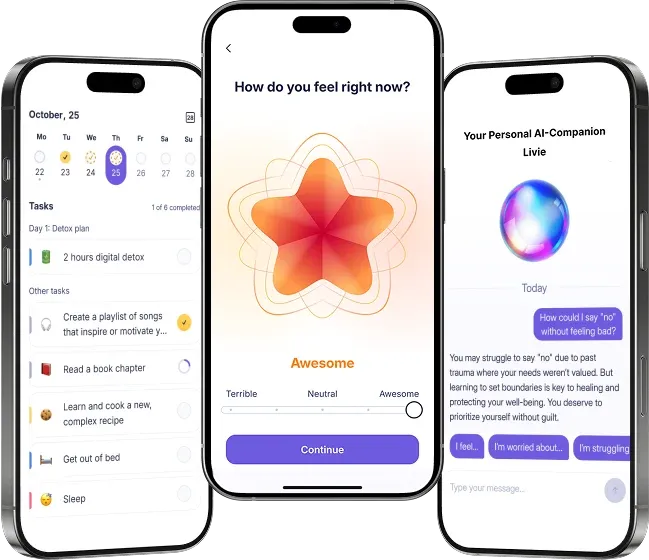
- Health anxiety feeds on the need for certainty, and certainty about your health is never fully available. DBT-based distress tolerance tools can help you sit with that discomfort without being driven by it. Liven's in-app practices include guided exercises that build on this exact idea.
If health anxiety is disrupting your daily life, e.g., your ability to work, be present in relationships, or get through a day without significant distress, that's the signal to move beyond self-help and into professional support. It's one of the more treatable forms of anxiety when the right approach is matched to the right pattern.
FAQ: How to Deal with Health Anxiety
What is the difference between health anxiety and hypochondria?
How do I deal with health anxiety when nothing reassures me?
How to deal with someone with health anxiety?
Can health anxiety cause physical symptoms?
Is health anxiety a form of OCD?